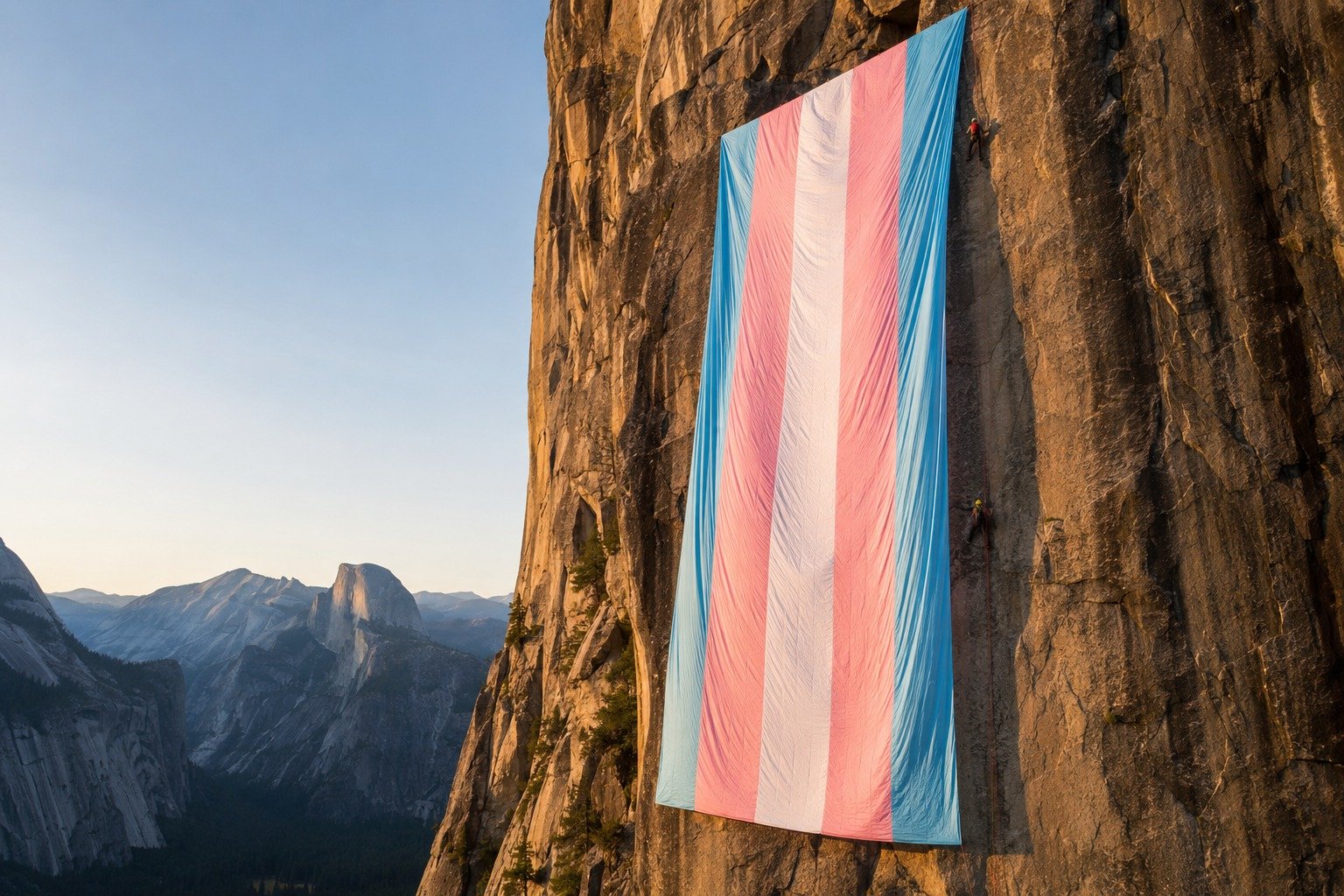
A federal judge has dismissed the lawsuit brought by a former Yosemite National Park ranger who was fired after helping hang a giant transgender pride flag on El Capitan — but the ruling did not decide whether the firing was lawful. The case was thrown out on procedural grounds, leaving the central free-speech question unanswered.
Shannon “SJ” Joslin, who is nonbinary and uses they/them pronouns, had argued the National Park Service punished them for protected political expression. On June 12, 2026, U.S. District Judge Jennifer Thurston ruled that Joslin filed in the wrong venue — not that the government was right to fire them.
A 66-Foot Flag on the Face of El Capitan
The episode began on May 20, 2025, when Joslin helped unfurl a transgender pride flag roughly 66 feet wide down the sheer granite face of El Capitan, one of the most iconic rock formations in the country. The flag hung for about two hours before being taken down voluntarily. Crucially, Joslin was off duty that day — the display happened on their own time, not while they were working as a ranger.
The image spread quickly online, drawing both praise and backlash. For supporters, it was a striking act of solidarity staged against one of nature’s most famous backdrops. For critics, it was an inappropriate use of a national landmark. Months passed before there was any formal consequence.
The Termination and the Lawsuit
In August 2025, Joslin received a termination letter from the National Park Service. The stated reason was a “failure to display appropriate conduct.” Joslin, who was a probationary employee at the time, saw the firing as retaliation for a personal, off-duty act of expression — and sued, alleging the government had violated their First Amendment rights.
The lawsuit framed a serious constitutional question: can a federal worker be fired for a peaceful display of support for transgender people, carried out on their own time? That is exactly the kind of question many expected a court to weigh. But the court never reached it.
Dismissed on a Technicality — Not the Merits
This is the part that matters most, and it is where headlines can mislead. Judge Thurston did not rule that the firing was legal. She did not rule that the flag display was unprotected speech. Instead, she found that Joslin had gone to the wrong place to make their case.
As a probationary federal employee, Joslin is required to first pursue their challenge through the process set out by the Civil Service Reform Act — which routes complaints through the Office of Special Counsel — before a federal court can step in. Because that administrative path had to come first, the judge dismissed the lawsuit without deciding the underlying free-speech claim. In plain terms: this was about which door Joslin has to walk through, not whether they were wronged.
The Fight Is Not Over
Far from ending the matter, the ruling simply moves it. Joslin has already filed a complaint with the Office of Special Counsel — the exact channel the judge pointed to. That means the question of whether the National Park Service can fire a worker over an off-duty expression of support for trans people remains very much alive, just in a different forum.
Anyone reading that the ranger “lost” should be careful. A procedural dismissal is not a verdict on the constitutionality of the firing. The legal substance — the First Amendment heart of the case — has not been tested.
What This Means for Workers
For everyday workers, especially those in government jobs, the case is a reminder of how much can turn on process. Probationary employees have fewer protections and must navigate specific administrative channels before they can reach a courtroom. That can feel like a maze — and in Joslin’s case, it delayed any ruling on whether their rights were actually violated. The outcome that matters, on free speech and on the limits of “appropriate conduct” for off-duty employees, is still ahead.
Stay informed on the stories that matter most. Follow Your Daily Updates on Facebook and bookmark yourdailyupdates.news for breaking news and analysis.