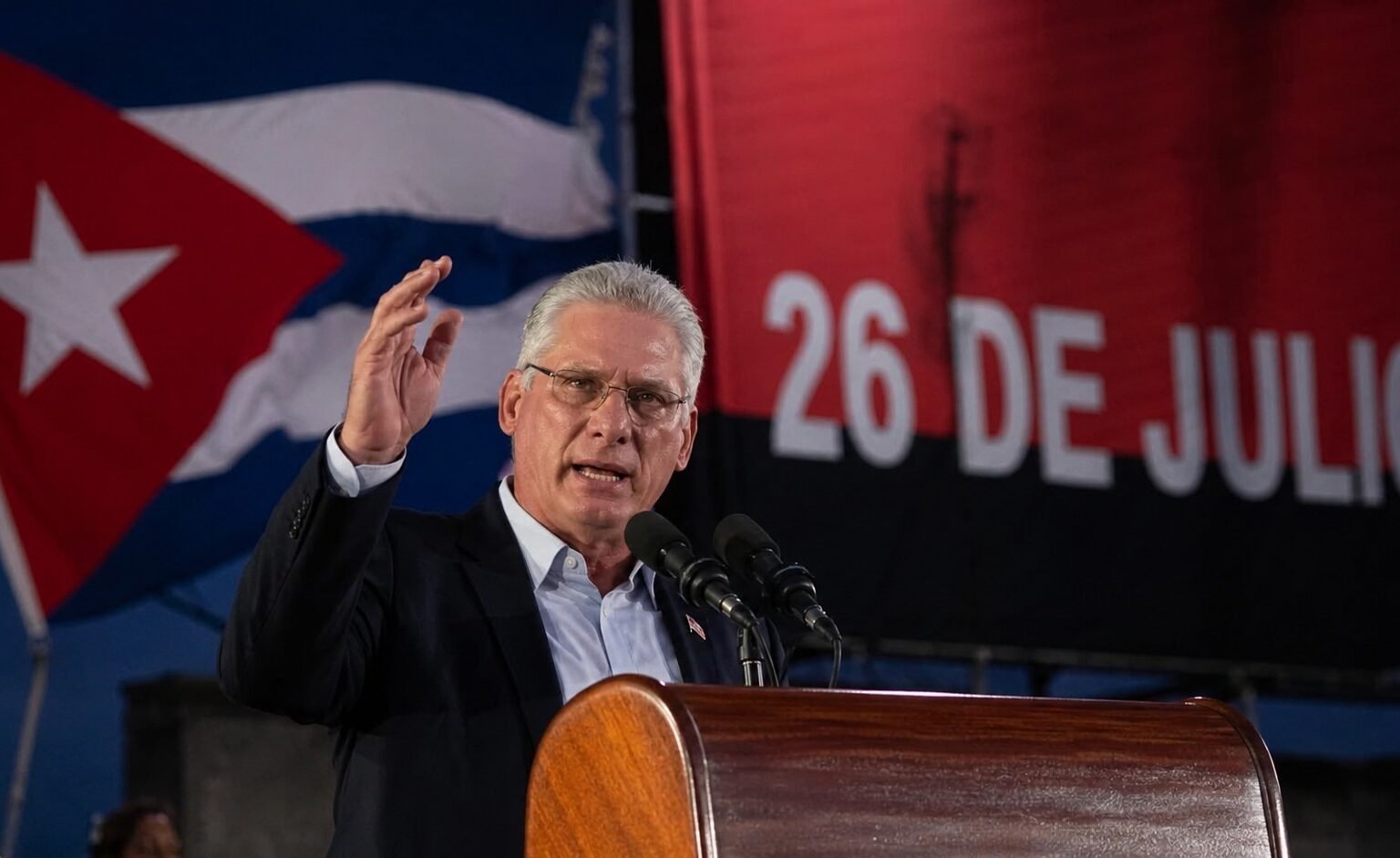
Cuba’s president has accused the United States of waging what he called a deliberate campaign to destroy his country. Speaking at a rally in Havana marking the 73rd anniversary of the Cuban Revolution, President Miguel Diaz-Canel declared, “I denounce that Cuba is the victim of a cold-bloodedly calculated genocide.” It was one of the sharpest public charges a sitting Cuban leader has leveled at Washington in years.
What Diaz-Canel Said
Addressing crowds gathered for the July 26 commemoration – the date that gives Cuba’s revolutionary movement its name – Diaz-Canel said the island was fighting “against the walls of a genocidal policy whose objective is to suffocate an entire people in order to appropriate the country.” He tied that language directly to what he described as the United States’ decades-long “economic strangulation” of Cuba: the trade embargo and layers of sanctions that have shaped the island’s economy for more than 60 years.
It is important to be precise about what this is. “Political genocide” is Diaz-Canel’s characterization – a piece of political rhetoric delivered to a domestic audience, not a finding by any court or by the United Nations. The underlying policy he is attacking is the economic embargo and sanctions regime, not a literal military invasion. His speech was framed as an accusation, and it should be read as one.
The Backdrop: Trump’s ‘Take Over’ Comment
The timing of the remarks was not accidental. Earlier this year, after the United States detained former Venezuelan president Nicolas Maduro in January, President Donald Trump said he would “take over” Cuba. Those were Trump’s own words in that moment – a statement, not a declared or codified U.S. policy. But for Havana, the comment landed as a threat, and Diaz-Canel’s July 26 speech was pitched as a direct answer to it.
Cuban officials have long argued that the U.S. embargo functions as a form of collective punishment, choking off access to fuel, medicine, food imports, and hard currency. Washington and successive administrations have countered that sanctions are aimed at pressuring the Cuban government over human rights and political freedoms, not at harming ordinary Cubans. That fundamental disagreement is the frame around which this latest clash is playing out.
Why the Language Matters
Words like “genocide” carry enormous weight in international law, where the term has a specific legal definition tied to the intent to destroy a national, ethnic, racial, or religious group. Diaz-Canel is using the word politically and rhetorically to dramatize the human cost of the embargo – not because an international body has made such a determination. Recognizing that distinction is essential to understanding the story accurately, and it is why his statement is best understood as an accusation rather than an established fact.
Still, the escalation is real. A head of state stood before his own people and publicly charged the world’s most powerful nation with trying to starve and seize his country. Whatever one makes of the claim, the rhetoric between Havana and Washington has rarely been this heated in recent memory, and it comes at a moment of broader tension across the hemisphere following the Maduro detention.
What This Means for Americans
U.S. policy toward Cuba has swung back and forth for generations, and every shift ripples through Cuban American families, agricultural exporters, travel businesses, and the broader debate over how the United States wields economic power abroad. A president openly musing about “taking over” a neighboring nation raises real questions about American intentions in the region – questions voters and lawmakers deserve honest answers to. How Washington responds to accusations like this one shapes not just Cuba’s future, but America’s credibility across Latin America.
Stay informed on the stories that matter most. Follow Your Daily Updates on Facebook and bookmark yourdailyupdates.news for breaking news and analysis.