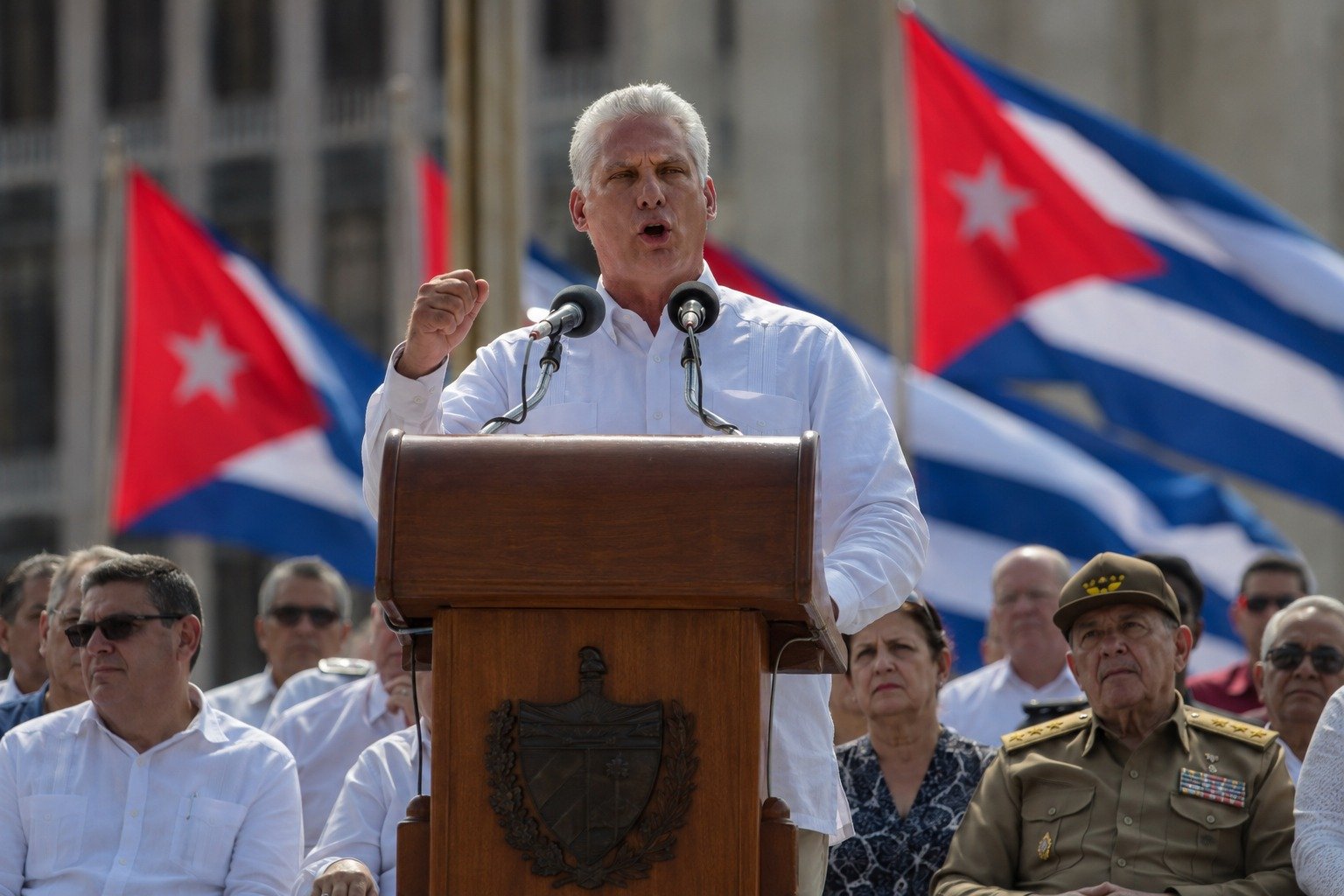
Cuban President Miguel Díaz-Canel has accused the United States of committing “genocide” against his country, arguing that Washington’s decades-old economic embargo is a deliberate campaign to break the Cuban people. Speaking on July 26, 2026, around the 73rd anniversary of the 1953 Moncada barracks attack that launched the Cuban Revolution, Díaz-Canel said the island “is the victim of a cold-bloodedly calculated genocide.”
He described what he called a “genocidal policy” engineered to “suffocate an entire people” through economic strangulation – language that escalates a long-running dispute over the human cost of the U.S. blockade. It is a political accusation from a foreign head of state, not a legal finding, but it puts a sharp spotlight on a policy that has shaped daily life in Cuba for more than six decades.
Why This Matters
The U.S. embargo on Cuba dates back to the early 1960s, tightening over the years into one of the most comprehensive sanctions regimes in the world. It restricts trade, finance, and travel, and its reach extends well beyond American borders because foreign companies risk penalties for doing business with Havana. Supporters in Washington have long framed it as pressure on an authoritarian government; critics argue it functions as collective punishment that lands hardest on ordinary Cubans.
Díaz-Canel’s choice of the word “genocide” is deliberate and provocative. By tying the term to the embargo, he is reframing a familiar sanctions debate as a question of humanitarian harm – and daring the international community to look at who actually bears the weight of the policy.
What He Said
The remarks came during commemorations marking the anniversary of the assault on the Moncada barracks in Santiago de Cuba, the event revolutionaries treat as the spark of the movement that eventually brought Fidel Castro to power. Against that backdrop, Díaz-Canel argued that the aim of the embargo is not security or diplomacy but suffering – a squeeze designed to make everyday life so unbearable that the island bends.
In practice, Cubans have faced chronic shortages of food, medicine, and fuel, along with power outages and rising prices. Díaz-Canel’s government blames the embargo for those hardships. He also pointed to President Donald Trump’s stated intention to “take over” the island, casting it as evidence that Washington still views Cuba as territory to be seized rather than a sovereign nation to be respected.
Reactions and Implications
Cuban officials have for years pressed their case at the United Nations, where the General Assembly has repeatedly voted by overwhelming margins to condemn the embargo. The accusation of “genocide,” however, raises the rhetorical stakes and is likely to be rejected in Washington, where the term carries a specific legal meaning tied to the intent to destroy a national, ethnic, or religious group. Critics of Havana note that Cuba’s government also bears responsibility for its own economic mismanagement and restrictions on political freedom.
Still, the core dispute Díaz-Canel is pointing to is real: a policy that has run for more than sixty years, with humanitarian consequences that even some U.S. allies have questioned. His framing is meant to force that conversation back into the open at a moment when Trump’s rhetoric about the island has hardened.
What This Means for Americans
For Americans, the standoff is a reminder that sanctions are never abstract – they shape whether families can find medicine or keep the lights on. The debate over the embargo is ultimately a debate about accountability: whether a policy that squeezes an entire population can be justified in 2026, and whether Washington should be judged by its stated goals or by the conditions ordinary people actually live under. It is a question voters and lawmakers, not just diplomats, will have to answer.
Stay informed on the stories that matter most. Follow Your Daily Updates on Facebook and bookmark yourdailyupdates.news for breaking news and analysis.