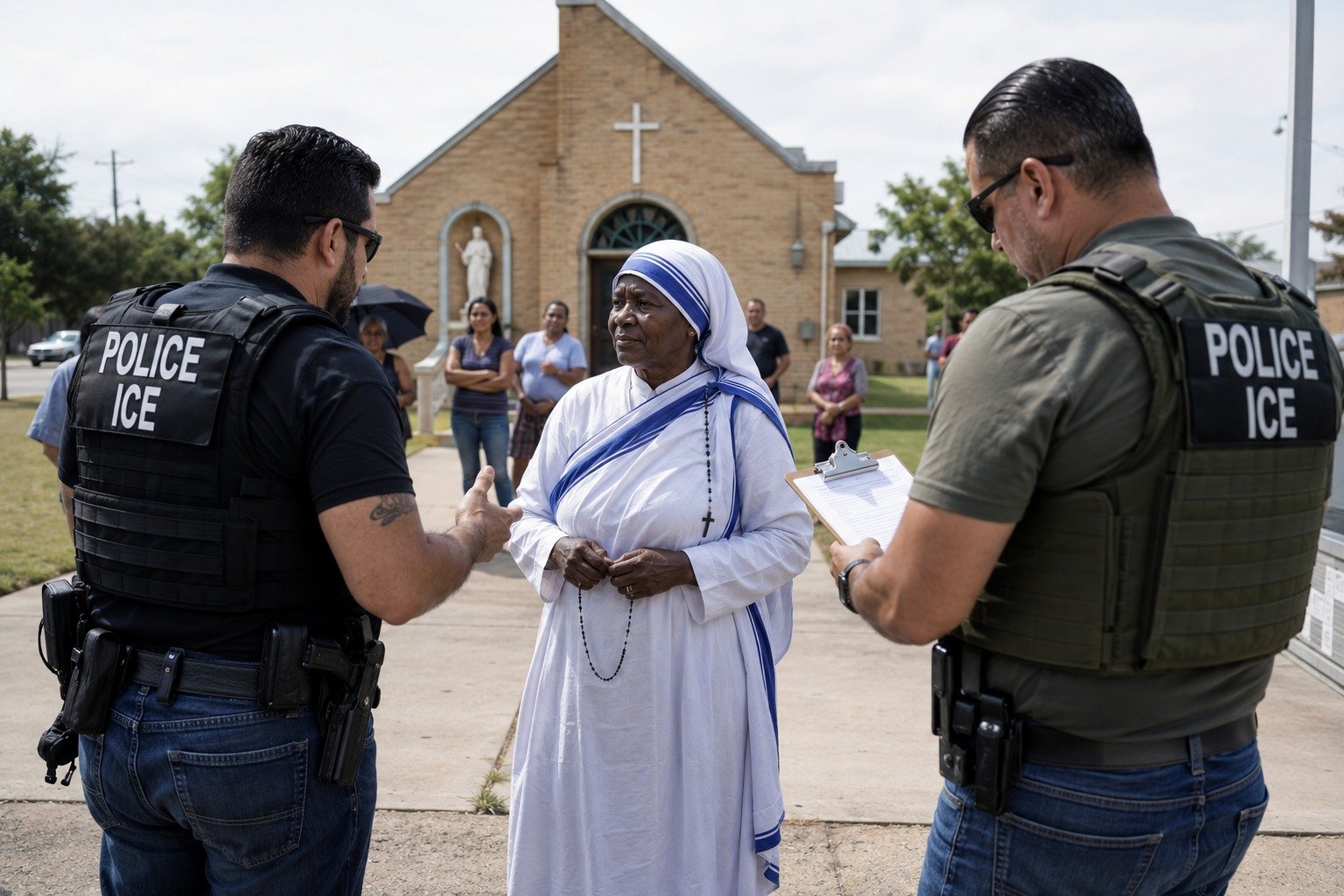
A Roman Catholic nun who has spent roughly a decade caring for patients as a registered nurse in South Texas was stopped, handcuffed and detained by federal immigration officers as she walked to Sunday Mass in McAllen — an arrest that drew swift, bipartisan condemnation and ended with her release the same day.
Sister Leticia “Letty” Ugboaja, 56, a Nigerian national and a member of the Daughters of Mary Mother of Mercy, was making her way to church just a few miles from the U.S.-Mexico border when U.S. Immigration and Customs Enforcement officers stopped her. According to multiple news accounts, officers confiscated her rosary and placed her in handcuffs before taking her into custody. Hours later, after members of Congress from both parties intervened directly with the Department of Homeland Security, she was released and returned home.
A religious sister, a nurse, and a decade of service
Ugboaja is not a stranger to the Rio Grande Valley. For about ten years she has worked as a registered nurse in South Texas, part of a religious congregation whose members have long served hospitals, clinics and parishes in the region. Her detention on the way to a Sunday liturgy — in full religious habit and veil, holding a rosary — struck many in the heavily Catholic border community as both bewildering and alarming.
The details of why she was stopped remain unclear. Neither ICE nor DHS has offered a public explanation for the arrest, and as of this reporting the agencies had not responded to requests for comment. What is clear is that the encounter escalated to handcuffs and detention before being reversed within hours.
Bipartisan backlash forced a fast reversal
What set this case apart was the speed and the political breadth of the response. U.S. Rep. Monica De La Cruz, a Republican from Edinburg, and U.S. Rep. Henry Cuellar, a Democrat from Laredo, each said publicly that they were communicating directly with DHS leadership about Ugboaja’s situation. That rare cross-party alignment appears to have been decisive: by the afternoon she had been let go, and by the next day she was back in her home.
It is worth being precise about the facts, because the story moved quickly online. Sister Letty was detained and then released the same day. She is not being held long-term, and the intervention that freed her came from lawmakers of both parties — a detail that underscores just how out of step the arrest struck observers across the political spectrum.
Why the case resonated
The image of a nun in her habit, rosary in hand, being handcuffed on her way to worship touched a nerve that goes beyond ordinary immigration debates. Houses of worship have historically been treated as sensitive locations where enforcement is approached with caution. For a woman who has spent years nursing the sick to be stopped en route to Mass raised immediate questions about how enforcement priorities are being applied on the ground — and to whom.
Faith leaders and civil-rights advocates have argued that cases like this one illustrate the human cost of aggressive, indiscriminate enforcement. When a long-serving nurse and religious sister can be detained on a Sunday morning, they say, it signals that few people feel genuinely secure — regardless of their record of service to the community.
What remains unanswered
Key questions are still open. Officials have not said what prompted the stop, what Ugboaja’s precise immigration status is, or what conditions, if any, accompanied her release. Both De La Cruz and Cuellar have signaled they want answers from DHS, and advocates are pressing for a fuller accounting of the circumstances.
For now, Sister Letty is home, free, and back among the community she has served for a decade. But the swift, bipartisan alarm her detention provoked suggests the questions it raised — about judgment, priorities and accountability at the border — are unlikely to fade quietly.