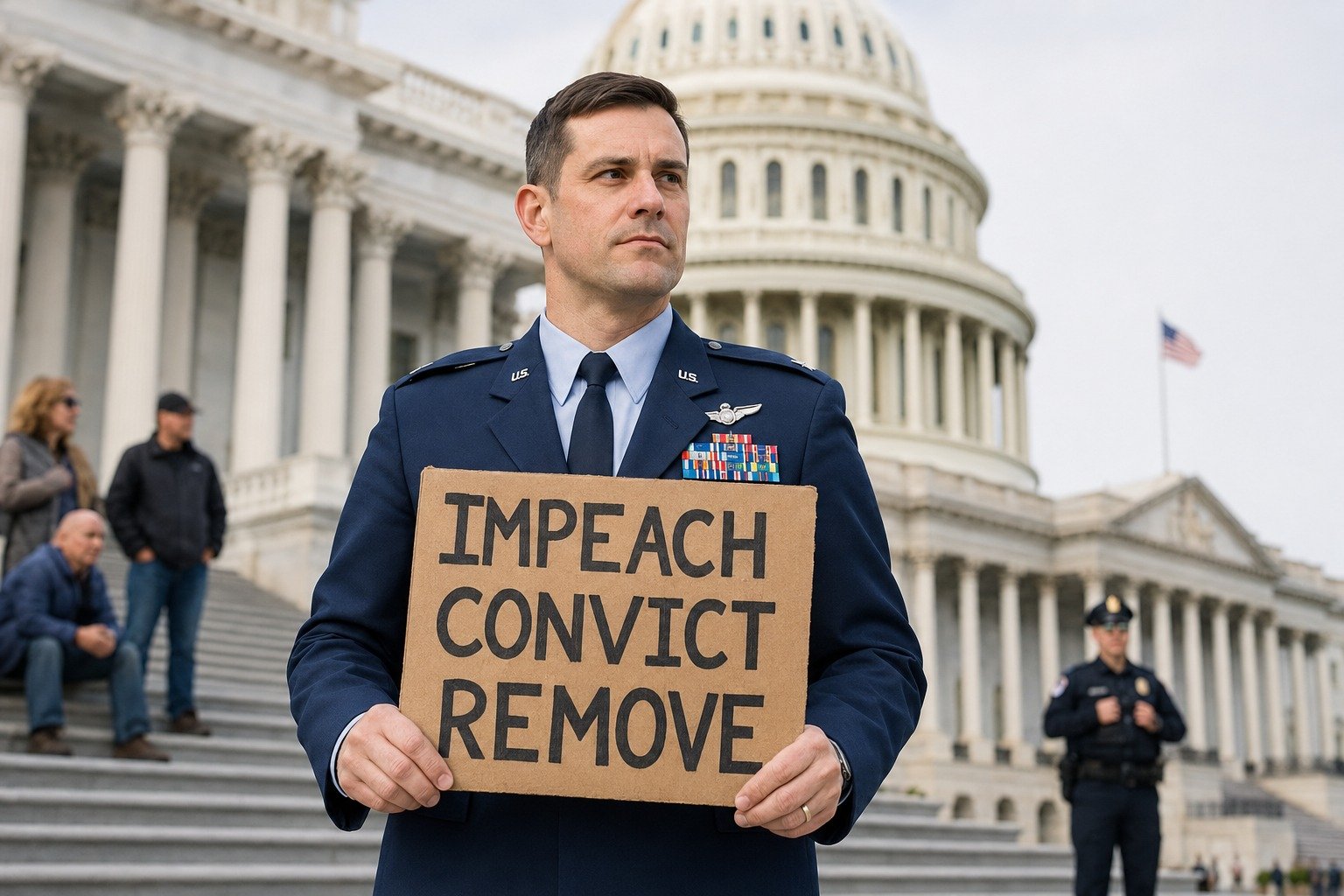
An active-duty Air Force major who was arrested on the steps of the U.S. Capitol has become an unlikely symbol of conscience — and the public is responding with an outpouring of financial support that has already climbed into the tens of thousands of dollars.
Maj. Jason Watson was taken into custody on July 1 after he stood on Capitol grounds holding a hand-lettered cardboard sign that read “IMPEACH CONVICT REMOVE.” The charge against him was later dropped, but by then the image of a uniformed officer being detained for a silent, individual act of protest had already spread widely across social media and national news outlets.
A fund that grew by the hour
Almost as soon as word of the arrest circulated, a legal defense fund was set up on the crowdfunding platform Spotfund to help cover Watson’s costs. The response was immediate and striking. According to verified reporting, the fund raised roughly $32,000 within hours of going live, and by the afternoon of Thursday, July 2, it had climbed to somewhere in the range of $60,000 to $70,000 — and it was still growing.
The surge was driven largely by small donations from thousands of individual contributors, many of them veterans and current service members who said they wanted to signal that they had Watson’s back. For a single act of protest by one officer, the scale of the financial response was notable, and it quickly became part of the story itself.
Why the moment resonated
To many of Watson’s supporters, the fundraiser is about more than one officer’s legal bills. It has become a flashpoint in a broader conversation about the boundaries of political expression — and specifically about whether those who wear the uniform forfeit the right to speak up as citizens.
Members of the armed forces operate under strict rules governing political activity while in uniform and on duty, and those rules exist for good reason: the military’s credibility depends on remaining apolitical as an institution. But supporters argue there is a meaningful difference between the institution and the individual conscience of a person who feels compelled to speak. The fact that the charge against Watson was ultimately dropped only sharpened that argument for the people rallying behind him.
Critics of the protest, by contrast, have pointed to the uniform itself, arguing that wearing it while holding a pointed political sign blurs a line the military has long worked to keep clear. That tension — between personal expression and institutional neutrality — is precisely what has made the episode so widely discussed.
An outpouring that says something bigger
Whatever one makes of the protest, the speed and size of the public’s response is hard to ignore. Legal defense funds rarely climb from zero into the tens of thousands in a single day, and when they do, it usually reflects something beyond the individual case — a sense among donors that they are answering a moment, not just a bill.
For the people chipping in $10, $25 or $100 at a time, the message appears to be about accountability and the right to raise one’s voice, even at personal risk. Many framed their donations as a stand for the principle that speaking up should not come at the cost of a person’s career or their conscience.
The core facts of the case have been corroborated by multiple national outlets, including CNN, NBC News, Military Times, The Hill and Newsweek, and reviewed by the fact-checking site Snopes. As of this writing, the defense fund total continued to rise, suggesting the story — and the debate it has reignited — is far from over.