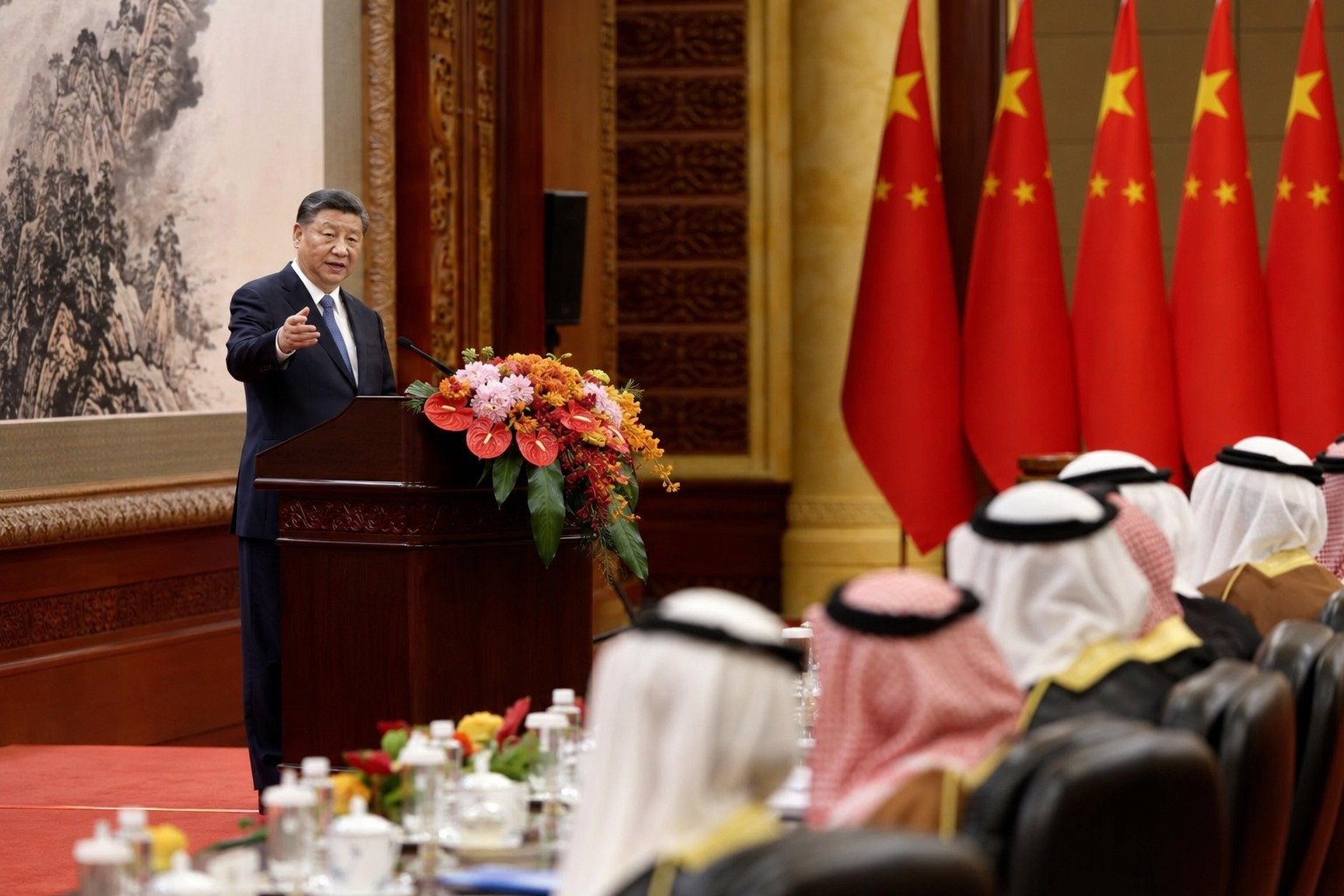
Chinese President Xi Jinping delivered his sharpest assessment yet of the Middle East crisis during a high-level diplomatic meeting in Beijing, telling the Crown Prince of Abu Dhabi that Israel’s military actions — not Iran — are the root cause of the region’s ongoing chaos. The statement marks a significant escalation in China’s diplomatic posture and places Beijing in direct opposition to Washington’s framing of the conflict.
What Xi Said — and Why It Matters
During the meeting at the Great Hall of the People in Beijing, Xi laid out a four-point proposal calling for peaceful coexistence, respect for national sovereignty, adherence to international law, and coordinated economic development across the Gulf region. His central message to Sheikh Khaled bin Mohamed bin Zayed Al Nahyan, Crown Prince of Abu Dhabi, was clear: the path to regional stability requires confronting what China views as the actual source of instability — Israel’s military operations, carried out with U.S. support.
Xi warned that nations which abandon international law risk dragging the entire region into what he called “the law of the jungle” — a pointed rebuke of the U.S.-Israel strikes against Iran that had rattled global energy markets in the weeks prior. Chinese analysts affiliated with state institutions called the timing of Xi’s statement deliberate and essential, noting that Gulf Arab leaders had grown increasingly uncertain about where China stood amid the escalating three-way conflict between the U.S., Israel, and Iran.
The Bigger Context: A Region on Edge
This meeting came in the aftermath of U.S.-Israel military strikes against Iran — a development that sent shockwaves through Gulf capitals and raised urgent questions about regional security. For Gulf states that have long relied on American military guarantees while simultaneously deepening economic ties with China, Xi’s blunt assessment created a fresh diplomatic dilemma. Beijing is now signaling that it is willing to say publicly what many Gulf leaders may only discuss in private.
Experts at Renmin University of China described the four-point proposal as “timely and critical,” noting that China’s emphasis on peaceful coexistence and rejection of military force as a resolution tool directly addresses the concerns of states like the UAE, which have watched the U.S.-Israel-Iran triangle escalate with growing alarm. Wang Yiwei, director of the Institute of International Affairs at Renmin University, noted that Xi’s framing reinforces a UN-centered international order — one that China argues the U.S. and Israel have undermined.
China vs. the U.S. — A Diplomatic Battle for the Gulf
At its core, Xi’s statement is a direct challenge to the American security architecture that has defined the Gulf region for decades. Washington has long positioned itself as the indispensable guarantor of Gulf security — the power that keeps shipping lanes open, protects oil infrastructure, and deters Iranian aggression. China is now offering an alternative narrative: that American and Israeli military action is itself the destabilizing force, and that Beijing represents a more reliable partner for a rules-based regional order.
For Gulf states, the tension is real. Many depend on U.S. military hardware, base agreements, and security guarantees. But they also conduct enormous trade with China, rely on Chinese investment in infrastructure and energy, and have increasingly sought to hedge their strategic bets by deepening ties with Beijing. Xi’s statement — delivered directly to UAE leadership — forces those states to confront a question they have long preferred to defer: whose vision of regional order do they actually support?
What This Means for Americans
When the world’s second-largest economy publicly blames a U.S. ally for a region’s instability and offers itself as the alternative power broker, American influence in a critical oil-producing region comes under real pressure. The Gulf supplies a significant portion of global energy — and any shift in Gulf states’ alignment has direct consequences for energy markets, gas prices, and U.S. strategic positioning in the Middle East. Xi’s message to Gulf leaders was also, unmistakably, a message to Washington: China is competing for influence here, and it is no longer staying quiet about whose policies it holds responsible.
Stay informed on the stories that matter most. Follow Your Daily Updates on Facebook and bookmark yourdailyupdates.news for breaking news and analysis.