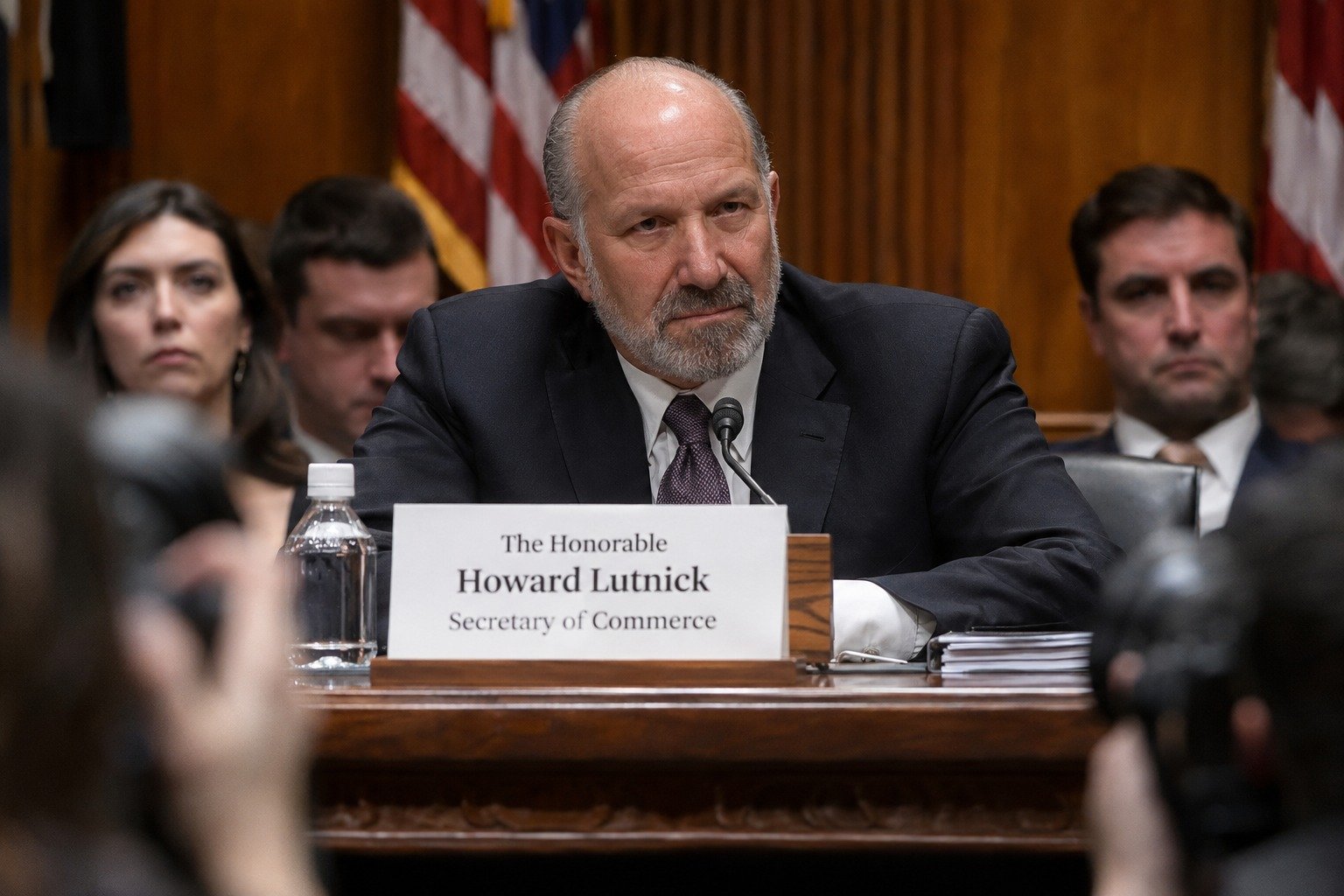
Four former Commerce Department officials are painting a damning picture of the agency under Secretary Howard Lutnick: an operation they describe as “chaos,” weighed down by micromanagement and, they say, repeated failures to act on evidence that advanced Nvidia chips were being smuggled toward China.
The accounts, shared anonymously with CBS News, land at a moment of intense scrutiny for the department that controls America’s export rules on cutting-edge semiconductors – and as senior White House officials have reportedly discussed whether Lutnick should keep his job.
A year without a single new blacklisting
The most striking detail in the former officials’ account is a number: zero. According to CBS News, no company has been added to the Commerce Department’s Entity List – the government’s main trade blacklist for firms deemed a national security risk – since Oct. 9, 2025. The former officials say that is the first yearlong gap since 2008.
The Entity List is one of the most powerful tools Washington has to keep sensitive technology, including advanced AI chips, away from adversaries. A full year without using it, the former officials argue, sent a signal that enforcement had stalled.
They also described an exodus of expertise. Up to 50 skilled staff members left the relevant operations in roughly 18 months, according to their account – the kind of institutional knowledge that is hard to rebuild once it walks out the door.
“Commerce has the pen”
The criticism is not coming only from former employees. Treasury Secretary Scott Bessent said Lutnick failed to follow through on enforcing the chip ban, pointing squarely at the department responsible for writing and policing export controls: “Commerce has the pen,” Bessent said, according to CBS News.
That is a remarkable statement from a fellow member of the president’s Cabinet, and it underscores where responsibility for export enforcement sits under the law.
The scandal that turned up the heat
The scrutiny intensified after Jensen Huang resigned as Nvidia’s CEO on Nov. 12. His departure followed reports of a relationship with Alice Huang, a former executive at Singapore-based Megaspeed whom U.S. authorities suspect of spying for Beijing, according to Reuters and CBS News. China denies the spying claim. Megaspeed says she left the company in 2025 and denies any wrongdoing. No charges have been announced.
Megaspeed itself is at the center of the questions about where Nvidia’s most advanced hardware has ended up. The company reportedly bought more than $4.8 billion in advanced Nvidia chips since June 2024, according to Reuters.
Lawmakers in both parties sound the alarm
On CBS’s Face the Nation on Sunday, Democratic Rep. Jim Himes of Connecticut put the blame on Lutnick directly: “it looks like he has been the barrier inside the government to stopping the flow of these Nvidia chips to China.”
Republican Rep. John Moolenaar of Michigan was blunt about the Nvidia side of the story, calling Huang’s relationship “simply irresponsible and a direct threat to our national security.”
Congressional investigators are moving. Sens. Elizabeth Warren and Chris Coons have demanded that relevant documents be preserved, and Sen. Ron Wyden and Rep. Richard Neal are investigating how chip sales were approved. Both Lutnick and Huang have agreed to testify, though no testimony has taken place yet.
Is Lutnick on his way out?
Not officially. Reuters reported on Nov. 12 that senior White House officials had discussed whether Lutnick should be pushed out, citing two people familiar with the conversations. The same day, a White House official said President Trump “maintains complete confidence in the secretary.” Lutnick has not resigned and has not been fired.
A sudden burst of action
On Monday, the Commerce Department imposed new licensing requirements on advanced chips sent to Brazil, Indonesia, Malaysia, Singapore and Thailand.
Critics are likely to ask why it took a scandal at the top of Nvidia for the department to move. Export controls exist to protect national security and the American workers and innovators who built this technology in the first place. When the agency charged with enforcing them goes a year without adding a single company to its blacklist, the public deserves a full accounting – and the upcoming testimony may be the first real chance to get one.
Sources: CBS News, Reuters, CBS News’ Face the Nation (Nov. 15, 2026).