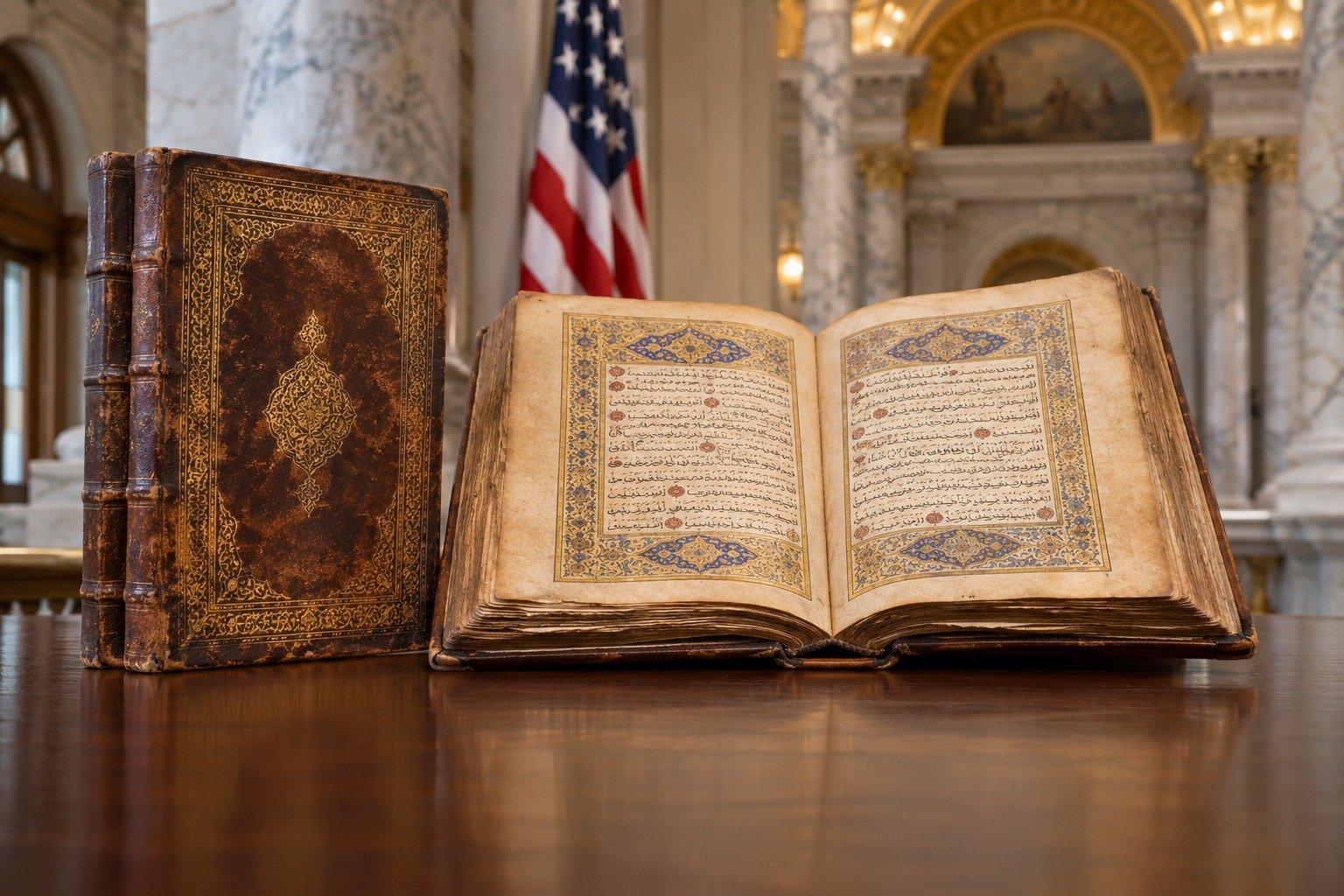
Michigan Senator-elect Abdul El-Sayed says he will likely take his oath of office on a Quran when the new Congress convenes in January, and one of the copies he has floated once sat on the bookshelf of Thomas Jefferson. El-Sayed, the Democrat who defeated Republican Mike Rogers on November 3, will become the first Muslim to represent Michigan in the United States Senate.
The senator-elect raised the idea in an interview with NPR published November 12. He made clear that no decision has been made. He mentioned that Jefferson owned a Quran, and he pointed to another option much closer to home: the University of Michigan holds the first Quran ever brought to Michigan, a copy he said “might be the choice.”
A Founding Father’s Quran
Jefferson’s two-volume copy of the Quran is now part of the collections of the Library of Congress. It is one of the more striking artifacts of the founding era, a reminder that the man who wrote the Declaration of Independence was deeply curious about the world’s religions and legal traditions.
Jefferson is also the author of the Virginia Statute for Religious Freedom, one of the foundational American documents separating government power from religious belief. Its principles flow directly into the Constitution, which states in Article VI that no religious test shall ever be required as a qualification for any public office in the United States.
That is the backdrop for El-Sayed’s comments. Under the Constitution, a senator’s faith is not a qualification and not a disqualification. A member of Congress may take the oath on a Bible, a Torah, a Quran, a law book, or no book at all.
The Book Has Made History Before
This would not be the first time Jefferson’s Quran has appeared at a congressional swearing-in. In 2007, Rep. Keith Ellison of Minnesota, the first Muslim elected to Congress, used the Library of Congress copy during his ceremonial swearing-in. The choice drew national attention and a wave of criticism from some conservative commentators at the time, and it became a lasting symbol of religious liberty on Capitol Hill.
In 2019, Michigan Rep. Rashida Tlaib considered using Jefferson’s copy as well. Now another Michigan Democrat is weighing the same symbol, this time on the Senate side of the Capitol.
A Historic Win in Michigan
El-Sayed’s victory over Rogers was one of the most closely watched Senate races of the 2026 cycle. A physician and former public health official, he ran as an unapologetic progressive and won a seat Republicans had hoped to flip. He is scheduled to take office when the new Congress convenes in January 2027.
Michigan is home to one of the largest and most established Arab American and Muslim communities in the country, particularly in Dearborn and the surrounding Detroit area. For many of those residents, seeing one of their own sworn into the Senate is a milestone generations in the making.
Reactions and What Comes Next
The choice of a religious text at a swearing-in is a personal decision, but it rarely stays personal for long. Supporters see the possibility of El-Sayed using Jefferson’s Quran as a powerful statement that Muslim Americans belong fully in American public life, and that the founders’ promise of religious freedom was meant for everyone. Critics of Ellison’s choice in 2007 argued that the Bible should be the standard. The Constitution says otherwise, and the practice of members choosing their own text is long established.
For now, the decision is still open. El-Sayed has named two meaningful options: a copy tied to a Founding Father and a copy tied to Michigan’s own history. Either one would send a message about who gets to hold power in America.
What This Means for Americans
The question at the heart of this story is bigger than one senator. It is whether the government treats every citizen’s faith equally, or quietly favors some over others. The no-religious-test clause exists to guarantee that voters, not religious gatekeepers, decide who represents them. When a Muslim senator can take the oath on the book of his faith without a second thought, that guarantee is working. When that choice becomes a political attack, it is worth remembering that the founders saw this coming and wrote the answer into the Constitution.
Stay informed on the stories that matter most. Follow Your Daily Updates on Facebook and bookmark yourdailyupdates.news for breaking news and analysis.