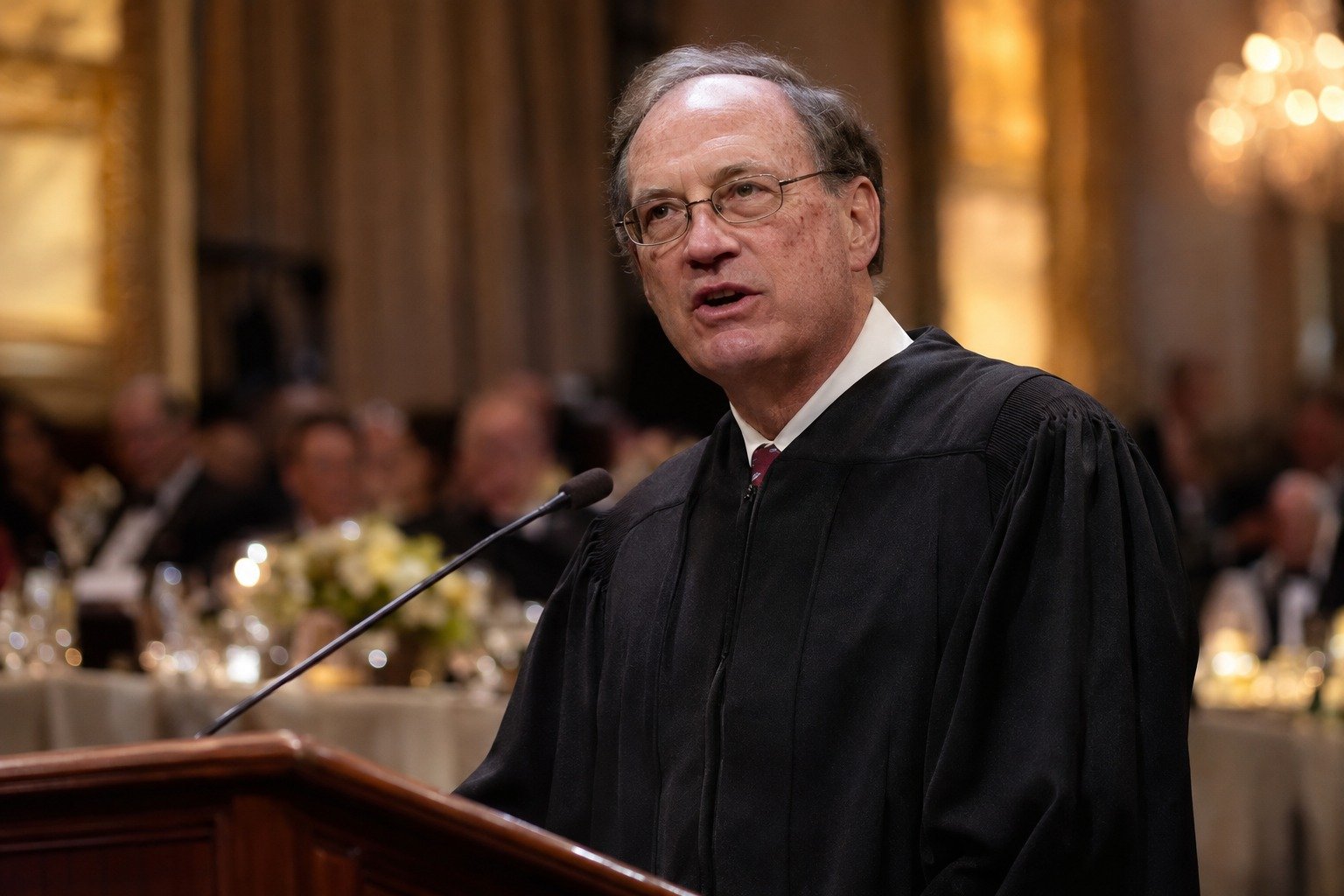
Supreme Court Justice Samuel Alito acknowledged Thursday night that Congress has the power to bring the nation’s highest court to a halt simply by cutting off its money. Speaking at the Federalist Society’s annual Antonin Scalia Memorial Dinner, in front of more than 1,000 conservative lawyers, Alito said Congress can “turn off the lights at the Supreme Court” and stop its work “if they want to defund their activities.”
It was a blunt admission from one of the most influential conservatives on the Court, and it came at a moment when the balance of power in Washington is about to change.
The Power of the Purse
Every part of the federal government runs on money that Congress appropriates, and the Supreme Court is no exception. The Constitution hands the legislative branch the power of the purse: the authority to decide how, and whether, federal dollars are spent. It is one of the oldest and most important checks that the people’s elected representatives hold over the rest of the government.
Justices are appointed for life. They do not stand for election, and they cannot be voted out. That is by design, meant to protect judges from political pressure. But it also means that the tools available to hold the Court accountable are limited, and nearly all of them run through Congress. Funding is one of the most powerful of those tools, and Alito just said so out loud.
The Timing Is Hard to Ignore
Alito’s remarks came about a week after the midterm elections, in which Democrats won control of both chambers of Congress. According to SCOTUSblog, Democrats flipped at least 40 seats in the House and at least 7 seats in the Senate. The new majorities take power in January 2027.
To be clear, Alito did not mention Democrats, the midterms, or the coming shift in power in his remarks. He described what Congress is able to do, not what any particular party plans to do. But his words landed in the middle of a live debate. Some Democrats have already floated the idea of using Congress’s power of the purse as a check on the Court.
The setting matters too. The Federalist Society is the conservative legal network that has played a central role in shaping the modern federal judiciary, and its annual dinner honoring the late Justice Antonin Scalia is one of the biggest nights on the conservative legal calendar. Alito chose that room, packed with like-minded lawyers, to acknowledge just how much power the legislative branch holds over his institution.
Two Sides of the Debate
Supporters of using the purse strings argue that it is exactly the kind of check the framers intended. In their view, a Court that answers to no voter must still answer to the Constitution’s system of checks and balances, and Congress has every right to decide how taxpayer money is spent.
Critics warn that threatening the Court’s budget could undermine judicial independence and turn the judiciary into a political bargaining chip. They argue that disagreements with the Court’s rulings should be settled through legislation, constitutional amendments, and future appointments rather than through funding fights.
Alito’s comments do not settle that argument. But they confirm one thing that is not in dispute: the power exists, and a sitting justice knows it.
What This Means for Americans
Supreme Court decisions reach into the daily lives of every American, from voting rights and workplace protections to health care and the environment. When nine unelected justices hold that much power, the question of who can check them is not an abstract one. Alito’s remarks are a reminder that accountability for the Court ultimately runs through the people’s elected representatives, and that the Congress voters just chose will decide how hard to push.
Whether the incoming majority uses that power, and how, will be one of the biggest questions in Washington when the new Congress is sworn in.
Stay informed on the stories that matter most. Follow Your Daily Updates on Facebook and bookmark yourdailyupdates.news for breaking news and analysis.