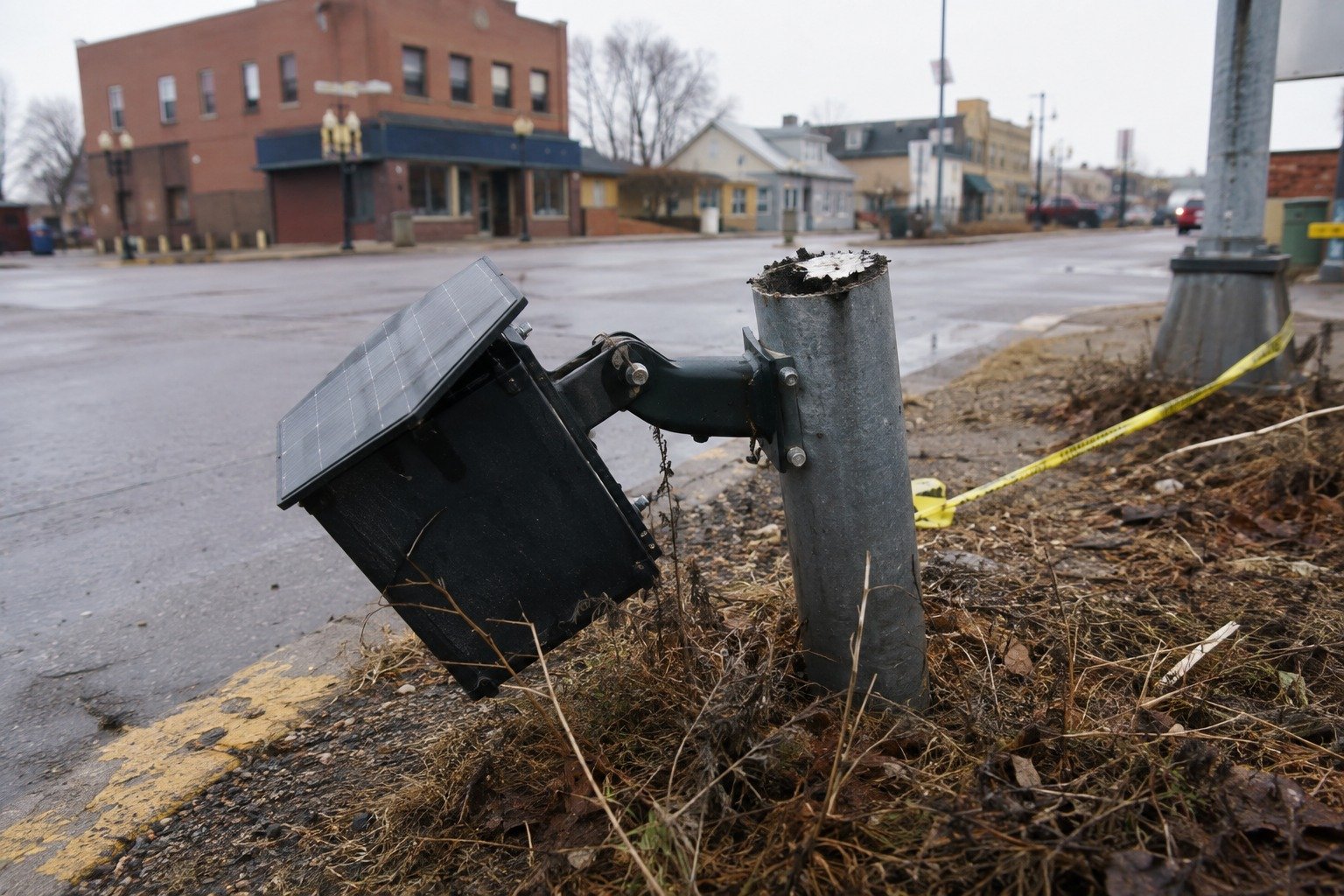
Police in Winona, Minnesota went looking for their license-plate surveillance network and found only stumps of metal. Every one of the city’s eight Flock Safety cameras had been sawed off at the base and carried away, stripped from four separate intersections over a stretch of several days between July 29 and August 1. No cameras have been recovered, and no suspect has been identified.
What makes the case unusual is not just the scale, but how quietly it happened. There was no dramatic report, no witness call in the night. Officers only realized something was wrong when the cameras stopped sending data. When they went to check the poles, they found them cut clean and lying in the roadside weeds.
What Happened in Winona
Winona is a small city on the Mississippi River in southeastern Minnesota, the kind of place where a coordinated removal of every automated camera in town does not go unnoticed for long. Yet the removal appears to have unfolded over a weekend rather than a single night, giving whoever was responsible time to work through four intersections without being caught.
Flock Safety cameras are compact, solar-powered devices mounted on poles that automatically photograph and log the license plate of nearly every vehicle that passes. The data feeds into a searchable database that police departments across the country tap into. In Winona, that entire system went dark at once when the hardware was physically removed.
Replacing the network will not be cheap. Each unit runs roughly $3,000, which puts the total cost to the city at about $24,000 — a bill that lands squarely on local taxpayers. The department has asked the public to come forward with any information that could help identify who was behind the removals.
Part of a Growing Pattern
Winona is not an isolated case. Flock cameras have been cut down, spray-painted, or torn out in a string of other Minnesota communities, including Edina, Plymouth, Faribault, and Columbia Heights. Taken together, the incidents point to something larger than random vandalism: a rising unease about how far automated surveillance has spread into everyday American life.
Automated license-plate readers have quietly become one of the most widespread surveillance tools in the country. They do not target suspects. They record everyone — the commuter, the churchgoer, the parent on a school run — and store where and when each car was seen. Critics argue that this kind of mass collection turns ordinary movement into a permanent, searchable record, built with little public debate and almost no independent oversight.
The Debate Over Mass Surveillance
Flock and the police departments that use its cameras say the technology helps solve crimes, recover stolen vehicles, and locate missing people. Supporters see the network as a modern investigative tool that fills gaps human officers cannot.
Privacy advocates see it differently. As the company’s black boxes multiply on poles from small towns to major cities, more communities are asking who authorized the constant tracking, who can access the data, and how long records of law-abiding drivers are kept. The vandalism in Winona and elsewhere is illegal, and no one should destroy public property to make a point. But the backlash reflects a real and unresolved question about consent that surveillance companies have largely sidestepped.
What This Means for Americans
For most people, the Winona case is a window into a system they never agreed to and may not even know exists. Cameras like these are increasingly watching the roads in communities nationwide, logging the movements of millions of drivers who have done nothing wrong. Whether that trade-off is worth it — and who gets to decide — is a conversation playing out one intersection at a time.
Stay informed on the stories that matter most. Follow Your Daily Updates on Facebook and bookmark yourdailyupdates.news for breaking news and analysis.