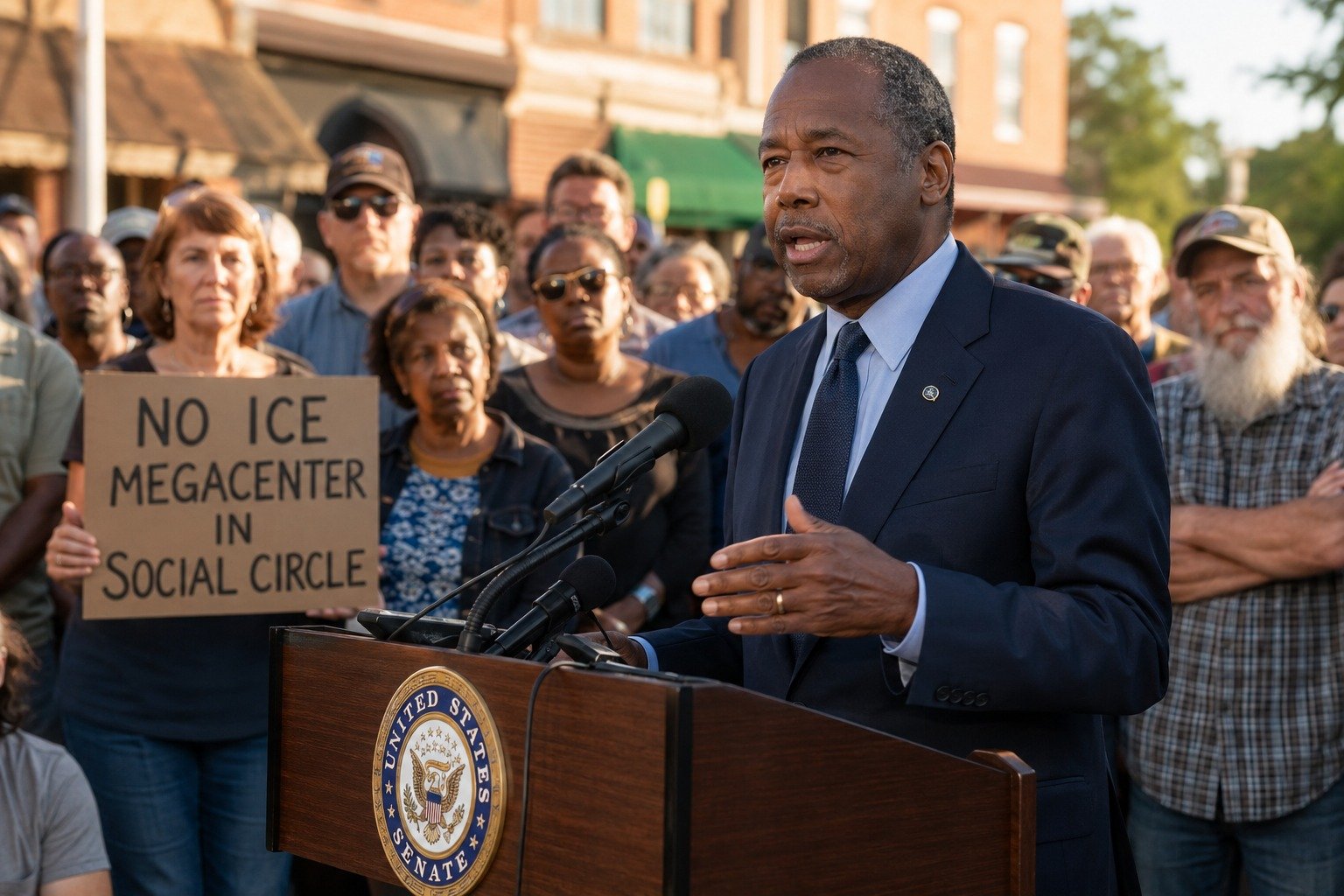
A Georgia town of roughly 5,000 people has done what few communities ever manage: it stopped the federal government from building one of the largest immigration detention facilities in the country in its own backyard.
The Department of Homeland Security has abandoned its plan to convert a sprawling warehouse in Social Circle, Georgia, into a roughly 10,000-bed Immigration and Customs Enforcement detention center, according to the city and multiple Georgia news outlets. The reversal caps months of resistance from residents, local officials, and Georgia’s two U.S. senators.
A megacenter in a town half its size
Federal officials had purchased the roughly one-million-square-foot warehouse and surrounding property earlier this year for about $128 million, with plans to retrofit it into a facility capable of holding as many as 10,000 detainees and employing around 2,500 people. The scale of the proposal was staggering for a community whose entire population is only about half the number of people the center would have been built to detain.
For Social Circle, the question was never abstract. It was about whether a small town’s infrastructure could physically absorb a facility of that size. City leaders repeatedly warned that the megacenter would overwhelm Social Circle’s water and wastewater systems, strain its roads, crowd its schools, and stretch a small police force far beyond its capacity.
The town fought back — and sued
Rather than wait quietly for a decision, residents organized. They packed community meetings, raised their concerns publicly, and pressed officials at every level for answers about a project that had moved forward with little local input. About a month before the plan collapsed, the city escalated the fight by filing a lawsuit against DHS, citing the burden the facility would place on local infrastructure.
That combination of grassroots pressure and legal action put the federal government on notice that Social Circle would not simply accept the project as a done deal.
Warnock and Ossoff apply the pressure
The town did not fight alone. Sens. Raphael Warnock and Jon Ossoff spent months pressing DHS for information about the project and ultimately urged the agency to walk away from it. Warnock traveled to Social Circle, met with local officials, and toured the very infrastructure he argued could not support a facility on that scale.
Ossoff, for his part, has pushed legislation aimed at giving communities a real voice in decisions like this one — a measure that would require the federal government to obtain written approval from state and local governments before opening new immigration detention or processing facilities.
When DHS finally backed off, Warnock said the people of Social Circle had been heard. The agency did not publicly attribute its decision to any single action, and the reversal appears to have been driven by sustained local opposition combined with the senators’ pressure rather than any one official intervention. Warnock has claimed credit for helping force the outcome, even as DHS declined to formally credit him.
What it means
The collapse of the Social Circle plan is a rare case of a federal reversal driven from the ground up. It is a reminder of what organized communities can still accomplish when they refuse to be steamrolled — and of how much weight local voices can carry when their elected officials stand with them.
For now, the warehouse that was to become a 10,000-bed detention center sits empty, and a town of 5,000 has its answer.