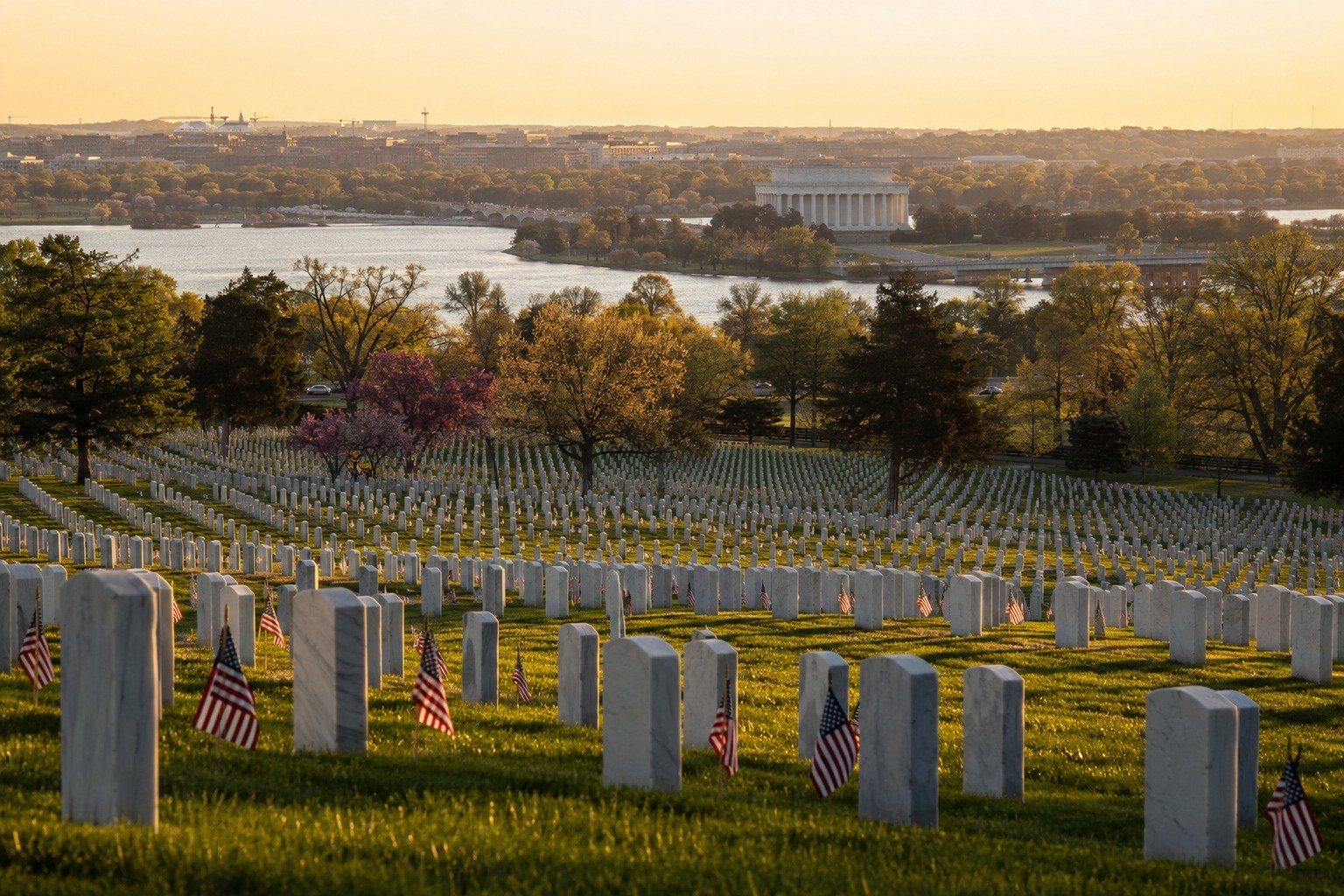
Three decorated Vietnam War veterans have taken the Trump administration to federal court — and their target is a 250-foot arch that the White House wants to plant right in one of the most hallowed corners of Washington, D.C.
The proposed “Independence Arch,” modeled after the Arc de Triomphe in Paris, would sit at Memorial Circle — a stretch of road between the Lincoln Memorial and the entrance to Arlington National Cemetery. At 250 feet tall, it would stand more than double the height of the Lincoln Memorial itself, making it the largest triumphal arch in the world if built. The administration is pushing to have it completed by July 4, 2026, to mark the nation’s 250th anniversary.
Veterans Michael Lemmon, Shaun Byrnes, and Jon Gundersen — backed by the Public Citizen Litigation Group — filed the lawsuit in the U.S. District Court for the District of Columbia in February. They argue the project violates multiple federal laws, including the Commemorative Works Act, the National Environmental Policy Act, and the National Historic Preservation Act. At the heart of the case: they say the White House bypassed the legal approval process entirely to fast-track the monument.
The veterans also say the arch would destroy something that can’t be rebuilt. The Memorial Circle sightline — connecting the Lincoln Memorial to Arlington House — was designed after the Civil War to represent national unity between North and South. The plaintiffs say erecting a massive arch in that space would permanently shatter that symbolism, effectively dishonoring the soldiers buried at Arlington by turning a site of solemn remembrance into a backdrop for a government construction project.
The U.S. Commission for Fine Arts recently approved the arch despite overwhelming public opposition — a move critics say proves the administration is steamrolling standard oversight. Supporters of the arch argue it celebrates American military history and is a fitting tribute for the country’s 250th birthday.
The legal challenge centers on the administration’s decision-making process. Federal law requires that any commemorative work on the National Mall go through a formal approval process involving Congress, the National Capital Planning Commission, and multiple federal agencies. Critics contend the White House effectively sidestepped these requirements by invoking executive authority to fast-track the project under the America 250 initiative — a move that the veterans’ attorneys say has no legal basis.
The arch’s proposed location amplifies the controversy. Memorial Circle sits at a symbolically charged intersection: it connects the Lincoln Memorial — built to honor the president who preserved the Union — with the entrance to Arlington National Cemetery, where more than 400,000 veterans are buried. The sightline between those two sites has been preserved for over a century as a deliberate act of historical memory. Inserting a 250-foot triumphal arch into that corridor, the plaintiffs argue, would fundamentally alter the meaning of the space.
The administration has defended the arch as a symbol of American strength and a celebration of the nation’s 250th anniversary. White House officials have pointed to support from some veterans’ groups and military families who see it as a fitting monument to American sacrifice and triumph. But the three plaintiffs — themselves combat veterans — say honoring military service does not require overriding the law or erasing the carefully constructed meaning of one of the country’s most sacred sites.
The legal battle over who gets to decide what stands near America’s most sacred military burial ground is now heading to a federal judge. A ruling could determine not just the fate of the arch, but set a precedent for how much executive authority can be wielded over the National Mall without congressional or public oversight.