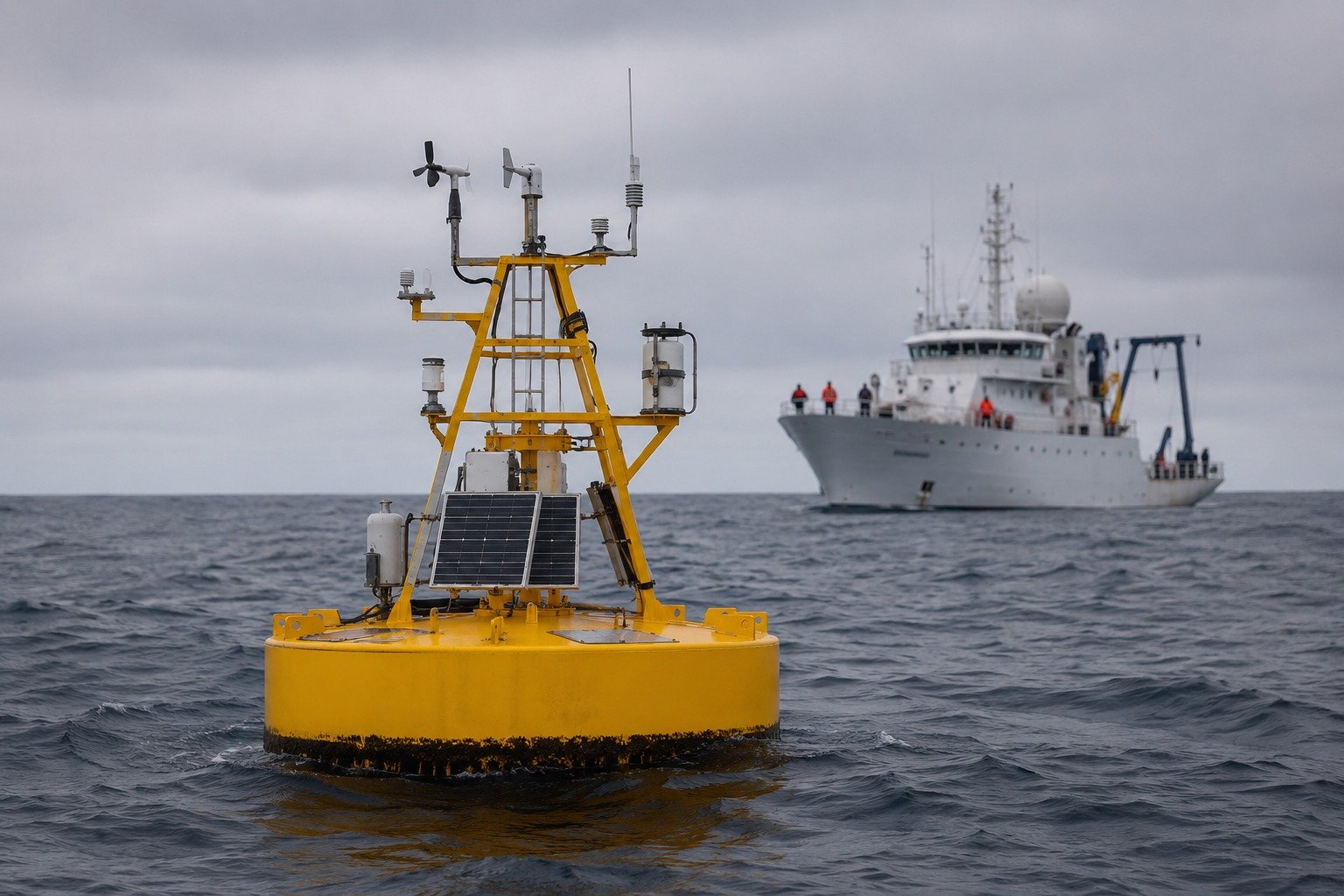
The United States is preparing to dismantle one of the largest ocean-monitoring systems ever built, and the timing could not be more striking. As federal officials begin pulling hundreds of deep-sea instruments out of the water this month, the European Union is moving in the exact opposite direction – pouring new money and new hardware into watching the seas.
The decision sets up a quiet but consequential split between two of the world’s largest scientific powers over a simple question: who should be keeping watch on the oceans, and how much is that worth?
What Is Being Removed
The system at the center of the story is the Ocean Observatories Initiative, a network of more than 900 deep-sea instruments built roughly a decade ago at a cost of about $370 million. Funded through the National Science Foundation, the OOI was designed to deliver round-the-clock data from some of the most remote and scientifically important waters on the planet.
This month, the NSF begins decommissioning that hardware. The instruments are being pulled from waters off Oregon, Washington, Alaska, and North Carolina, as well as from a stretch of the North Atlantic between Greenland and Iceland known as the Irminger Sea – a region scientists consider critical for understanding how heat and carbon move through the global ocean.
Why the Data Matters
For years, the OOI network fed researchers a continuous stream of measurements on ocean currents, marine heat waves, fish habitats, and the conditions that drive coastal flooding along the East Coast. That data is not just academic. It feeds into forecasts and models that help communities prepare for storms, helps commercial fisheries track where fish are moving, and gives scientists an early warning system for changes in the ocean that can ripple onto land.
Supporters of the program argue that once the instruments are gone, that steady flow of information goes quiet, leaving a blind spot in some of the most consequential waters in the Northern Hemisphere. They warn that rebuilding such a network later would cost far more than maintaining it now, and that years of continuous records – the kind that make long-term trends visible – cannot be recovered once the gap opens.
The Case for the Cuts
Backers of the decision frame it differently. They point to the steep price tag of building and operating a sprawling deep-sea network and argue that federal science spending has to be prioritized. In that view, an expensive observatory system is a reasonable place to trim, especially as the government weighs competing demands across the research budget.
The debate is less about whether ocean data is useful – few dispute that – and more about who should pay for it, how much, and whether this particular network is the most efficient way to collect it.
Europe Moves the Other Way
While the U.S. winds its system down, the European Union is scaling up. European officials have been expanding ocean-observation efforts across member states, adding new monitoring buoys, investing in satellite tracking, and building shared research data systems that let countries pool their measurements.
The contrast is hard to miss. One side is removing instruments from the water; the other is putting more in. For Europe, expanded monitoring is increasingly tied to fisheries management, shipping safety, and coastal planning – practical concerns that touch daily life along thousands of miles of coastline.
What This Means for Americans
For people living along the U.S. coasts, the stakes are concrete. Ocean data helps power the forecasts that warn of dangerous flooding, supports the fisheries that put food on tables and money into local economies, and gives planners the information they need to protect roads, homes, and ports. Whether the loss of the OOI leaves a meaningful gap – or whether other systems can fill it – is now at the heart of the debate.
What is clear is that the question of who watches the oceans, and how much that is worth, is no longer settled. As the instruments come out of the water this month, that conversation is only getting louder.
Stay informed on the stories that matter most. Follow Your Daily Updates on Facebook and bookmark yourdailyupdates.news for breaking news and analysis.