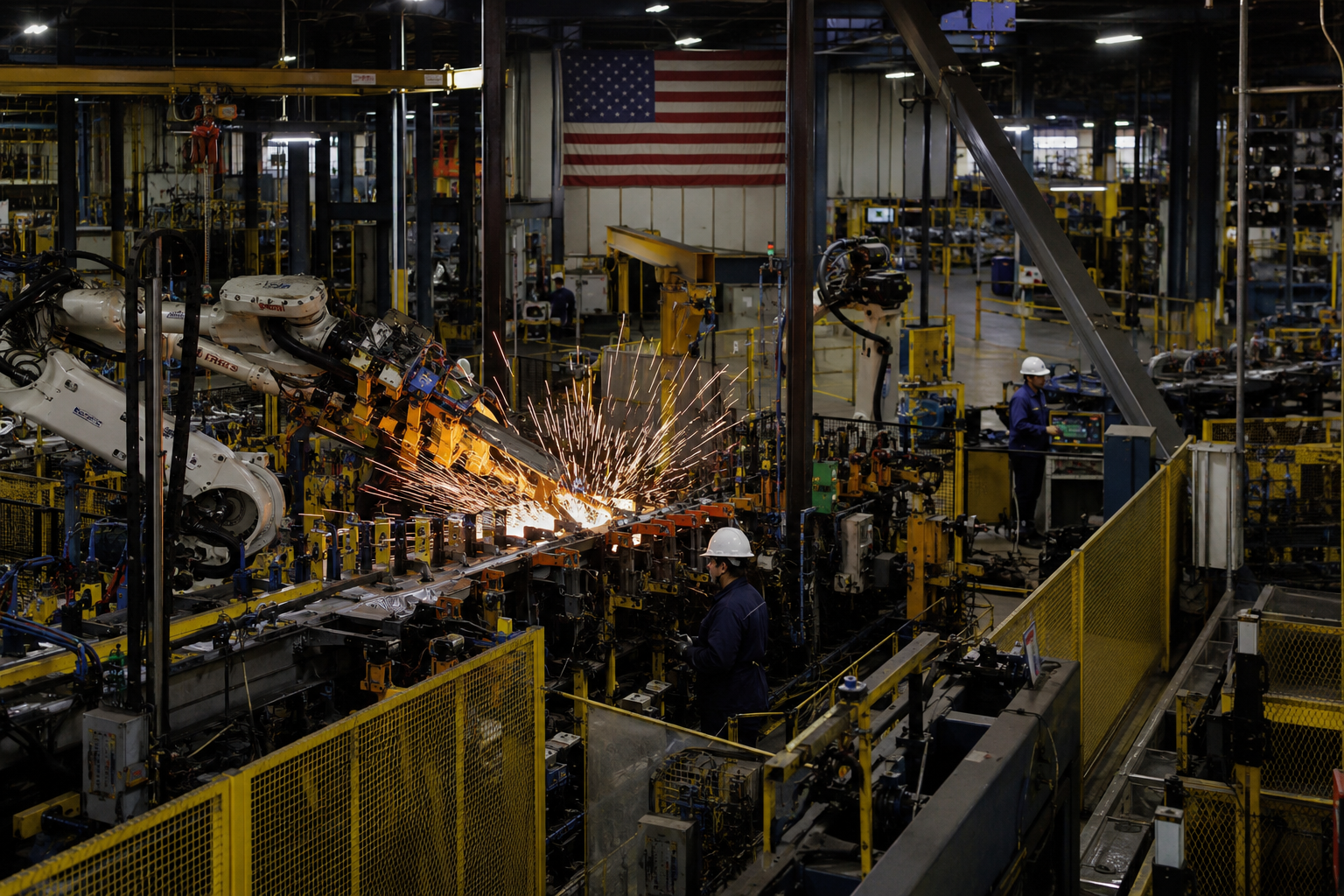
American factories accelerated sharply in April, with industrial production posting its biggest single-month gain in over a year — despite rising tariff costs and ongoing U.S.-Iran military conflict driving global uncertainty. Federal Reserve data released May 15 shows overall industrial production climbed 0.7% in April, topping every single forecast in a Bloomberg survey of economists. That’s not a near-miss beat. That’s a clean sweep.
The Numbers
Manufacturing output — the core of the industrial production report, accounting for roughly three-quarters of the total index — climbed 0.6%. Factory capacity utilization rose to 75.8%, the highest reading since September 2024. That figure matters because it signals how hard America’s industrial infrastructure is being pushed. When utilization rises, it means existing factories are running closer to full capacity — a leading indicator of future hiring and investment decisions.
The 0.7% headline gain reverses several months of sluggish readings. Economists surveyed by Bloomberg had expected a far more modest gain, with most forecasts clustered well below the actual result. The miss wasn’t close. The April number came in above every single estimate in the survey — a rare outcome that signals the economy is running meaningfully hotter than professional forecasters anticipated.
What’s Driving It
Two structural forces appear to be the primary drivers. First: the AI data center construction boom. Building hyperscale computing facilities requires enormous quantities of steel, copper wiring, electrical components, transformers, and industrial equipment. That demand is flowing directly to American manufacturers. Unlike a typical cyclical uptick, this demand is driven by a multi-year technology buildout that has no end date in sight. Companies like Microsoft, Google, Amazon, and Meta have publicly committed to hundreds of billions in data center capital expenditure over the next several years — and a significant portion of that spend hits U.S. factory floors.
The second force is fiscal policy. Recent federal tax cuts have reduced corporate tax burdens, freeing up capital that companies are reinvesting in equipment, expansion, and domestic production. The stimulative effect appears to be more than offsetting the drag from tariff-driven input cost increases — at least for now. That’s the key qualifier economists are watching closely.
The Headwinds Haven’t Gone Away
The backdrop that makes April’s number remarkable is the cost environment factories are operating in. Tariffs on imported materials — steel, aluminum, semiconductors, component parts — have been rising for over a year. The ongoing U.S.-Iran conflict has kept global energy prices volatile, pushing up transportation and fuel costs across the supply chain. These aren’t small line items. For manufacturers with thin margins, tariff-driven input cost increases can rapidly erode profitability even as revenue grows.
That’s why economists are split on what April means. The bull case: AI-driven demand and tax cut stimulus represent durable, structural tailwinds that can sustain manufacturing growth even through elevated costs. The bear case: tariff cost increases tend to hit with a lag of three to six months, and the full weight of recent tariff escalations hasn’t fully worked its way through the supply chain yet. April’s strength may reflect orders placed before the latest cost increases hit — and a slowdown could be coming.
What It Means for the Fed
Federal Reserve policymakers will be watching closely. A manufacturing sector running hotter than expected complicates the case for near-term rate cuts that financial markets have been pricing in. If industrial output continues to accelerate, it signals the economy may not need the stimulus of lower rates — and could push the Fed’s timeline for easing further into the future. The next few months of data will be decisive.
What It Means for Working Americans
A stronger manufacturing sector translates directly to jobs — and factory jobs typically pay above the national median wage. When capacity utilization rises toward 80%, companies face a choice: run overtime or hire. Communities where manufacturing is the backbone of the local economy — across the Midwest, the South, and the industrial Northeast — have the most to gain if April’s momentum holds. The question every economist, factory owner, and policymaker is now asking: was April a turning point, or a one-month pop before the full weight of tariff and war costs catches up?
Stay informed on the stories that matter most. Follow Your Daily Updates on Facebook and bookmark yourdailyupdates.news for breaking news and analysis.