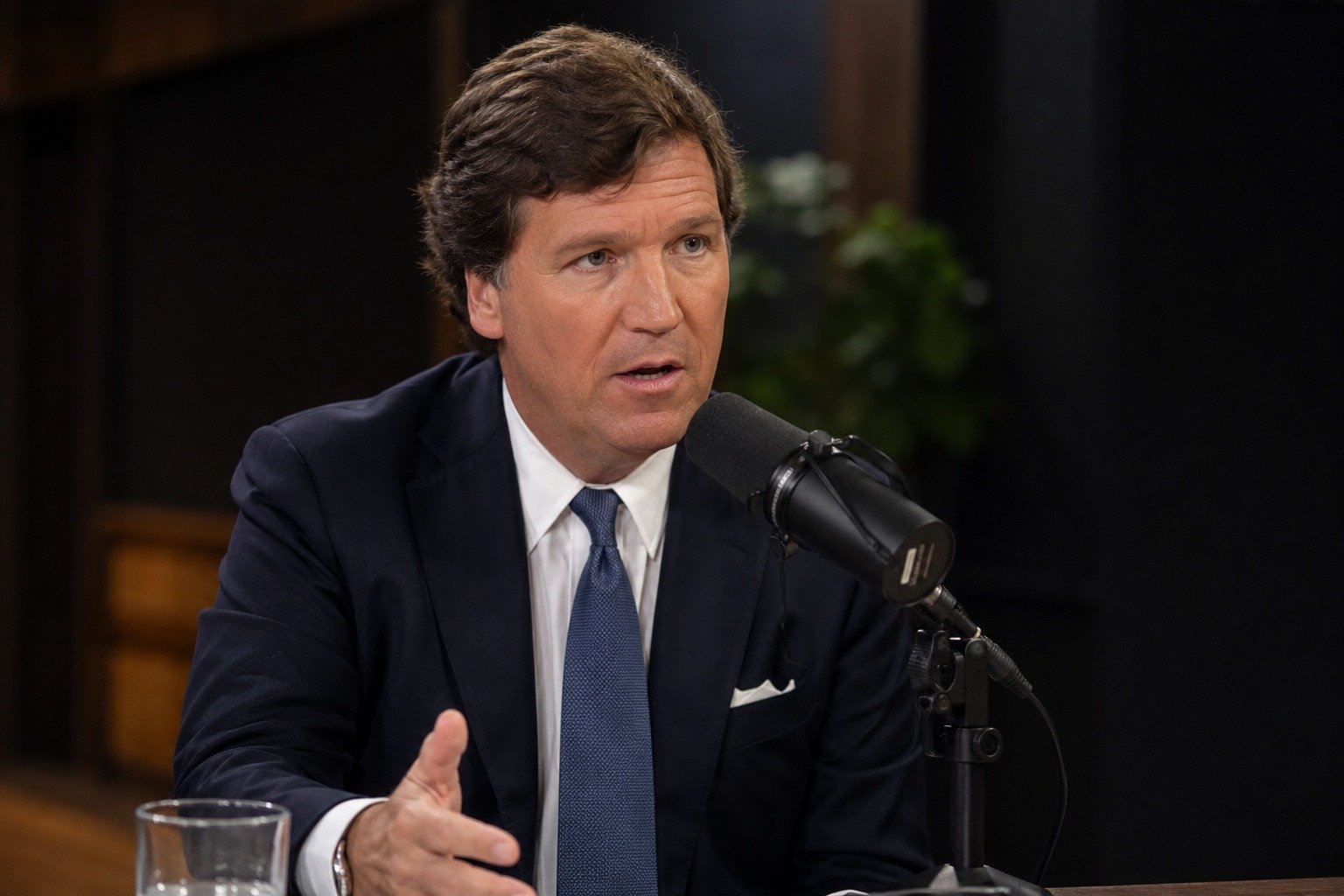
The coalition that powered the modern Republican Party is fracturing in public, and one of its most influential media voices has now stepped outside the tent. In a podcast appearance that spread rapidly online this week, conservative commentator Tucker Carlson declared “I’m out” on the GOP, saying he can no longer support a party he believes has betrayed the voters who put it in power.
Carlson’s stated breaking point is the Iran war and the foreign-policy choices that surrounded it. He argued that Republican leaders placed loyalty to Israel above the interests of the United States, accusing the party of backing a Middle East conflict driven by pressure from abroad rather than the priorities of American citizens.
“How could I or any American voter support a political party that’s not loyal to the United States — that puts the interests of a foreign country above those of its own citizens?” Carlson asked. He stopped short of endorsing the other side of the aisle, saying he is not joining the Democrats and is genuinely unsure how he will vote going forward.
A statement of disaffiliation, not a registration change
It is worth being precise about what this is and is not. Carlson’s remarks are a personal statement of disaffiliation made on a podcast — an expression of where he stands politically — rather than a formal change of party registration or the launch of a new political movement. He has not announced a third party, a candidacy, or an organized effort to peel voters away from the GOP.
Still, the symbolism is hard to overlook. Carlson spent years as one of the most-watched voices in conservative media, and his audience overlaps heavily with the Republican base. When a figure with that kind of reach says he can no longer back the party, it registers as more than an offhand comment.
Carlson also suggested he is not alone. If he is walking away, he said, “a lot of other people are out” too — framing his decision as a reflection of a broader mood rather than an isolated grievance.
Marjorie Taylor Greene echoes the break
That prediction found at least one prominent echo almost immediately. Rep. Marjorie Taylor Greene, long one of the party’s most vocal members, wrote that Carlson is “not the only one” who feels the GOP has lost its way, arguing that many conservatives believe the party has betrayed its voters and its country.
The convergence of two high-profile figures on the same complaint — in the same week — points to a real fault line rather than a passing dispute. The disagreement is not about a single policy detail but about a foundational question: whose interests the party is ultimately serving.
The deeper question: war powers and accountability
Beneath the personalities, the more durable story is about war powers and accountability. A growing bloc on the right has been asking why the country was drawn into another Middle East conflict, who made that decision, and whether the public’s interests were genuinely weighed against those of foreign partners.
Those questions are not new, but they tend to surface most forcefully when a war’s costs become harder to justify. Debates over how the United States enters armed conflicts — and how much say voters and Congress have in them — have repeatedly reshaped both major parties. Carlson’s break is the latest sign that the Iran war has reopened that argument inside the conservative movement.
Whether this moment becomes a lasting rupture or fades as the news cycle moves on remains to be seen. What is clear is that the disagreement over the Iran war, and over who the Republican Party answers to, is now playing out in the open — voiced by some of the very people the party has counted on to carry its message.