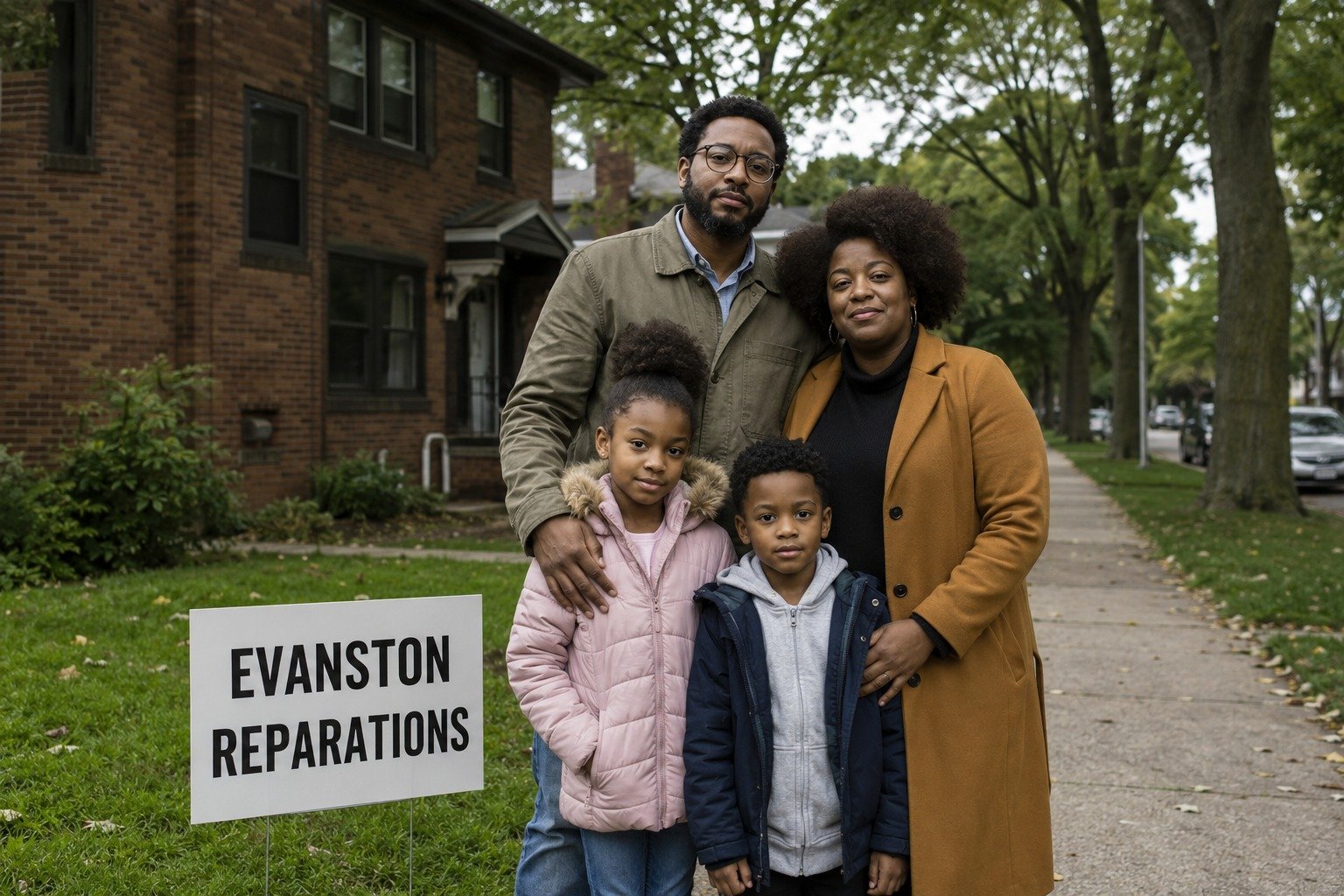
The Trump administration has taken an unprecedented step against one of the most closely watched civil-rights experiments in the country: a federal effort to dismantle the first reparations program for Black residents ever launched by an American city.
This week, the U.S. Department of Justice’s Civil Rights Division moved to intervene in a lawsuit against the city of Evanston, Illinois, asking a federal judge to declare the city’s reparations program unconstitutional. The program has not been shut down. But for the first time in American history, the federal government has formally thrown its weight behind an effort to end a local reparations initiative.
What Evanston Built
Evanston, a suburb just north of Chicago, launched its reparations program in 2021 after years of local research and public debate. The initiative offers $25,000 housing grants to Black residents and their direct descendants who can show they were harmed by the city’s own documented housing discrimination between 1919 and 1969 — a period when local ordinances, banking practices, and zoning decisions systematically locked Black families out of homeownership and confined them to specific neighborhoods.
The grants are not cash handouts in the conventional sense. The money is restricted to housing-related uses: down payments on a home, mortgage assistance, or repairs to an existing property. City officials designed it that way deliberately, framing the program as a targeted remedy for a specific, government-caused wrong rather than a broad transfer of wealth.
The DOJ’s Argument
The Justice Department contends that because the grants are tied to race, the program violates the Equal Protection Clause of the Fourteenth Amendment and the federal Fair Housing Act. In its filing, the department argues that distributing public benefits based on race — even to remedy past discrimination — runs afoul of constitutional guarantees of equal treatment under the law.
The federal government is not starting a case from scratch. Instead, it is seeking to join an existing lawsuit. In 2024, a group of non-Black descendants of Evanston residents sued the city, arguing that their exclusion from the program amounted to unlawful discrimination. A federal court declined to dismiss that suit earlier in 2026, allowing it to move forward. The DOJ then opened its own investigation and, when the city declined to cooperate, moved to intervene directly.
Two Competing Visions
To supporters of the program, the case represents something deeply unsettling: a city that openly acknowledged it had harmed Black families, tried to repair that damage with its own funds, and is now being hauled into federal court for the attempt. They argue the program was never about race as an abstraction. It was about repairing concrete harm that the government itself inflicted and documented.
Critics counter that any race-based distribution of public money is unconstitutional on its face, no matter how well-intentioned, and that remedies must be available to all residents on equal terms. That tension — between correcting historical injustice and maintaining strict race-neutrality in government programs — sits at the heart of the case.
Why This Case Matters
Evanston’s program has been a model studied by city councils and advocacy groups across the country. A federal ruling against it could ripple far beyond one Chicago suburb, effectively setting the legal ceiling for how far any American city can go in attempting reparations for housing discrimination.
For now, the program remains in place, and the families relying on those housing grants continue to receive them. But the question before the court is sweeping: whether a city that caused documented harm can choose a race-conscious remedy to fix it — and whether any American community will be allowed to try reparations again.