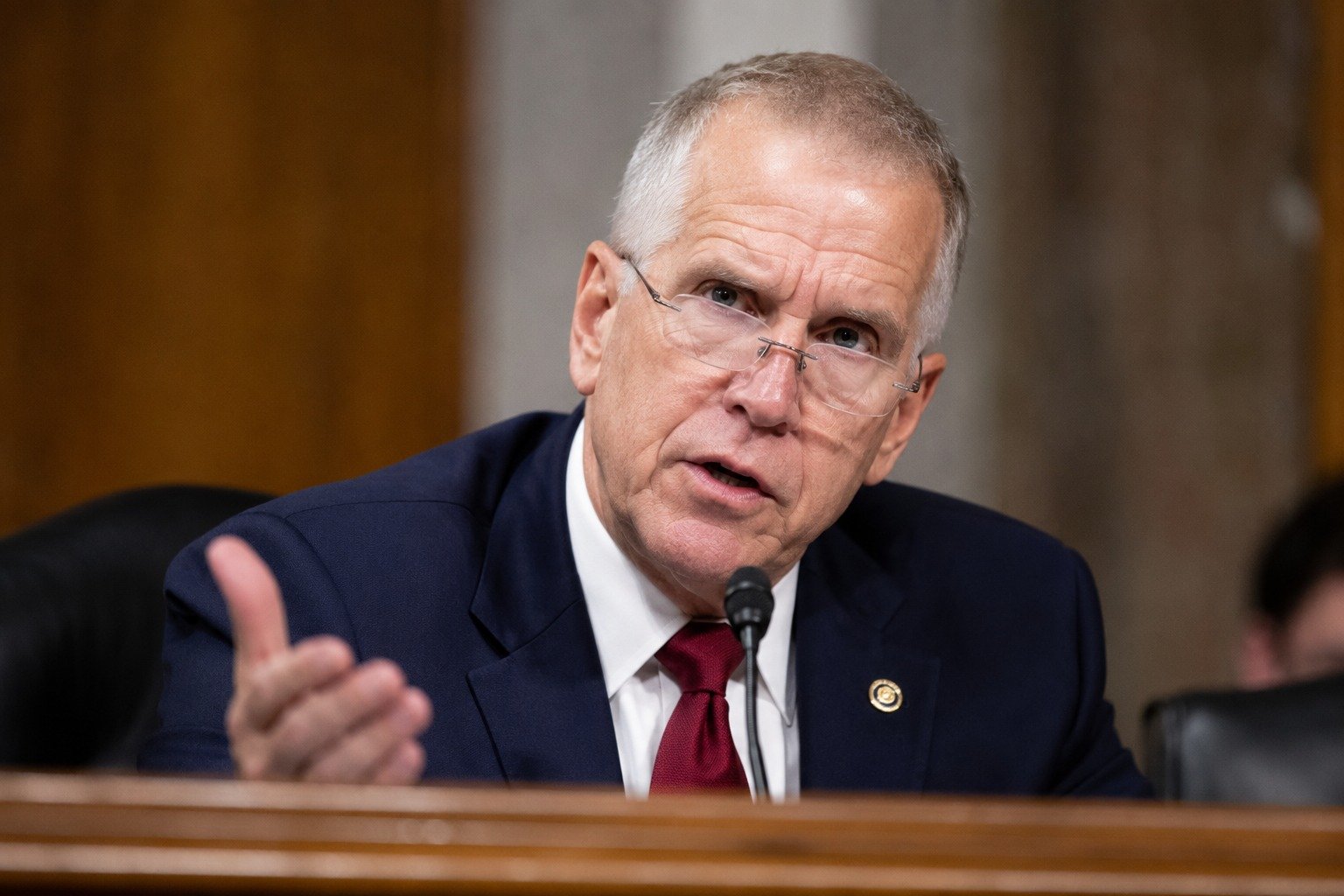
It is not often that a Republican senator turns his fire on his own party’s Justice Department. But Sen. Thom Tillis (R-NC) did exactly that this week, drawing a blunt and uncomfortable contrast between how the Trump-era DOJ is treating accused vandals and how it treated the rioters who assaulted police on January 6.
The flashpoint was a string of prosecutions threatened by Trump’s U.S. Attorney, Jeanine Pirro, against people accused of cutting and damaging the lining of the Lincoln Memorial Reflecting Pool. Prosecutors signaled that those charges could carry sentences of up to 10 years in prison. To Tillis, the math simply did not add up.
“You cut a pool lining, you get 10 years,” Tillis said. “You beat a cop, you get out free.”
That second line is the one that stings, and it is not rhetorical excess. When Donald Trump returned to office, one of his earliest acts was issuing sweeping, blanket pardons to the people who stormed the U.S. Capitol on January 6, 2021 – including those who physically assaulted Capitol and Metropolitan Police officers. Officers were crushed in doorways, struck with poles and improvised weapons, and dragged into a hostile crowd while trying to hold the line. Many of those who attacked them saw their charges erased with the stroke of a pen.
Set against that backdrop, the threat of a decade behind bars for damaging stonework at a national monument reads, to Tillis, as a question of priorities and proportion. It is the kind of contrast that critics of the administration have been pointing to for months – but it carries a different weight coming from a member of the president’s own party rather than from the opposition.
A Two-Tier System, Named by a Republican
The phrase “two-tier justice” has become a fixture of American political argument, deployed by both sides depending on who feels aggrieved. What makes Tillis’s comment notable is the direction it points. Here is a conservative senator looking at the Justice Department under a Republican president and suggesting, in effect, that the scales are not balanced – that the government appears willing to throw the book at one category of defendant while having extended extraordinary leniency to another.
The Lincoln Memorial Reflecting Pool, it is worth clarifying, is not a swimming pool. It is the long, iconic basin that stretches between the Lincoln Memorial and the Washington Monument on the National Mall – a space woven into the country’s civic memory, from civil rights marches to national mourning. Damaging it is, by any measure, a serious act of vandalism against shared public property. The question Tillis raised is not whether vandalism should be punished, but whether a system that reserves its harshest threats for property damage while pardoning violence against police can credibly claim to deliver equal justice.
Why the Messenger Matters
Tillis is no firebrand and no reliable critic of his party. He has spent his Senate career as an institutionalist, often searching for the middle of a negotiation rather than the edge of a fight. That track record is precisely why this particular critique lands. When a senator with his reputation for caution looks at how the DOJ is choosing whom to pursue and whom to protect and calls the result unserious, it is harder to dismiss as partisan noise.
It also speaks to a broader unease that has not gone away since the January 6 pardons were issued. The officers who defended the Capitol that day – and the families of those who later died – have spoken repeatedly about feeling abandoned by the very system they were injured trying to protect. Each new prosecution that appears disproportionate by comparison reopens that wound and renews the question Tillis put so plainly.
For now, the senator’s remark stands as a rare moment of intraparty candor: a Republican publicly asking whether his own administration’s Justice Department is applying the law evenly, or simply selectively. The answer to that question – equal justice for whom – is one the country has been wrestling with since the pardons were signed, and it is not going away.