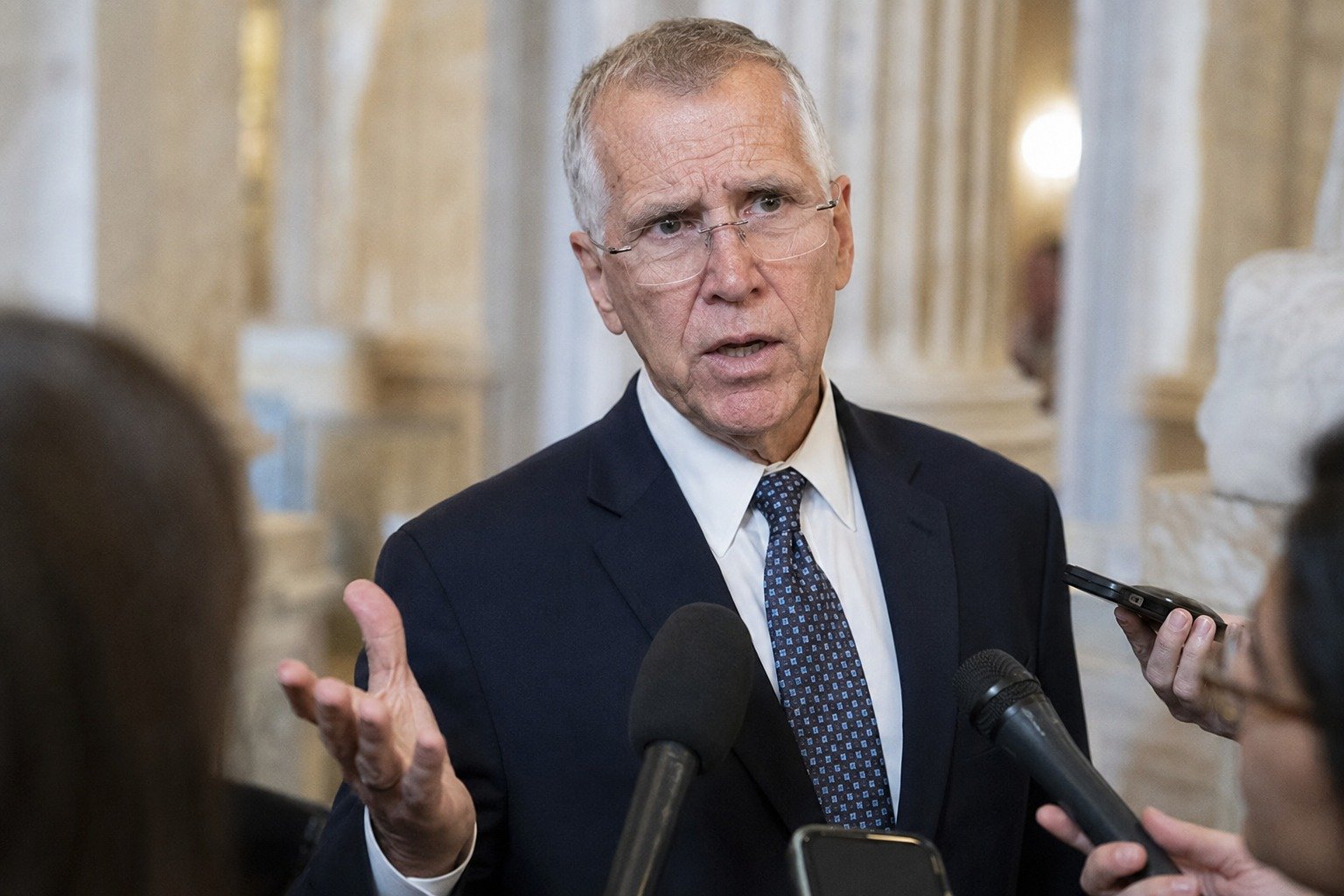
It is not every day a Republican senator turns to reporters and asks what universe he woke up in. But that is exactly what Sen. Thom Tillis of North Carolina did this week, tearing into the Justice Department over what he described as a jaw-dropping double standard in how the law is being applied.
The contrast Tillis pointed to is stark. On one side are the people who stormed the U.S. Capitol on January 6, 2021, including those who assaulted police officers. Many of them received blanket pardons from President Donald Trump. On the other side are people accused of vandalizing the Lincoln Memorial reflecting pool, who the DOJ, with U.S. Attorney Jeanine Pirro leading the effort, has moved aggressively to prosecute.
Trump himself floated the harshest figure. In a social media post, he warned that people who damaged the reflecting pool could face up to 10 years in prison, citing the Veterans’ Memorial Preservation Act. That 10-year number did not come from a judge or a courtroom sentence. It came from the president’s own online threat, and it quickly became the benchmark critics seized on to illustrate the gap.
Tillis could not square the two. “What freaking parallel universe did I just wake up in?” he asked. For a member of Trump’s own party to say that out loud, on the record, is not a small thing. It signals just how far the situation has drifted from any consistent standard of justice.
The senator’s frustration boils down to a simple comparison. Under the current posture, someone who beat a police officer during the Capitol riot can walk free with a pardon, potentially even eligible for restitution. Meanwhile, someone merely accused of scraping at a reflecting pool is staring down the possibility of a decade behind bars. Tillis argued that a prosecution built on that kind of imbalance cannot be taken seriously.
A few points deserve precision. The reflecting pool suspects are accused, not convicted. Their cases have not been decided, and they are entitled to the presumption of innocence like anyone else. And again, the 10-year figure originated in Trump’s public threat rather than in any sentence handed down by a court. But those caveats are, in many ways, exactly Tillis’s point. The full force of federal outrage, and the machinery of aggressive prosecution, is being aimed at alleged paint-scrapers while people who injured officers were handed a clean slate.
The Veterans’ Memorial Preservation Act, the statute cited in Trump’s threat, is designed to protect monuments and memorials from damage. Its existence is not in dispute. What Tillis and other critics question is the sense of proportion. When the same government that pardoned violent offenders turns around and threatens the maximum penalty for property damage that has not even been proven in court, the message about who the law protects and who it punishes becomes difficult to defend.
Pirro, a former Fox News host who now serves as a U.S. attorney, has been the public face of the reflecting pool prosecutions. Her involvement has drawn attention precisely because of the optics: a high-profile Trump ally pressing hard on a relatively minor vandalism case at the same moment the administration’s signature act of clemency benefited people convicted of far more serious conduct.
Tillis’s comments matter because they come from inside the coalition, not outside it. Democrats have hammered the January 6 pardons for months. When a Republican senator openly asks what parallel universe he woke up in, the criticism becomes harder to dismiss as partisan noise. It becomes a question about the basic promise that the law should mean the same thing for everyone.
That is the debate now playing out in Washington. Not whether vandalism should be prosecuted, but whether a justice system that pardons people who attacked police while threatening a decade in prison for alleged paint damage can claim to be fair. For at least one Republican senator, the answer is a bewildered question of his own.