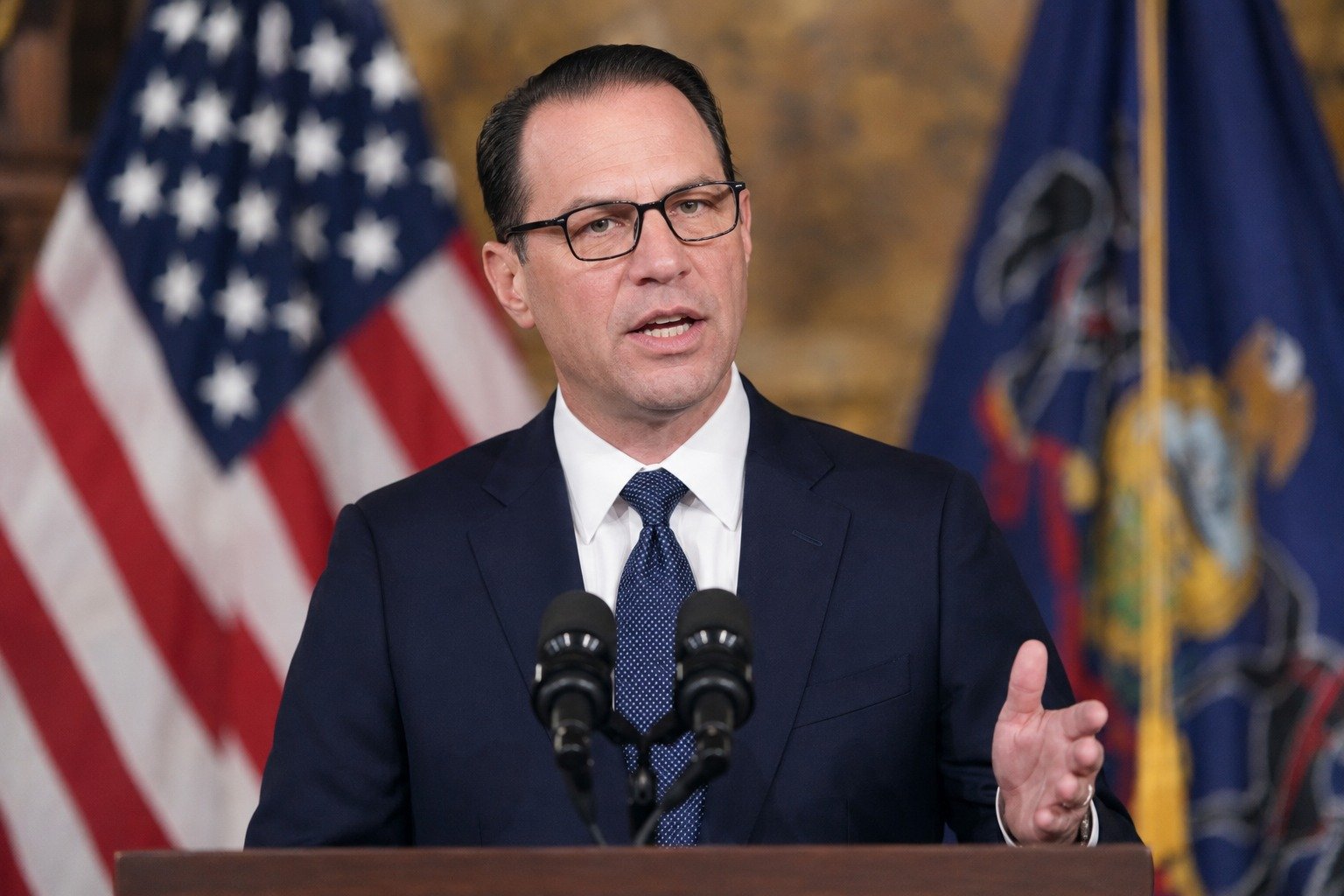
Pennsylvania Gov. Josh Shapiro did not soften his words about President Donald Trump’s posture toward Canada this week, calling the president’s rhetoric toward America’s northern neighbor “reckless and disrespectful” even as he moved to deepen his state’s economic ties with one of the country’s closest trading partners.
On Wednesday, June 10, Shapiro met with Ontario Premier Doug Ford and signed a partnership agreement aimed at strengthening cooperation between the Canadian province and the commonwealth. The document is a memorandum of understanding — a statement of shared intent to keep doing business across the border — rather than a binding treaty or trade pact. It commits the two governments to work together on commerce and economic development, but it does not carry the force of law in the way a formal trade agreement would.
The signing came against a backdrop of mounting tension between Washington and Ottawa. Shapiro made clear he respects Canadian sovereignty, a pointed contrast with Trump’s repeated jabs suggesting Canada should become the “51st state.” Those comments have rankled Canadian officials and ordinary citizens alike, and have become a recurring irritant in cross-border relations.
A $500 million hit to cross-border trade
Shapiro pointed to a concrete cost of the deteriorating relationship: trade between Ontario and Pennsylvania has already fallen by roughly $500 million, he said, amid the Trump administration’s trade war and the rhetoric surrounding it. For a state economy with deep manufacturing and energy ties to Canada, that is not an abstract figure — it represents lost orders, strained supply chains, and uncertainty for businesses that depend on predictable access to markets on both sides of the border.
Ontario is among the largest trading partners for many U.S. states, and Pennsylvania has long counted the province as a key market for its goods and a source of imports that feed its own industries. When that flow slows, the effects ripple through both economies. Shapiro framed the new partnership as an effort to stabilize and protect that relationship even as federal policy creates headwinds.
Trump’s USMCA stance looms over the talks
Hanging over the discussion is the future of the United States-Mexico-Canada Agreement, or USMCA, the deal that governs much of the commerce across North America. Trump has said he is “not looking to renew” the pact, raising questions about what the rules of cross-border trade will look like in the years ahead.
That uncertainty is part of what appears to be driving state leaders to act on their own. With the federal framework in doubt, governors have an incentive to build direct relationships with provincial and regional partners to keep commerce moving regardless of what happens in Washington.
States step in where Washington steps back
Shapiro’s move reflects a broader pattern. Governors from both parties have increasingly stepped in to protect regional economies when federal policy injects volatility. A memorandum of understanding cannot rewrite national trade law, but it can signal commitment, open channels of communication, and lay groundwork for cooperation on specific projects.
For Shapiro, the partnership with Ontario doubles as both an economic strategy and a political statement. By publicly affirming respect for Canadian sovereignty and criticizing the president’s approach, he positioned himself in clear contrast to the White House on one of the more visible foreign-policy flashpoints of the moment.
Whether the agreement translates into measurable economic gains will depend on follow-through and on the larger trajectory of U.S.-Canada relations. But the message from Harrisburg was unambiguous: some state leaders are not waiting for Washington to sort things out, and they are willing to say so plainly.