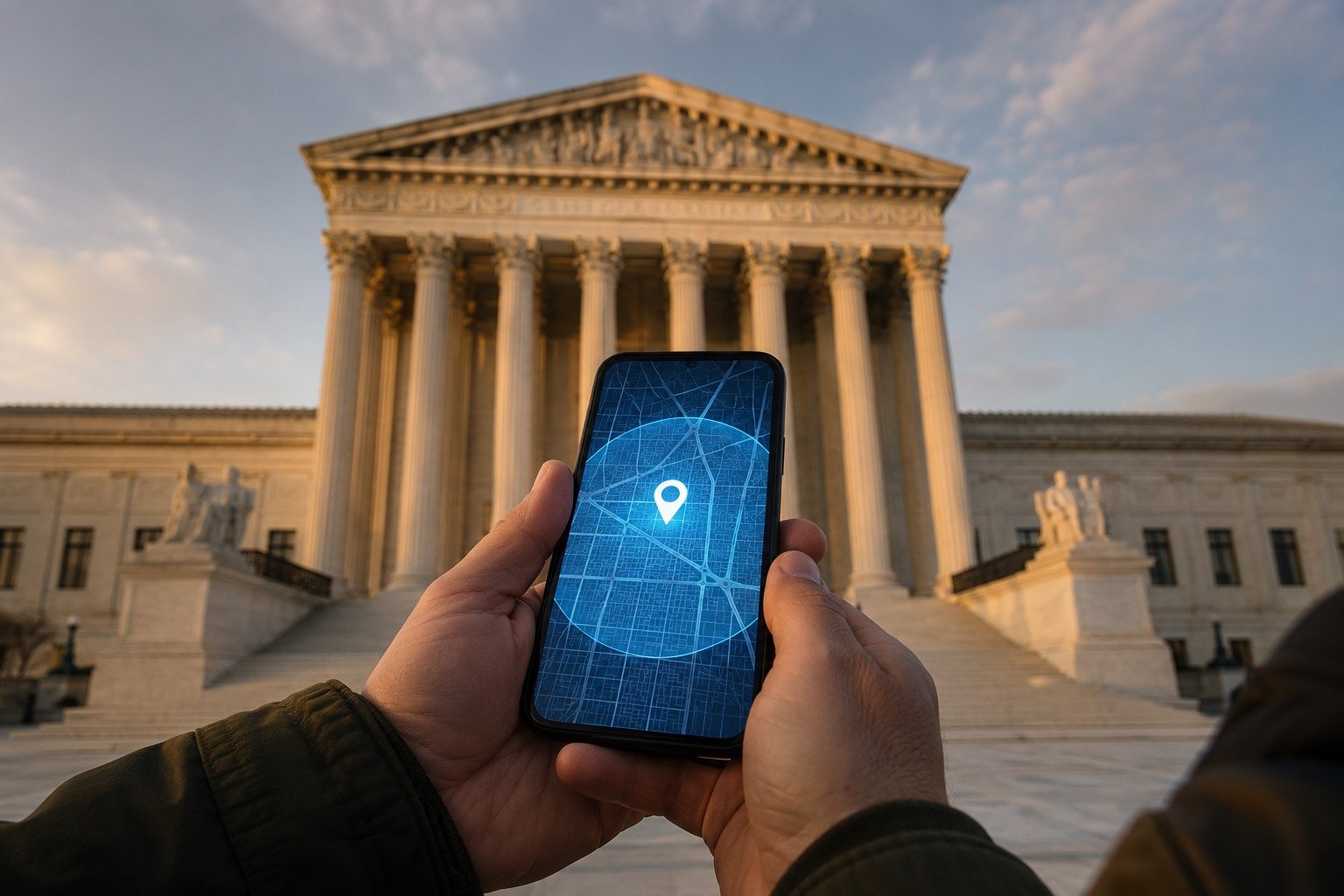
The Supreme Court has handed digital privacy advocates a significant victory, ruling that police cannot freely sweep up location data from every phone in a given area without first obtaining a narrowly tailored warrant. In a 6-3 decision issued on June 29, 2026, the justices held that so-called “geofence warrants” implicate the Fourth Amendment’s protections against unreasonable searches.
Writing for the majority, Justice Elena Kagan made clear that the bulk collection of location data is not the kind of routine investigative step police can take without judicial oversight. Law enforcement, the Court ruled, must now secure a warrant that is specific and limited in scope before requesting the location records of everyone whose device happened to be near a particular place at a particular time.
What Is a Geofence Warrant?
Geofence warrants are a relatively new and increasingly controversial tool. Rather than naming a specific suspect, they ask technology companies to identify every device that was present within a defined geographic boundary during a defined window of time. The result can be a list of dozens, hundreds, or even thousands of people, the overwhelming majority of whom have no connection to any crime.
Critics have long argued that this approach turns the traditional logic of a warrant on its head. Instead of starting with probable cause to search a specific person, investigators cast a wide digital net and work backward, sifting through the data of ordinary people who simply walked, drove, or lived nearby.
The Case Behind the Ruling
The decision grew out of a 2019 bank robbery in Virginia. Investigators, lacking a named suspect, obtained a geofence request that pulled location data on every device detected near the crime scene. Among those swept into the dragnet were people who had nothing whatsoever to do with the robbery, raising the central constitutional question the Court ultimately addressed: can the government collect that much data about that many innocent people without meaningful limits?
The justices answered that the practice triggers Fourth Amendment scrutiny. While the Court did not declare every geofence request unconstitutional, it established that these sweeping requests are searches that require a warrant grounded in particularity, not a blanket order covering an entire neighborhood.
Regulated, Not Banned
It is important to be precise about what the Court did and did not do. The justices did not ban geofence warrants outright. Police can still seek location data through this method. What changed is the standard: any such request must now be narrowly tailored and supported by a warrant, rather than functioning as an open-ended sweep.
In practice, that means investigators will need to justify the scope of their requests to a judge, limiting the geographic area and time frame and explaining why the intrusion into so many people’s data is reasonable. The 6-3 split reflects an ongoing debate on the Court about how the Fourth Amendment, written in the 18th century, should apply to technologies that can track our movements with extraordinary precision.
Why It Matters
For most Americans, the ruling lands close to home. Smartphones are now constant companions, quietly logging where we go, when, and for how long. That data can reveal deeply personal details, from medical appointments to places of worship to political gatherings. A legal framework that allowed police to vacuum up that information in bulk, without individualized suspicion, posed a real threat to privacy on a mass scale.
The decision builds on a line of cases in which the Court has recognized that digital data deserves robust constitutional protection. It is a reminder that privacy rights in the smartphone age are not automatic – they have to be defined, defended, and reaffirmed, one ruling at a time. For now, the message from the nation’s highest court is clear: your phone’s location history is not an open book for investigators, and the government must show its work before it goes looking.