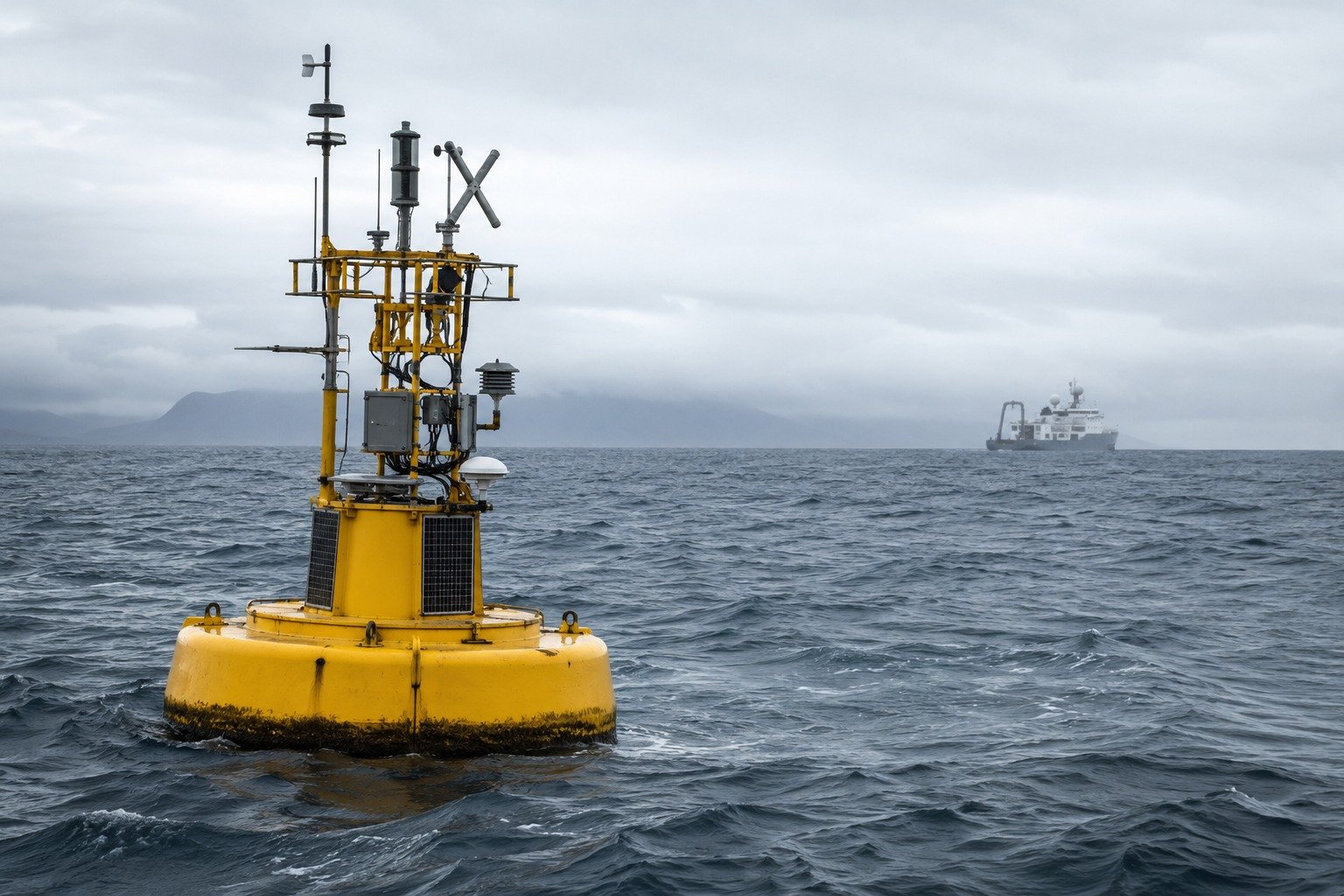
The federal government has begun dismantling one of the most ambitious ocean-monitoring systems ever deployed. On May 21, 2026, the National Science Foundation announced it would “descope” the Ocean Observatories Initiative, a $368 million network that has streamed continuous data from the deep sea since 2016. Over the next 15 months, crews will pull in-water equipment from waters off Alaska, Washington, Oregon and North Carolina, along with a site in the North Atlantic near Greenland.
What the Ocean Observatories Initiative Does
Launched in 2016, the Ocean Observatories Initiative was built to give scientists something the ocean rarely offers: an unbroken, real-time stream of data from beneath the surface. The network strings together more than 900 instruments across several arrays, measuring temperature, salinity, currents, oxygen levels and other markers of ocean health. Much of that hardware sits in some of the harshest and most remote waters on the planet, where collecting consistent data has historically been difficult and expensive.
That continuity is what made the program valuable to researchers. A single research cruise can capture a snapshot, but the OOI was designed to capture a decade-long film — the kind of long-running record that lets scientists separate short-term noise from genuine long-term shifts in the ocean.
What Is Being Removed
According to the NSF, the descoping will be a phased recovery and removal process spread across roughly 15 months. As equipment is pulled from each array, the real-time data feeds tied to it will go dark. The infrastructure slated for removal sits off the coasts of Alaska, Washington, Oregon and North Carolina, plus a site in the Irminger Sea, a marginal sea between Greenland and Iceland.
Not everything is being switched off. The NSF says the Regional Cabled Array, which runs from the Oregon coast out to the Juan de Fuca plate in the Pacific, will remain in service for the foreseeable future. The agency has also stressed that the program is not being canceled outright, even as the bulk of its in-water hardware is recovered.
The Administration’s Rationale
The NSF frames the decision as part of a broader effort to run a leaner, more flexible research portfolio. In the agency’s telling, the move aligns with a strategy of prioritizing support for evolving scientific priorities and emerging technologies rather than committing large sums to maintain a sprawling, aging sensor grid. An NSF spokesperson emphasized to reporters that the program is being scaled back, not eliminated.
The context is budgetary. The initiative’s funding faced an 80% cut under FY2026 proposals, leaving the agency to decide how to operate a costly network with a fraction of its previous resources. Supporters of the reductions argue that federal science budgets cannot fund everything indefinitely, and that expensive legacy infrastructure should not be exempt from the same hard choices facing the rest of the government.
Critics Push Back
Scientists and several lawmakers see the move very differently. They warn that the OOI has assembled one of the few continuous records of deep-ocean temperature and current data — information used to track climate trends and monitor major Atlantic currents that influence weather across North America and Europe. Once the instruments come out of the water, they argue, that unbroken record stops, and restarting it later would be costly and slow.
Sen. Sheldon Whitehouse (D-RI) and other Democrats publicly opposed the decision, with Whitehouse framing it as turning off the monitors at the very moment ocean data is most needed. Democrats have signaled they intend to fight the cut as the budget process moves through Congress, setting up a broader clash over how much the federal government should spend on long-term environmental monitoring.
What This Means for Americans
For most people, ocean sensors hundreds of miles offshore feel distant. But the data they gather feeds into weather forecasting, fisheries management and climate research that shape everyday decisions — from storm warnings to coastal planning. The debate now heads to Congress, where lawmakers will decide whether to restore the funding or let the removal proceed. The outcome will determine not just the fate of the hardware, but whether one of the nation’s longest continuous ocean records keeps running.
Stay informed on the stories that matter most. Follow Your Daily Updates on Facebook and bookmark yourdailyupdates.news for breaking news and analysis.