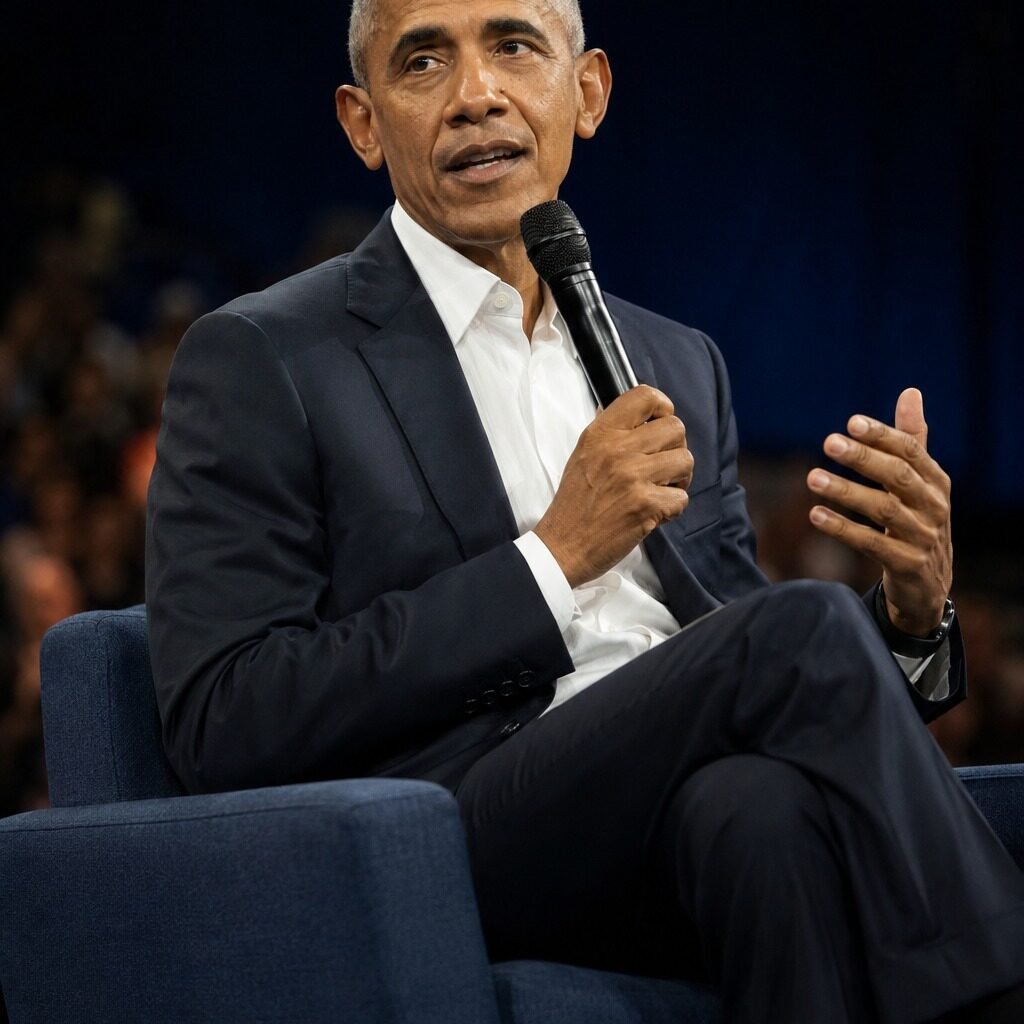
Barack Obama rarely dominates a news cycle with a single sentence anymore. He managed it anyway. Speaking during an on-stage conversation at London’s O2 Arena, the former president offered a blunt diagnosis of what ails the world: “It’s fair to say that 80% of the world’s problems involve old men hanging on who are afraid of death and insignificance, and they won’t let go.”
The line landed instantly. Within hours it was circulating across social platforms, quoted, clipped, and debated. It carried the compact, quotable quality Obama has long been known for — a big idea folded into a sentence you can repeat from memory.
What He Actually Said
Obama made the remark during a wide-ranging public appearance in London, the kind of moderated conversation he has favored since leaving office. He did not name any individual. He offered the observation as a general theory of power — a comment on leaders who cling to relevance rather than a targeted attack on any one figure.
That distinction matters, because the quote was quickly reshaped online into something more specific than what he said. When a line is this clean, it tends to get twisted, trimmed, or attached to claims the speaker never made. In this case, the wording held up. Fact-checkers at Snopes, along with reporting from Newsweek and others, confirmed the quote is authentic and closely matches what Obama said.
The Interpretation Everyone Reached For
Almost as soon as the clip spread, a common reading took hold: that Obama was taking a veiled shot at a particular political rival. That interpretation is understandable, and it is widespread — but it is interpretation, not confirmed fact. Obama did not identify a target, and framing the remark as a direct attack on any named person goes beyond what he actually stated.
Part of what makes the sentence stick is exactly that ambiguity. By leaving it open, Obama let listeners fill in the blank with whichever leader came to mind. Different audiences around the world could hear it and picture entirely different people. That is a feature of the phrasing, not a slip.
A Comment About Power Itself
Strip away the guessing game and the remark reads as a broader statement about power and mortality. It describes a recognizable type: the leader who would rather see everything unravel than accept that their moment has passed. Fear of death and fear of insignificance, Obama suggested, drive a surprising share of the dysfunction that plays out on the world stage.
It is a theme that applies far beyond any single country or party. Aging strongmen, entrenched officials, and figures who refuse to pass the torch exist in capitals across the globe. That universality is likely why the line traveled so quickly and why so many people saw their own political frustrations reflected in it.
What This Means for Americans
For an American audience, the comment cuts close to a live debate about age, ambition, and letting go of power. Questions about how long leaders should hold office, and whether they know when to step aside, are not abstract here. Obama’s framing invites readers to ask a simple question about their own leaders: is this person serving the public, or holding on out of fear?
Whether you hear a specific target in the line or a broader warning about power everywhere, the sentence is doing precisely what Obama seemed to intend: making people argue about who, exactly, cannot let go.
Stay informed on the stories that matter most. Follow Your Daily Updates on Facebook and bookmark yourdailyupdates.news for breaking news and analysis.