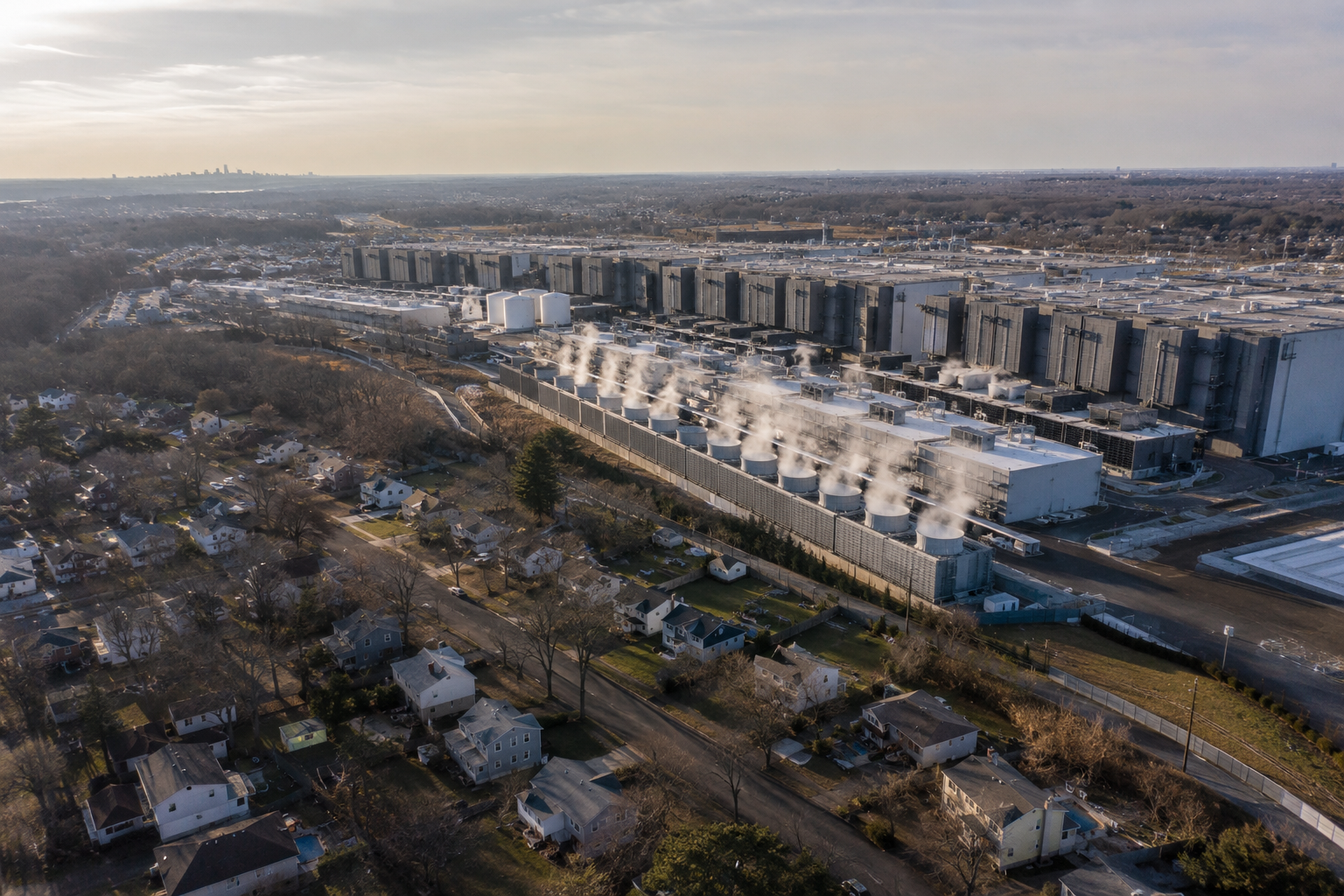
New Jersey is at the center of a growing national fight over artificial intelligence infrastructure. A coalition of 60 environmental, labor, and community organizations has formally demanded that Governor Madeleine Sherrill invoke emergency executive powers to halt all new AI data center construction across the state — citing explosive electricity demand, chemical contamination risks, and a near-total absence of public oversight.
The Scale of the Problem
To understand why this coalition is sounding the alarm, consider the numbers. A single mid-size AI data center consumes as much electricity as an entire city of 40,000 people. New Jersey — one of the most densely populated states in the country — is currently home to one of the largest concentrations of data center development on the East Coast, and more facilities are being approved and built at a rapid pace. The state’s grid, already under pressure from electrification of homes and vehicles, is struggling to absorb the additional load.
The growth of AI services — cloud computing, machine learning, large language models — has driven an unprecedented surge in demand for data center capacity. Major tech companies are racing to build these facilities wherever land is available, power is accessible, and regulatory resistance is low. New Jersey has become a prime target. But local communities say they never consented to becoming the power-hungry backbone of the AI economy.
What the Coalition Is Demanding
Last week, the coalition — representing environmental groups, labor unions, municipal advocates, and community associations — submitted a formal letter to Governor Sherrill’s office. Their demands are specific and urgent: an immediate executive moratorium on all new data center approvals and construction permits, a mandatory environmental impact review process before any future facilities can break ground, and direct community input requirements that give residents a formal voice in siting decisions.
The groups argue that the current approval process has been effectively invisible to the public. Data centers are classified in ways that allow them to bypass the environmental review requirements typically imposed on industrial facilities of comparable scale. By the time most residents learn a facility is being built near their neighborhood, the permitting process is already complete.
The PFAS Crisis: “Forever Chemicals” in Drinking Water
Among the concerns raised by the coalition, the PFAS contamination risk stands out as the most alarming. The cooling systems used in large-scale data centers rely on chemicals that are associated with PFAS — a class of synthetic compounds known as “forever chemicals” because they do not break down naturally in the environment. When cooling systems develop leaks, these chemicals can seep into the soil and groundwater, ultimately contaminating municipal water supplies.
PFAS exposure has been linked to a serious and growing list of health consequences, including weakened immune response, elevated cancer risk, birth defects, and damage to the liver and kidneys. Communities in New Jersey’s Pinelands region — already classified as one of the most ecologically sensitive areas in the Northeast — are particularly vulnerable to contamination events that would be nearly impossible to fully remediate once they occur.
Bipartisan Pushback at the Local Level
The resistance to data center expansion in New Jersey is not coming from one side of the political spectrum. Several municipalities have already taken unilateral action. Pemberton Township, Monroe Township, and North Hanover Township have each passed local ordinances banning new data center construction within their borders. Mayors from Sussex County to Bayonne have been vocal in their opposition, and municipal leaders across the state are reportedly drafting similar measures.
Residents framing the issue as a community safety matter — rather than a partisan one — have found traction with neighbors across political divides. A recent Fairleigh Dickinson University survey found that 65 percent of registered New Jersey voters support a statewide ban on new data centers until additional power generation capacity can be brought online. A Pinelands Alliance petition calling for a moratorium has gathered nearly 7,500 signatures.
Governor Sherrill Has Acknowledged the Problem — But Hasn’t Acted
Governor Sherrill has publicly acknowledged that the rapid expansion of AI data centers is a contributing factor in rising electricity rates across the state. That acknowledgment has done little to satisfy the coalition, which argues that recognizing the problem and doing nothing about it is no longer acceptable. The groups say the Governor has the executive authority to act — and that the science and the polling both support using it.
What This Means for New Jersey Residents
For the average New Jersey family, the implications of unchecked data center expansion are direct and tangible. Higher electricity bills, risk of drinking water contamination, and industrialization of residential and ecologically sensitive communities are not abstract concerns — they are already materializing in towns across the state. The 60 organizations that signed this letter are asking Governor Sherrill to make a simple choice: protect the people she was elected to serve, or continue to prioritize the interests of the tech industry over those of the communities absorbing the cost.
Stay informed on the stories that matter most. Follow Your Daily Updates on Facebook and bookmark yourdailyupdates.news for breaking news and analysis.