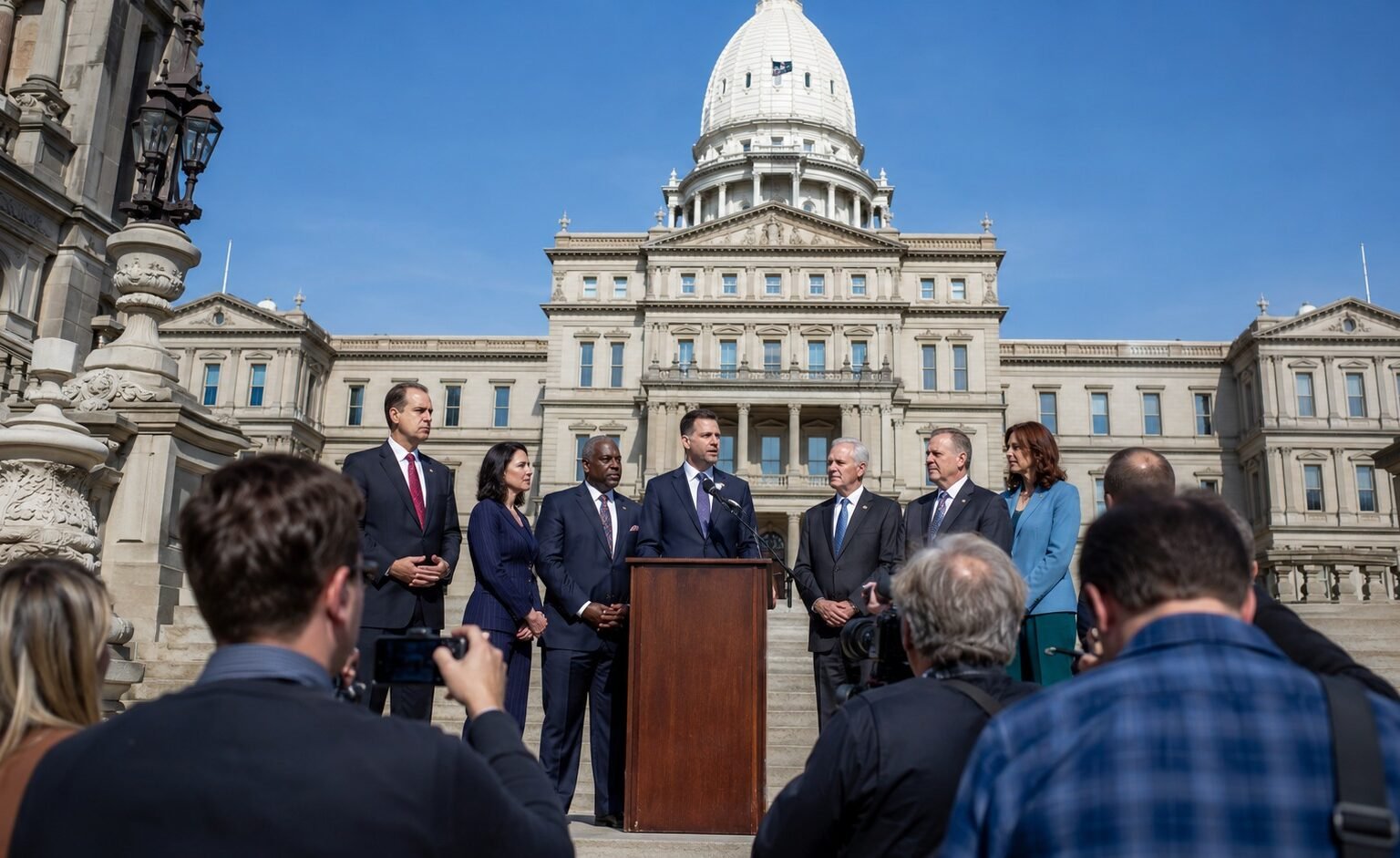
Two Michigan Democrats have introduced a package of bills that would bar business corporations, nonprofit corporations, and limited liability companies from spending a single dollar to support or oppose any candidate, political party, political committee, or ballot question in the state.
Rep. Betsy Coffia of Traverse City introduced House Bills 6216 through 6218 along with House Joint Resolution Z. Sen. Sean McCann of Kalamazoo introduced the companion measures in the upper chamber: Senate Bills 1085 through 1087 and Senate Joint Resolution L. The package was announced in early July 2026.
A different legal theory
What separates this effort from the long line of campaign finance proposals that came before it is the legal route it takes. It does not attempt to overturn Citizens United v. FEC, the 2010 Supreme Court decision that opened the door to unlimited independent corporate spending in American elections. Overturning that ruling would require either the Supreme Court reversing itself or an amendment to the U.S. Constitution. Neither is happening quickly.
Instead, the Michigan package goes around it. States charter corporations. When a state creates a corporate entity, it also defines what that entity is legally empowered to do. The Coffia-McCann package uses that authority to say, in plain terms, that spending money on elections is simply not among the powers a Michigan corporation possesses.
The approach is modeled on what reform advocates call the Montana Plan, sometimes referred to as the Transparent Election Initiative. The argument is that a corporation is a creature of state law, and a state that grants a power can decline to grant it in the first place. Under the Michigan proposal, the restriction would apply not only to companies chartered in Michigan but also to out-of-state corporations doing business within Michigan.
Michigan is not alone
At least 13 other states have seen versions of this legislation introduced, including California, Georgia, Iowa, Kansas, Maryland, Minnesota, Missouri, New York, Oklahoma, Rhode Island, Vermont, and Virginia. Hawaii has gone furthest, having already enacted its version into law.
There is also a parallel track in Michigan that does not depend on the Legislature at all. A citizen ballot initiative organized under the banner Michiganders for Money Out of Politics submitted petition signatures in May 2026, aiming to put the question directly to voters rather than waiting for lawmakers to act.
What has not happened
It is worth being precise about the current status of these bills, because the headline writes itself in a way the legislative calendar does not support. These measures have been introduced. That is all. They have not been passed by either chamber. They have not been voted on. They have not been signed by the governor. Corporate election spending remains legal in Michigan today, exactly as it was before the package was filed.
The path ahead is steep. Michigan’s House of Representatives is controlled by Republicans, who have generally opposed measures restricting independent political spending. A joint resolution, which is part of both the House and Senate packages, carries an even higher bar than an ordinary bill. Introduction is the beginning of a process, not the end of one.
Still, the significance of the filing is not nothing. For fifteen years, the standard response to Citizens United from reform advocates has been to call for a constitutional amendment, an effort that has gone essentially nowhere. This package represents a different bet: that the states, which manufacture corporations in the first place, retain a lever they have never fully pulled.
Whether that lever holds up in court is the question that will define the next phase. Corporate interests would almost certainly challenge such a law, and the litigation would test how far a state’s chartering power actually reaches. Hawaii’s enacted version may provide the first real answer. For now, Michigan has done the one thing that puts the theory on the table: it has put it in writing.