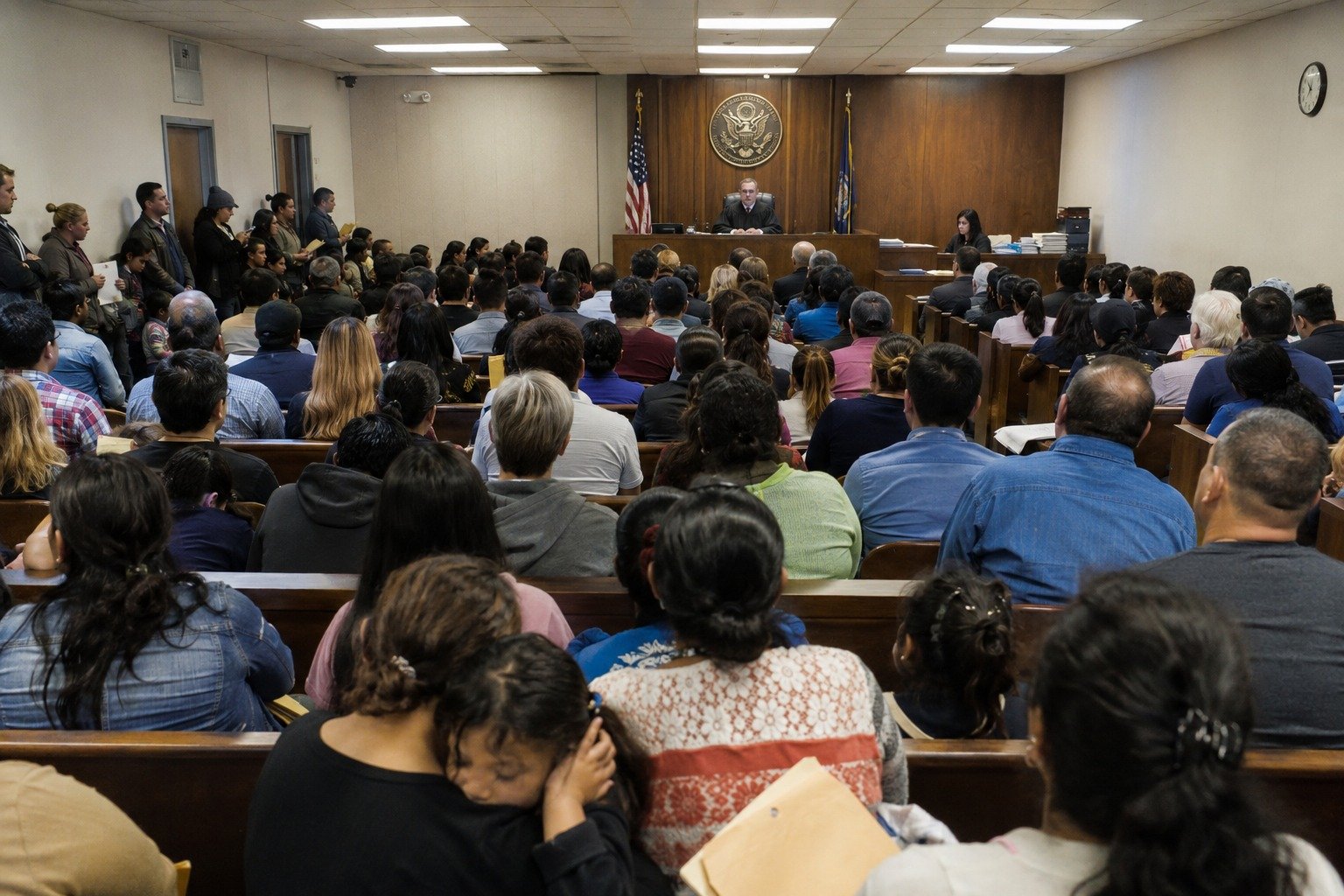
Immigration courts across the country have started scheduling more than 100 people in front of a single judge at the same time. The practice, known inside the system as a “mega master” hearing, began appearing around May 14, 2026 in courts run by the Justice Department’s Executive Office for Immigration Review. It has coincided with the highest number of removal orders ever recorded in a single month.
In June 2026, the Transactional Records Access Clearinghouse at Syracuse University counted 78,882 removal orders nationwide. That is up from roughly 33,000 in January 2025. More than 53,000 of June’s orders were issued in absentia, meaning the person was not in the room.
What a Mega Master Hearing Actually Is
A master calendar hearing is not a trial. It is a procedural check-in. The judge advises the person of their rights, takes pleadings on the Notice to Appear, and sets a date for the merits hearing where the actual case will be argued. A normal master calendar docket runs somewhere between 10 and 40 cases. A mega master roughly doubles that or more.
So the hearings themselves are not where people get deported. The removals come as a downstream effect. Under 8 U.S.C. § 1229a, an immigration judge can order someone removed in absentia if they fail to appear. Pack the docket, shorten the notice, and the number of people who miss their date climbs. So does the number of removal orders.
New York City immigration court was an early epicenter. The practice has since been reported in Boston and Chelmsford, Massachusetts, as well as Chicago, San Diego and New Orleans.
The Notice Window Collapsed
The scheduling change is dramatic. In Chicago, the median notice period for an immigration court date fell to 34 days in June 2026. One month earlier, in May, it was 229 days. Many people who had hearings docketed for 2027, 2028 or even 2029 saw those dates abruptly pulled forward.
Attorneys have described receiving only a few days of warning in some cases, and in others say they received no notice at all. Those are attorney accounts rather than agency data, but the aggregate numbers point the same direction. The share of people missing scheduled immigration hearings roughly doubled, from about 20% in January 2025 to about 40% nationally by June 2026.
A Record Month
June’s totals stand out. The more than 53,000 in absentia orders represented a 55% jump over May and the highest monthly figure on record going back to the late 1990s. Deportation was ordered in 87.1% of all completed cases that month. Hearings with at least 70 people scheduled and 45 days or less of notice alone produced 20,763 in absentia removal orders.
Representation collapsed alongside the notice window. Only 21.5% of immigrants had an attorney at the time their removal order was issued in June 2026.
One Judge, Two Very Different Days
A single San Diego judge illustrates the gap. On a regular master calendar day in June, that judge heard 27 cases and issued zero in absentia orders. On a mega master day the same week, the judge was scheduled for 90 cases and issued 51 in absentia removal orders.
What the Government Says
The Justice Department says EOIR is prioritizing timely case completion so that cases do not languish. In May 2026 the department announced it had sworn in 77 immigration judges plus five temporary immigration judges, which it called the largest class of new adjudicators in EOIR history. The push aligns with the administration’s stated goal of deporting roughly one million people per year.
Two structural facts are worth keeping in view. Immigration judges are Justice Department employees, not independent Article III judges. And separate reporting indicates that judges with the lowest removal rates have been fired.
What This Means for Americans
No statute created mega master hearings. No published regulation established them, and no final court ruling has struck them down. This is an administrative scheduling decision, made inside an executive agency, that is quietly reshaping who gets a meaningful day in court. It is also worth being precise about the numbers: these are removal orders, not completed deportations, and an in absentia order can be challenged through a motion to reopen, including for lack of proper notice or exceptional circumstances.
Still, the practical effect falls hardest on people least able to absorb it. A family that planned around a 2028 hearing date and gets 34 days notice instead may never learn the date changed. Without a lawyer, and without notice, the case can end before it is ever argued. Due process is not only about the ruling. It is about whether you were told when to show up.
Stay informed on the stories that matter most. Follow Your Daily Updates on Facebook and bookmark yourdailyupdates.news for breaking news and analysis.