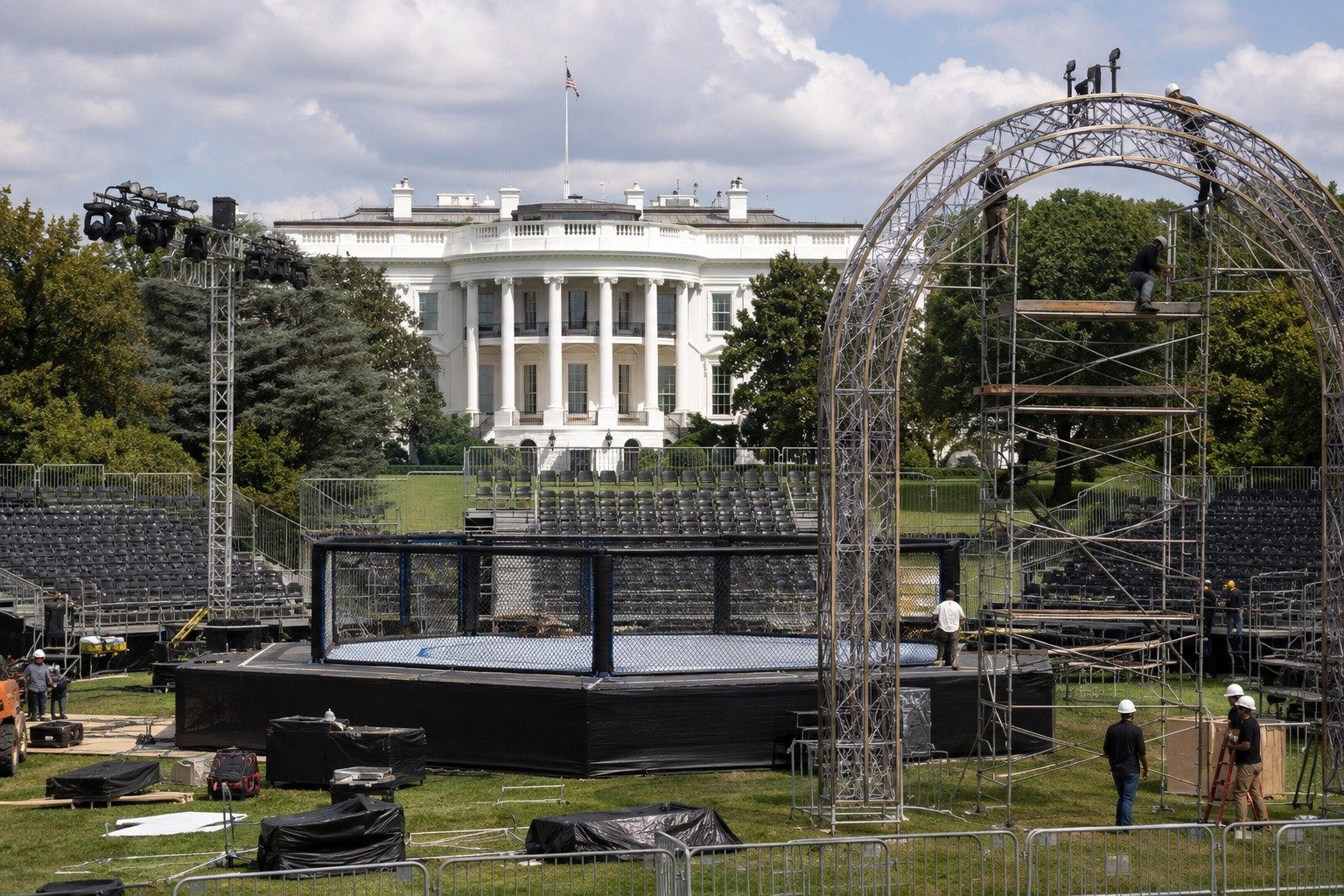
A federal lawsuit filed this week is trying to stop one of the most unusual events ever planned on government property: a live UFC cage fight on the White House South Lawn, scheduled for Donald Trump’s 80th birthday on June 14, 2026.
The suit, brought by the Public Integrity Project on behalf of a political activist and an Air Force veteran, asks a federal court to block the event, billed as “UFC Freedom 250,” before it takes place. At its core, the case raises a basic question that goes well beyond one birthday party: who actually controls the public land surrounding the people’s house, and what can it legally be used for?
What the Lawsuit Argues
The South Lawn of the White House is not private property. It is federal parkland, managed as part of the national park system, and that status comes with legal protections. The lawsuit contends that converting that ground into a venue for a ticketed mixed-martial-arts spectacle violates federal law governing how protected public land can be used.
The filing goes further than the event itself. It claims that construction already underway on the grounds, including a large arch being erected as part of the staging, was never authorized by Congress. Major changes to federal property of this kind typically require legislative sign-off, and the plaintiffs argue that step was skipped entirely.
The suit also points to a missing environmental review. Before crews begin building on protected federal land, an environmental assessment is normally required by law to weigh the impact of the work. According to the lawsuit, no such review was completed before construction began, an omission the plaintiffs say makes the entire project unlawful from the start.
The White House Response
The administration is not backing away from the plans. White House officials dismissed the lawsuit as “obstructionist, baseless, and dilatory,” language that signals they view the case as a delay tactic rather than a serious legal threat. The clear message is that the birthday event is moving forward as scheduled, court challenge or not.
That sets up a direct confrontation. On one side is an administration determined to stage a high-profile spectacle on the grounds of the White House. On the other are plaintiffs arguing that no president gets to treat federal parkland as a personal event space without following the laws that govern it.
An Important Distinction
It is worth being precise about where things stand. No judge has stopped anything. This is a lawsuit seeking to halt the fight, and the court has not yet ruled on it. The event remains on the calendar for June 14, and unless a court intervenes, the construction and the fight can proceed.
What the case does is force a public reckoning with questions that rarely get asked out loud. Can the South Lawn be handed over for a private celebration? Who decides whether protected federal land gets reshaped with new construction? And what happens to the legal guardrails, congressional authorization and environmental review, when an administration decides it would rather not wait for them?
Why It Matters for Americans
The White House grounds belong to the public, not to whoever happens to live there at any given moment. The rules requiring congressional authorization and environmental review exist precisely so that changes to shared national property are made in the open, with accountability, rather than by unilateral decision. When those steps are skipped, the people who lose their say are ordinary Americans, the actual owners of that land. This lawsuit is a test of whether those protections still hold when they become inconvenient.
Stay informed on the stories that matter most. Follow Your Daily Updates on Facebook and bookmark yourdailyupdates.news for breaking news and analysis.