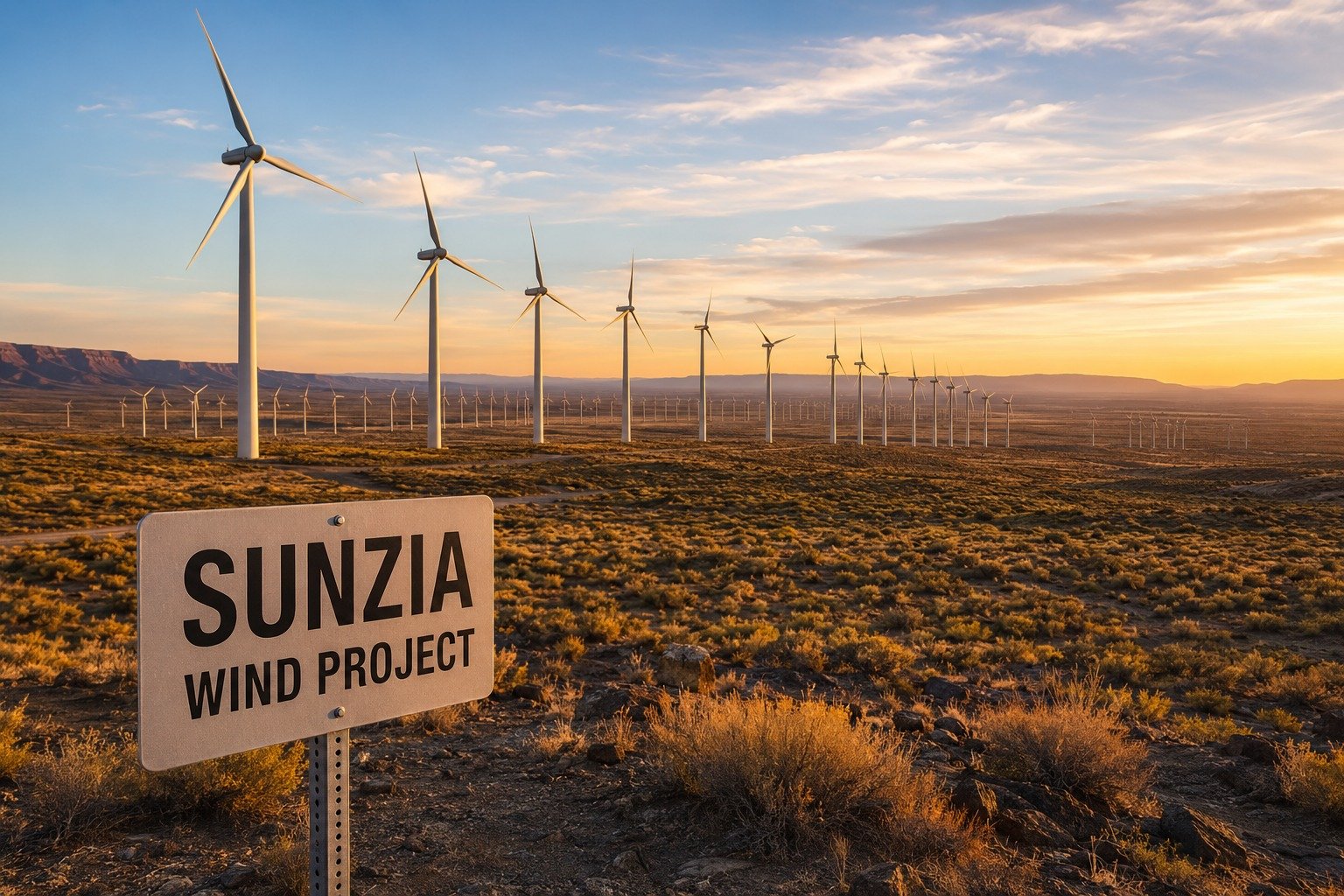
It is official: the largest wind farm in the United States is now spinning across the high desert of central New Mexico. The SunZia Wind Project, developed by Pattern Energy, has come online in June 2026 with roughly 3,650 megawatts of generating capacity – more than three times the size of the next-largest wind farm in the country. With more than 900 turbines now turning in the wind, the project is already producing enough electricity to power about one million homes.
The scale is hard to overstate. For years, the title of America’s biggest wind farm belonged to projects a fraction of this size. SunZia does not just edge past them; it eclipses them. Spread across thousands of acres of rolling sagebrush plains, the rows of white turbines stretch to the horizon, quietly converting the steady winds of the Southwest into clean, affordable power for families and businesses across the region.
Power That Travels Hundreds of Miles
Generating that much electricity is only half the challenge. Getting it to the people who need it is the other half. To move SunZia’s power to market, the project is paired with a new 550-mile high-voltage transmission line that carries electricity west from New Mexico into Arizona. That line is a critical piece of infrastructure, connecting one of the windiest corners of the country to fast-growing population centers that are hungry for reliable, low-cost energy.
Transmission has long been one of the biggest bottlenecks holding back clean energy in the United States. Plenty of regions have abundant wind and sunshine, but without the wires to carry that power to cities, much of it goes untapped. By building generation and transmission together, the SunZia project tackles both problems at once – a model that energy experts say will be essential if the country wants to keep expanding affordable clean power.
Thousands of Jobs and a Boost for the Southwest
Projects of this size are not just about megawatts. They are about paychecks. The construction of SunZia and its transmission line has supported thousands of good-paying jobs – electricians, ironworkers, equipment operators, engineers, and the many skilled tradespeople who put the turbines in the ground and the towers in the air. Once a wind farm is running, it also requires a long-term workforce of technicians and operations staff to keep the turbines maintained and producing for decades to come.
For rural New Mexico, that kind of investment can be transformative. Wind projects typically deliver steady lease payments to landowners and ranchers who host the turbines, along with new tax revenue that helps fund local schools, roads, and emergency services. In communities where economic opportunity has often been scarce, a project of this scale represents a meaningful and durable source of income.
What It Means for Clean Energy
SunZia coming online is a milestone for the broader push toward clean, affordable energy. Wind power produces no fuel costs and no smokestack pollution, and as more capacity like this is added to the grid, it helps hold down electricity prices and reduce dependence on volatile fossil fuel markets. Every gigawatt of wind that comes online is a gigawatt that does not have to be generated by burning coal or gas.
The achievement also sends a signal about what is possible. A decade ago, a single wind farm powering a million homes might have sounded like a stretch. Today it is a working reality in the New Mexico desert. As the country continues to modernize its grid and expand renewable generation, projects like SunZia show that large-scale clean energy is not a distant promise – it is being built right now, creating jobs and delivering power in the process.
For now, the turbines of SunZia will keep turning over the high desert at sunrise and sunset, a visible reminder that America’s energy future is taking shape – and that it is being built, in no small part, in the wind-swept Southwest.