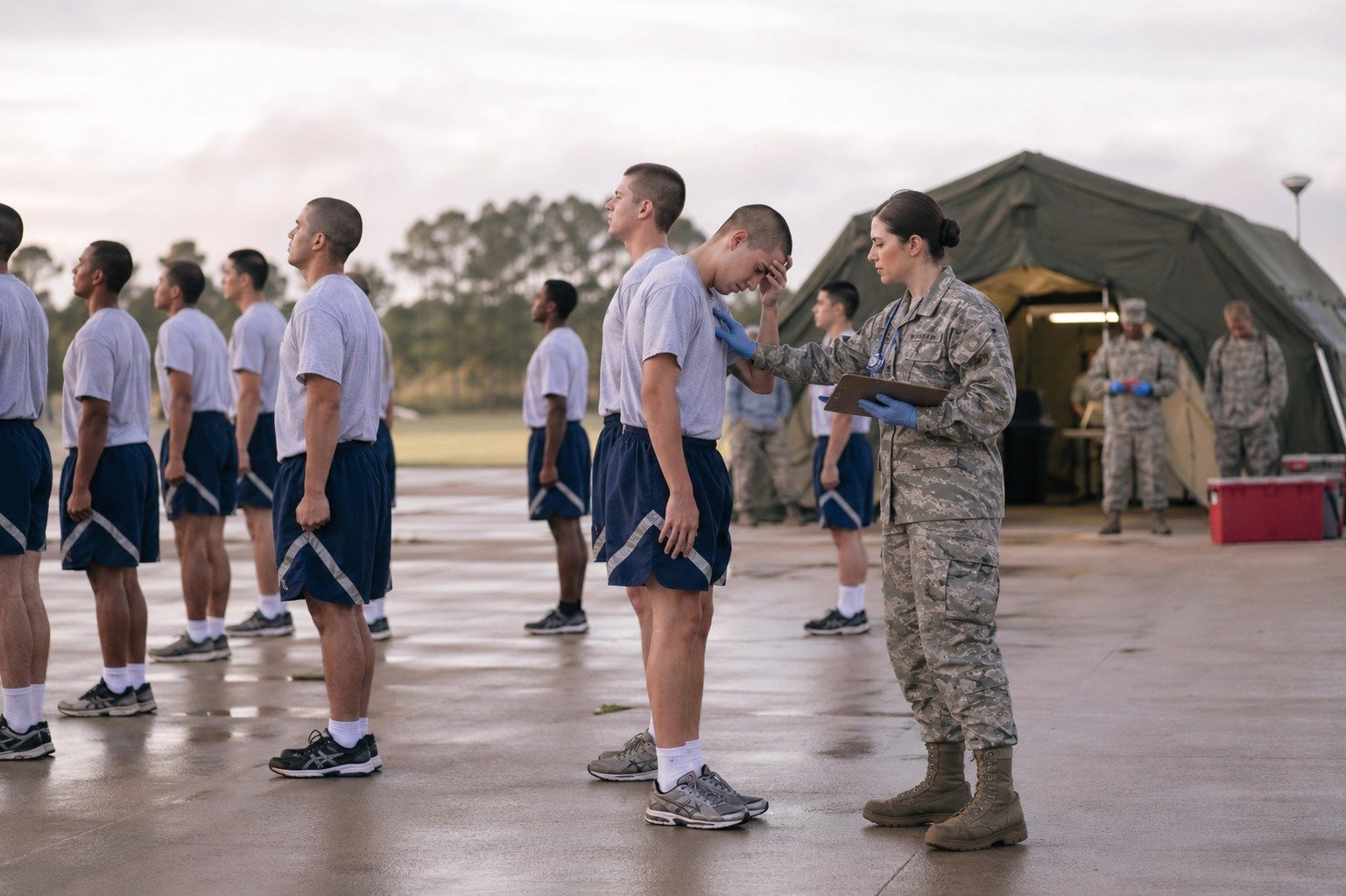
An influenza outbreak has swept through Air Force basic training at Joint Base San Antonio-Lackland in Texas, sickening at least 159 recruits and sending at least two to the hospital, military officials confirmed this week. The outbreak comes just two months after Defense Secretary Pete Hegseth made the annual flu vaccine optional for service members, a decision public health experts had warned could leave troops dangerously exposed.
According to reporting from ABC News, KSAT, and MSNBC, the recruit vaccination rate at Lackland has plummeted since the policy change took effect in April. Where nearly 100 percent of incoming trainees had previously received the flu shot under standing military requirements, that figure has now collapsed to roughly 40 percent. In the close quarters of basic training, where recruits live, eat, sleep, and drill shoulder to shoulder, that drop created exactly the conditions in which a respiratory virus can race through a population.
A Predictable Consequence
For decades, the U.S. military has treated vaccination not as a personal preference but as a readiness issue. Troops who fall ill cannot train, cannot deploy, and cannot perform the missions they signed up for. The annual flu shot was long considered one of the simplest, cheapest, and most effective tools for keeping units healthy and operational, particularly in training environments where thousands of young people from across the country are suddenly packed together.
That is why Hegseth’s April decision to strip away the mandate drew immediate concern from medical professionals. Making a proven vaccine optional, they argued, was not a neutral act of personal freedom but a gamble with the health of an entire force. When vaccination rates fall, the protective effect that shields even the unvaccinated begins to erode, and outbreaks become not just possible but likely.
The Lackland numbers appear to bear that warning out. An outbreak of 159 confirmed cases among recruits, with multiple hospitalizations, is not a minor seasonal sniffle. It is a significant strain on a training pipeline that the Air Force depends on to produce its next generation of airmen, and it raises pointed questions about whether the policy change traded long-standing readiness for a political statement.
Questions Officials Have Not Yet Answered
The outbreak has unfolded against a somber backdrop. A trainee at the base, identified as Keon McDaniel, died on June 16. Military officials have not confirmed that his death is connected to the flu outbreak, and no causal link has been established. Out of respect for the facts and for his family, the cause of his death should not be assumed or attributed to the outbreak absent an official determination.
Still, the timing has intensified scrutiny of the vaccine policy. Lawmakers and military families alike are asking why a long-standing safeguard was removed, who weighed the risks before the change, and what the Pentagon plans to do now that an outbreak has materialized at one of its largest training installations.
The broader concern is what happens next. Basic training never stops; new recruits arrive in waves, and if vaccination rates remain low, Lackland and other installations could see repeated outbreaks. Each one means lost training days, hospital costs, and young service members suffering through illness that, in many cases, a routine shot could have prevented or blunted.
For now, the Air Force has not announced whether it will reinstate the requirement at its training bases. What is clear is that a policy sold as expanding individual choice has produced a measurable public health cost, borne by some of the youngest and newest members of the armed forces. Whether that cost prompts a reversal, or simply becomes the new normal, may depend on how loudly the public and Congress demand answers.