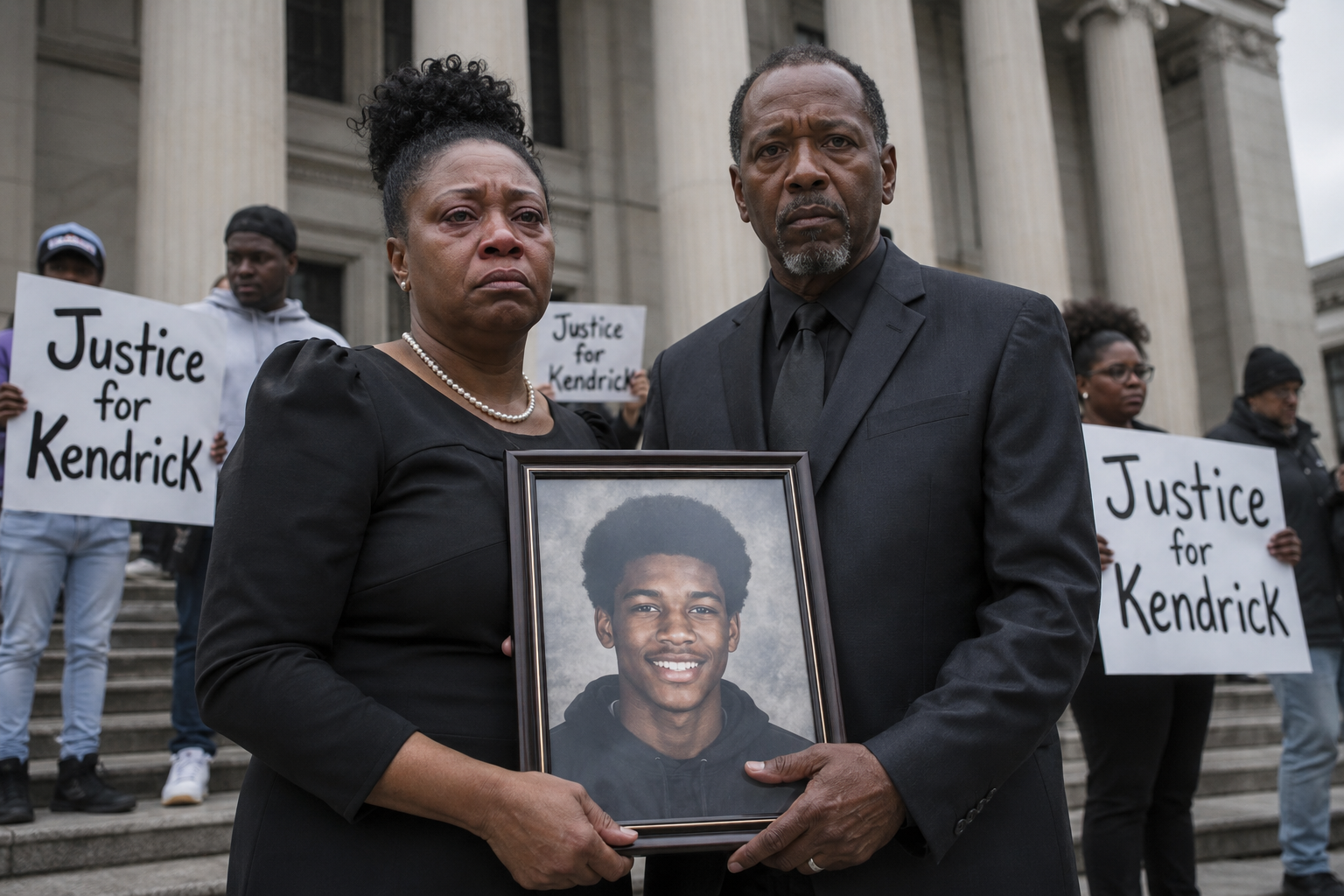
It has been thirteen years since 17-year-old Kendrick Johnson was found dead inside a rolled-up wrestling mat at Lowndes High School in Valdosta, Georgia. Authorities ruled it an accident — they said Kendrick had reached into the mat for a sneaker and suffocated. His parents, Kenneth and Jacquelyn Johnson, never believed it. They still don’t.
What they believe — and what they have spent more than a decade fighting to prove through courts, protests, congressional inquiries, and relentless public pressure — is that Kendrick did not die alone in that gym. They believe he was killed. And they believe the truth has been buried, not just by local authorities, but now allegedly, by the federal judiciary itself.
A $10 Billion Lawsuit — Targeting the Judges
Within 24 hours of a federal court dismissing their previous $1 billion civil rights lawsuit, the Johnson family didn’t retreat. They escalated. A brand-new $10 billion complaint was filed immediately — and this time, the targets are not just the people suspected of covering up Kendrick’s death. This time, the Johnsons are suing the federal judges who dismissed their case.
Chief Judge Leigh Martin May of the Northern District of Georgia and Judge Sarah Elisabeth Geraghty are specifically named in the complaint. The family alleges both judges issued “materially false, fraudulent, and felonious” rulings that were designed to end the case before it could ever reach a jury. They are not accusing the courts of mere error. They are accusing the courts of being part of the same cover-up they have been fighting to expose for over a decade.
The Case That Would Not Die
The Kendrick Johnson case has been one of the most contested and emotionally charged legal battles in recent American memory. From the start, the family faced resistance at every level. The original coroner’s ruling of accidental death came under immediate scrutiny after an independent autopsy commissioned by the family concluded Kendrick had died from blunt force trauma to the neck — not positional asphyxia.
The FBI investigated. The U.S. Attorney’s office reviewed the case. A second autopsy was ordered. Media coverage intensified. Congressional representatives demanded answers. And then, one by one, courts declined to let the family’s lawsuits proceed.
Then, in February 2025, something remarkable happened. The Eleventh Circuit Court of Appeals reversed one of the earlier dismissals, ruling that at least one of the Johnson family’s claims could move forward. It was one of the only meaningful legal victories in more than a decade — a narrow opening after years of sealed doors. That opening was closed again when the district court dismissed the remaining claims. The $10 billion lawsuit was filed the next day.
Targeting the Bench Itself
Suing a sitting federal judge is extraordinarily rare — and extraordinarily difficult. Federal judges enjoy broad judicial immunity for their official decisions. Courts have consistently held that even deeply incorrect or unjust rulings do not expose judges to personal liability. But the Johnsons’ complaint does not allege that the judges simply got it wrong. It alleges the decisions were criminal — “materially false, fraudulent, and felonious” acts committed to obstruct justice and protect those responsible for Kendrick’s death.
Whether that framing is sufficient to pierce judicial immunity is a legal question that will now wind through the courts. Legal experts have noted the difficulty of such a claim, but the family is not litigating for easy wins. They are litigating to keep the story alive and on record.
The Reward That Has Never Been Claimed
For years, the Johnson family has kept a $500,000 reward posted for anyone with information about what really happened to Kendrick on January 10, 2013. To date, it has gone unclaimed.
That detail speaks to one of two possibilities: either no one with knowledge has come forward, or those who know are protected, afraid, or both. The family believes it’s the latter — and their new lawsuit argues that the federal courts have been complicit in keeping those individuals shielded from accountability.
What Comes Next
The $10 billion lawsuit will now be tested in court, where it will almost certainly face aggressive challenges based on judicial immunity and procedural grounds. But the Johnsons have faced those challenges before, and they have kept going.
Their case has drawn the attention of civil rights advocates, legal scholars, and millions of Americans who have followed the story of Kendrick Johnson since it first captured national attention years ago. Whatever one believes about the underlying facts, one reality is undeniable: his family has not stopped. They filed a new lawsuit less than 24 hours after the old one was dismissed. They have posted a half-million-dollar reward for over a decade.
Thirteen years. A $10 billion complaint. A $500,000 reward still on the table.
The Johnsons are still fighting.