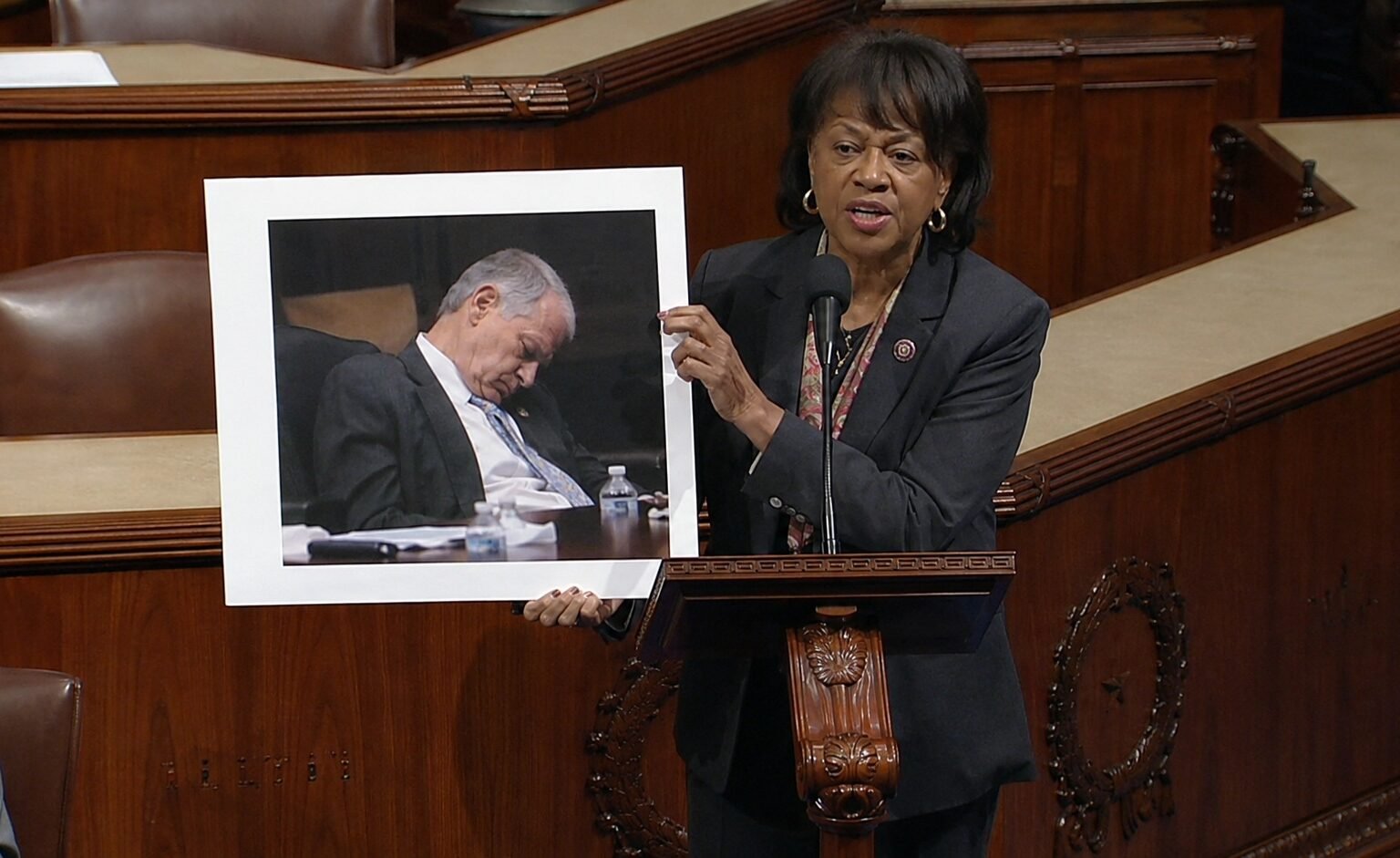
It is not every day a member of Congress brings a poster board to the House floor. But on June 10, 2026, Rep. Sydney Kamlager-Dove of California did exactly that — holding up an enlarged photograph of President Donald Trump appearing to nod off at a meeting and telling her colleagues that the president’s “sleeping habits” amounted to a “grave national security threat.”
It was a striking piece of political theater, and it traveled fast. Within hours the moment was circulating on social media, replayed and reframed across the political spectrum. What gave it staying power was not just the image of a lawmaker brandishing a photo on the floor of the House — it was that the photo tapped directly into a conversation already well underway online.
The Backdrop: Viral Clips of a Dozing President
For weeks, clips of Trump appearing to doze during Cabinet meetings have been racking up millions of views. Each new video has fed a running talking point among the president’s critics: that the commander in chief, the person ultimately responsible for responding to a crisis at any hour, is not always visibly alert in the room.
That chatter had largely lived on phones and feeds. Kamlager-Dove’s contribution was to lift it off social media and drop it into the Congressional Record, the official, permanent account of what is said on the House floor. By doing so, she transformed a viral meme into a formal point of political argument — framing it not as a punchline but as a question about whether the person at the top is sharp enough for the demands of the job.
What Actually Happened on the Floor
The substance of the moment was a single floor speech delivered by one member. Kamlager-Dove stood at the lectern, raised the enlarged image, and delivered her line about the president’s sleeping habits being a grave national security threat. The quote was pointed and deliberate, the kind of phrasing built to be clipped and shared.
It is worth being precise about what this was and what it was not. This was a rhetorical, political statement from a single lawmaker — not a formal resolution, not an official finding, and not the opening of any investigation. No committee endorsed it. No vote was taken. It was the sort of speech members deliver to draw attention to a concern and force it into the news cycle. On that narrow measure, it plainly succeeded.
The Pushback
The White House pushed back hard. It dismissed the characterization outright, insisting that the president is sharp, engaged, and fully in command of his duties. Allies of the president framed the speech as a cheap shot — a stunt designed for clicks rather than a serious commentary on his fitness.
The president’s critics saw it differently. To them, Kamlager-Dove had simply said out loud, on the record, what a great many people have been quietly wondering as those Cabinet-meeting clips spread. In that reading, the speech was less theater than overdue candor — a member of Congress willing to put a politically uncomfortable question on the permanent record.
What This Means for Americans
Questions about a president’s stamina and alertness are not new, and they are not trivial. The presidency is a job without an off switch, and the public has a legitimate interest in whether the person holding it is up to its demands. At the same time, a viral clip is not a medical assessment, and a floor speech is not a finding of fact. Both things can be true: the concern is real and worth airing, and a single dramatic speech does not resolve it.
What the moment really illustrates is how quickly online culture now shapes the formal business of Washington. A clip becomes a meme, the meme becomes a talking point, and the talking point ends up enlarged on a poster board in the people’s chamber. Whether you see Kamlager-Dove’s speech as a fair accountability question or as political theater probably depends on where you already stand — but the image of it is the kind of thing that keeps traveling.
Stay informed on the stories that matter most. Follow Your Daily Updates on Facebook and bookmark yourdailyupdates.news for breaking news and analysis.