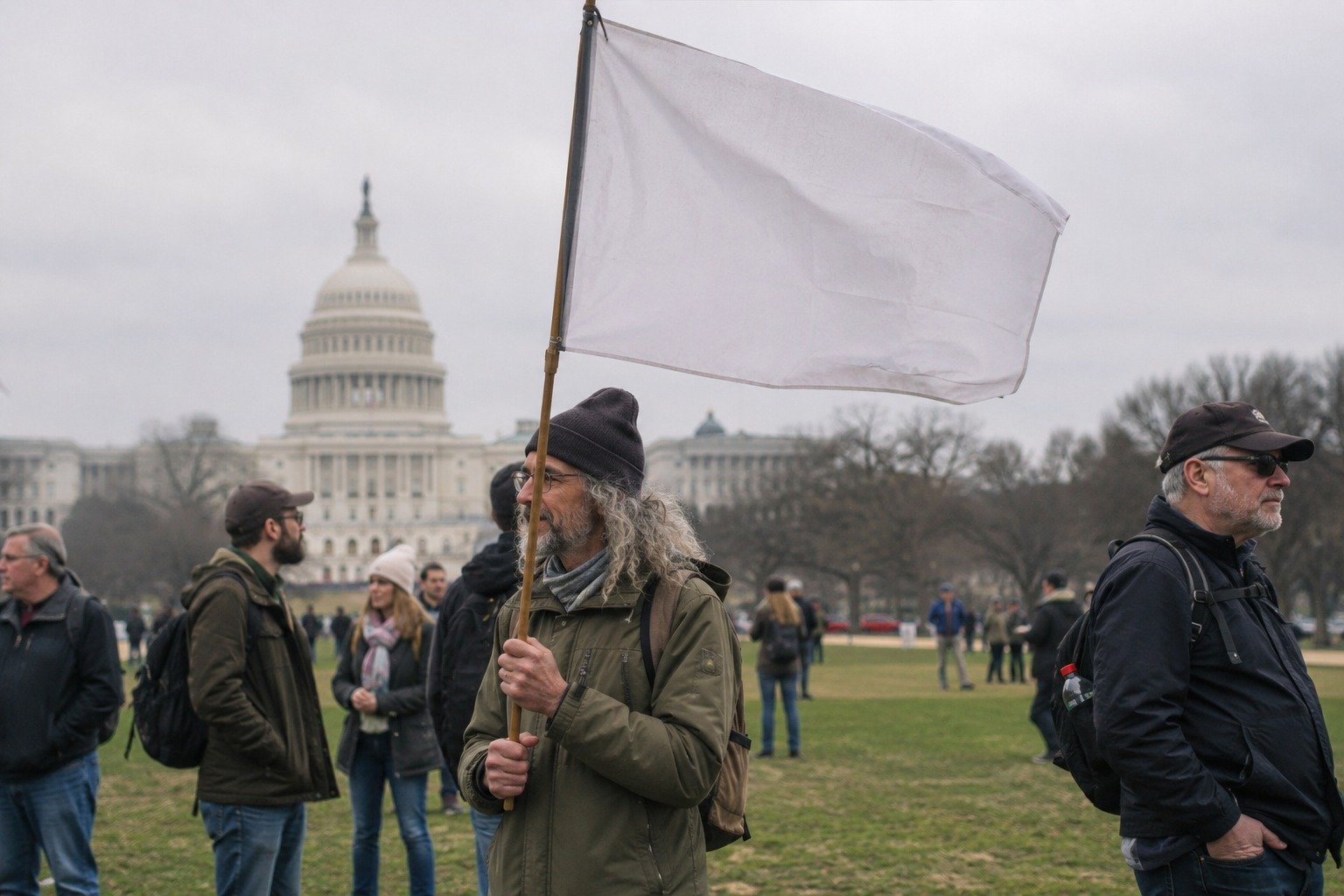
A federal judge has barred the U.S. government from forcing a protest group to take down a flag reading “86 47” near the National Mall in Washington, D.C., ruling that the message is protected political speech rather than a threat against President Donald Trump, the nation’s 47th president.
U.S. District Judge Randolph Moss of the District of Columbia issued a temporary restraining order this week blocking the National Park Service from removing the flag. The order keeps the display in place for at least 14 days while the broader legal dispute moves forward in court.
How the Standoff Started
The flag belongs to Accountability Now USA, a group that has maintained a permitted, round-the-clock demonstration near the U.S. Capitol for roughly six months. The group obtained a permit, raised the “86 47” flag in one of the most visible locations in the country, and then sued when the National Park Service threatened to revoke that permit over the display.
The government argued the number combination could be read as a call to harm the president. The protesters countered that the phrase is political shorthand criticizing the administration, and that pulling their permit over it would amount to silencing core political expression. Judge Moss agreed that the government had not met the high bar required to treat the message as a genuine threat.
What “86” Actually Means
Much of the 21-page opinion turned on the meaning of a single number. Citing Merriam-Webster, Moss noted that “86” is slang dating back to 1930s soda-counter culture, meaning to throw out, to get rid of, or to refuse service to someone. He pointed out that the interpretation of “86” as “to kill” is a sparse, recent extension that the dictionary does not even formally endorse, given how rarely it is used that way.
Because the term is so ambiguous, the judge concluded, it cannot reasonably be treated as a “true threat” — the narrow legal category of speech that falls outside First Amendment protection. The number “47” refers to Trump as the 47th president, making the overall message a statement of political opposition rather than an articulable threat of violence.
The Judge’s Reasoning
In his memorandum opinion, Moss wrote that the government “seeks to squelch core political speech without any articulable – much less evidentiary – basis for concluding that the speech actually threatens the life or safety of the President.” In other words, officials offered no concrete evidence that the flag endangered anyone.
The order specifically restrains Interior Secretary Doug Burgum and Kevin Griess, the superintendent of the National Mall and Memorial Parks, from taking enforcement action against the group because of the display. That protection lasts for 14 days while litigation continues, after which the court may revisit the question or extend its order.
Reactions and What Comes Next
Supporters of the ruling have called it a clear First Amendment victory, arguing that the government should not be able to shut down a protest simply because officials dislike the message. Free-speech advocates note that the bar for stripping speech of constitutional protection is intentionally high, and that ambiguity should be resolved in favor of expression.
Critics see it differently. They argue that, given the real threats public figures face, a number sequence widely read as targeting a sitting president is provocative and crosses a line, regardless of its dictionary origins. That tension – between robust political protest and concern for public safety – is now at the heart of the case.
What This Means for Americans
The decision is a reminder of how broadly the First Amendment protects political speech, even speech that many find offensive or alarming. For ordinary Americans, it reinforces that the government generally cannot silence a protest based on the discomfort a message causes – it has to show real, evidence-based danger. The outcome of the full case could help define where the line sits between protected dissent and a genuine threat for years to come.
Stay informed on the stories that matter most. Follow Your Daily Updates on Facebook and bookmark yourdailyupdates.news for breaking news and analysis.