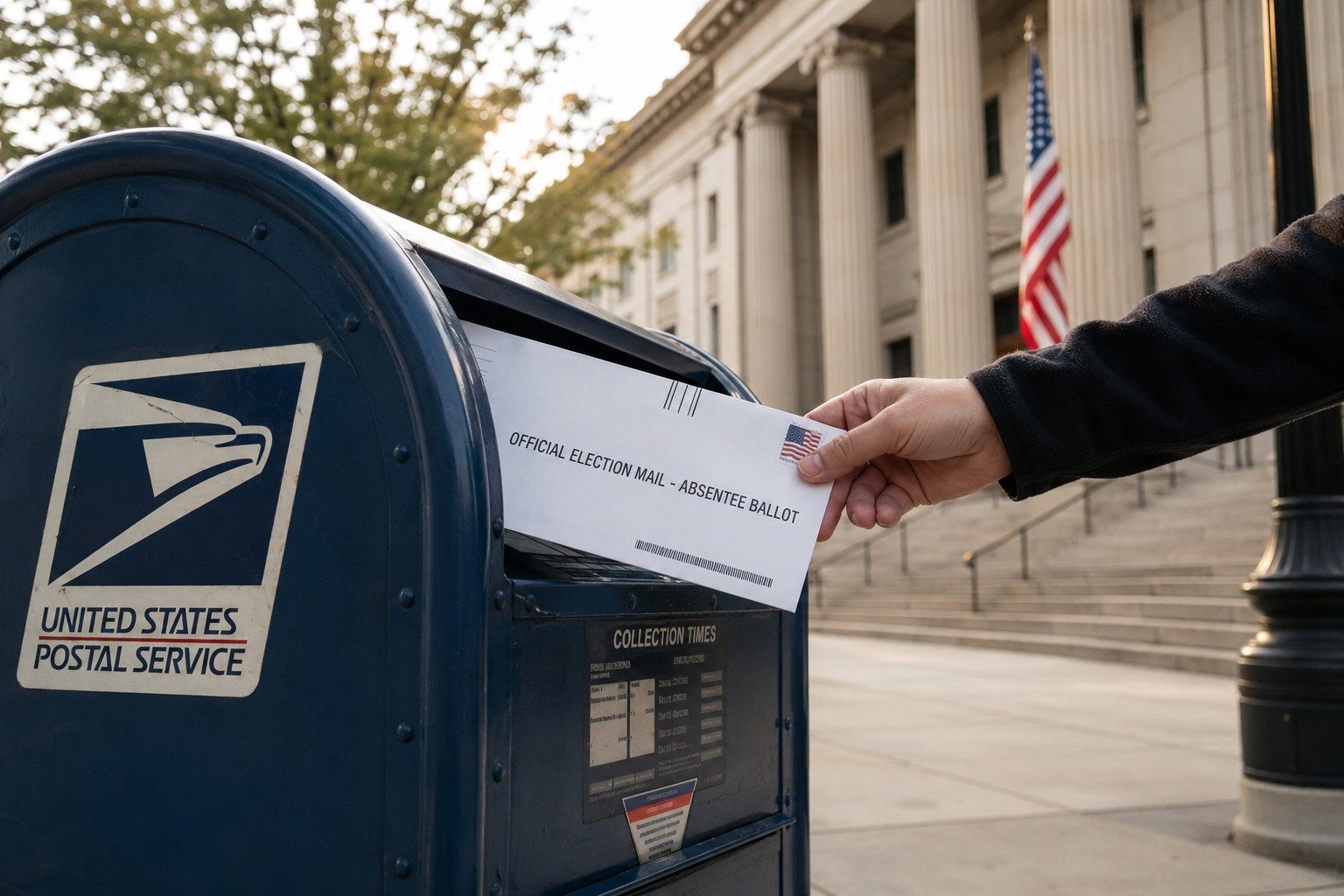
Voting rights advocates scored another courtroom victory this week as a federal judge blocked the U.S. Postal Service from carrying out proposed restrictions on the delivery of mail-in ballots. The rules grew out of President Donald Trump’s March 2026 executive order on elections, and the ruling marks the second court defeat in two weeks for the administration’s broader effort to limit voting by mail ahead of the November 3 midterm elections.
In the Boston case, U.S. District Judge Indira Talwani ruled that the president does not possess sweeping authority over how the nation’s elections are conducted. In a detailed opinion, she wrote that the Constitution assigns the power to set the rules for federal elections to state legislatures and to Congress, not to the executive branch. The directive at issue would have allowed the Postal Service to refuse delivery of absentee ballots to voters who did not appear on federally compiled lists.
A separate ruling out of Washington, D.C., reached a similar conclusion on different legal grounds, underscoring just how much trouble the administration’s mail-voting push has run into across the federal judiciary. Together, the decisions send a clear signal that courts are skeptical of attempts to reshape election administration by executive fiat.
What the order would have done
The executive order sought to create federal lists of eligible voters and to direct the Postal Service to deliver mail ballots only to people whose names appeared on those lists. The order also instructed the Department of Homeland Security to compile rosters of each state’s voting-age citizens ahead of the election. Critics warned that layering federal gatekeeping on top of state-run elections would have introduced confusion, delay, and the real risk that lawful ballots would never reach the voters who requested them.
The Boston ruling halts the Postal Service from implementing the plan in the roughly two dozen Democratic-led states and the District of Columbia that challenged it in court. For those jurisdictions, the order that DHS assemble citizen lists is also blocked. The practical effect is that, for now, election officials in the states that sued can continue to run their mail-voting systems the way they have for years.
Why mail voting matters
Millions of Americans rely on mail voting to cast their ballots. Seniors, rural residents who live far from polling places, military families stationed away from home, and people with disabilities all depend on the ability to vote by mail safely and on time. Supporters of the court rulings argue that blocking mail delivery would have amounted to disenfranchisement by paperwork, cutting off a method of voting that has been used reliably in states across the political spectrum.
Defenders of the executive order have argued that the measures were intended to strengthen the integrity of the vote. But election experts have repeatedly found that mail voting is secure, and courts have now twice concluded that the specific approach taken here exceeds the president’s constitutional authority over elections.
What comes next
The administration is widely expected to appeal, so the legal fight is far from over. Higher courts could weigh in before November, and the outcome may shape how ballots are handled in states that did not join the original lawsuits. For the moment, however, the judiciary has drawn a firm line: the Postal Service cannot be turned into an instrument for deciding whose ballot counts.
With the midterms approaching, the rulings offer a measure of certainty to voters and election administrators who feared last-minute disruption. The message from the courts is that the rules governing how Americans vote are not the president’s alone to rewrite.