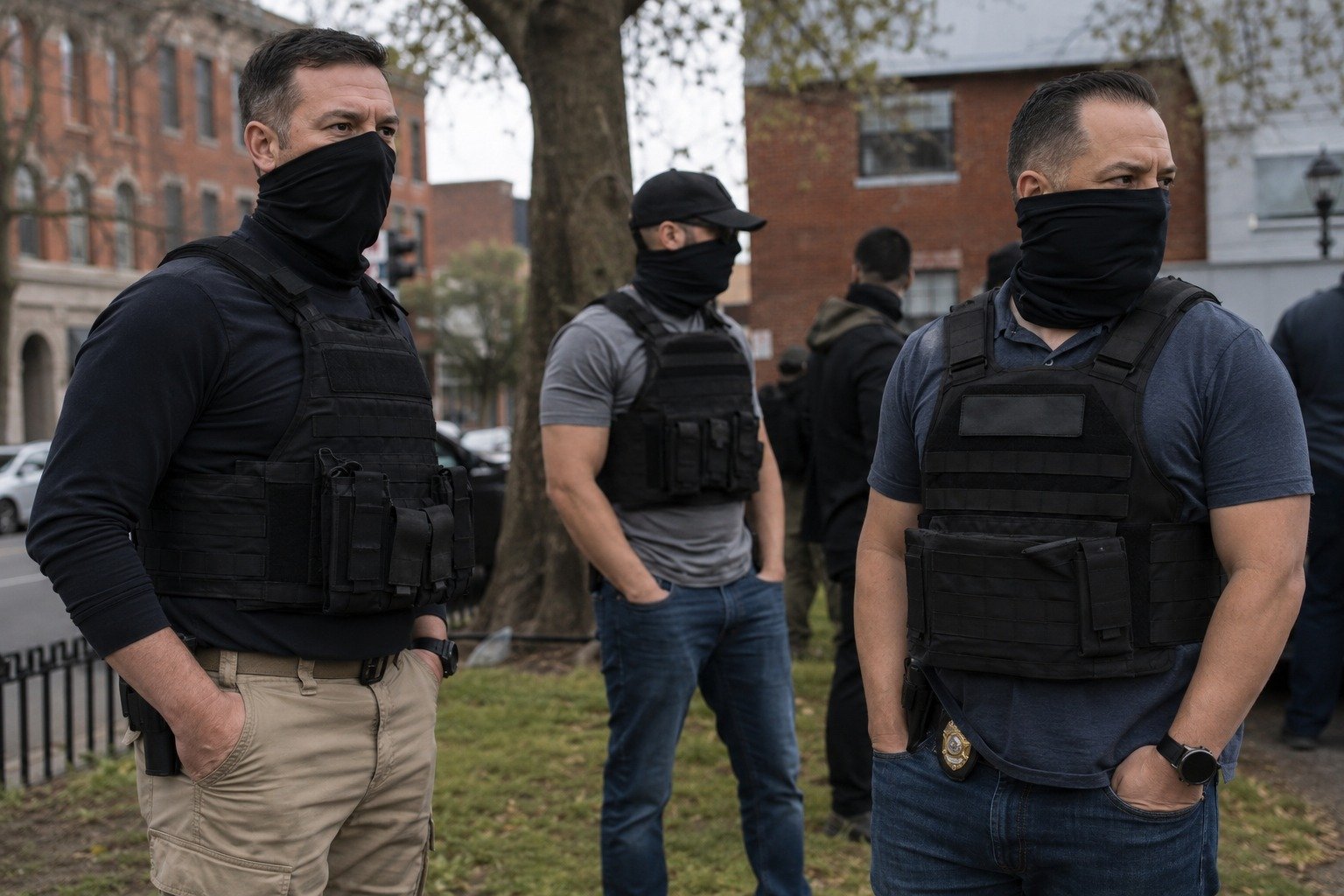
A federal judge has temporarily blocked part of a New York law that barred on-duty law enforcement officers – including federal agents – from covering their faces on the job, an early win for the Trump administration in a widening fight over whether states can force immigration agents to reveal who they are.
U.S. District Judge Mae D’Agostino, of the Northern District of New York, issued a preliminary injunction on Monday, August 3, halting enforcement of the mask provisions New York enacted in May. She concluded the state likely cannot dictate how federal officers carry out their duties, ruling that the measure probably violates the Supremacy Clause of the U.S. Constitution because it directly regulates agents of the federal government.
What the law actually says
New York’s statute was written to apply to on-duty law enforcement officers generally, not to ICE alone. The mask and identification provisions, adopted this past spring, require officers to keep their faces visible while working and to make themselves identifiable to the public. But the litigation that produced Monday’s ruling centered on masked federal immigration agents – the anonymous, face-covered officers who have become a flashpoint of the administration’s deportation campaign.
Supporters of the New York measure argue that officers who conceal their identities while stopping, questioning, and detaining people should still be identifiable and accountable for how they treat the public. Civil-liberties advocates have warned that masked, unmarked agents make it harder for residents to know whether the people confronting them are genuine law enforcement at all. The federal government counters that masking shields officers and their families from doxxing, harassment, and threats that have escalated alongside high-profile enforcement operations.
A preliminary ruling, not the final word
It is worth being precise about what Monday’s decision does and does not do. A preliminary injunction is not a final judgment. It reflects the judge’s early assessment that the challengers are likely to succeed and that enforcing the law in the meantime would cause harm – but the case continues, and a full ruling on the merits could still land in either direction. Higher courts may also weigh in before the dispute is resolved.
The order was also narrow. Judge D’Agostino enjoined only the mask and identification requirement as applied to federal officers. A separate part of the New York law – a provision limiting cooperation agreements between ICE and local police under the federal 287(g) program – was left standing. That means New York’s effort to restrict how deeply local departments can partner with immigration enforcement remains in effect for now, even as the mask rule is paused.
The Supremacy Clause question
At the heart of the ruling is a long-running constitutional principle: under the Supremacy Clause, states generally cannot regulate the federal government or its agents as they perform official duties. Courts have repeatedly held that a state cannot impose its own operational rules on federal officers. By writing a mask ban broad enough to reach on-duty federal agents, New York ran into that doctrine – and the judge found the state’s justification, however sympathetic, was unlikely to overcome it.
Legal scholars note the tension the case exposes. States and cities have limited tools to demand transparency from federal enforcement operating within their borders, precisely because those officers answer to Washington rather than to local law. That leaves questions of accountability – who an agent is, which agency they serve, and how to file a complaint – largely in federal hands.
What happens next
For now, the practical effect is straightforward: federal agents operating in New York can keep their faces covered while the litigation plays out. State officials can continue to defend the law and may appeal, and the broader constitutional questions will be argued more fully as the case proceeds.
The dispute keeps alive a national debate that reaches well beyond New York: whether the public has a right to know who is carrying out enforcement in their communities, or whether that demand for transparency must yield to the federal government’s authority over its own officers. Similar clashes are likely to surface in other states weighing how far they can go to require that the people wielding government power in their neighborhoods are willing to show their faces.