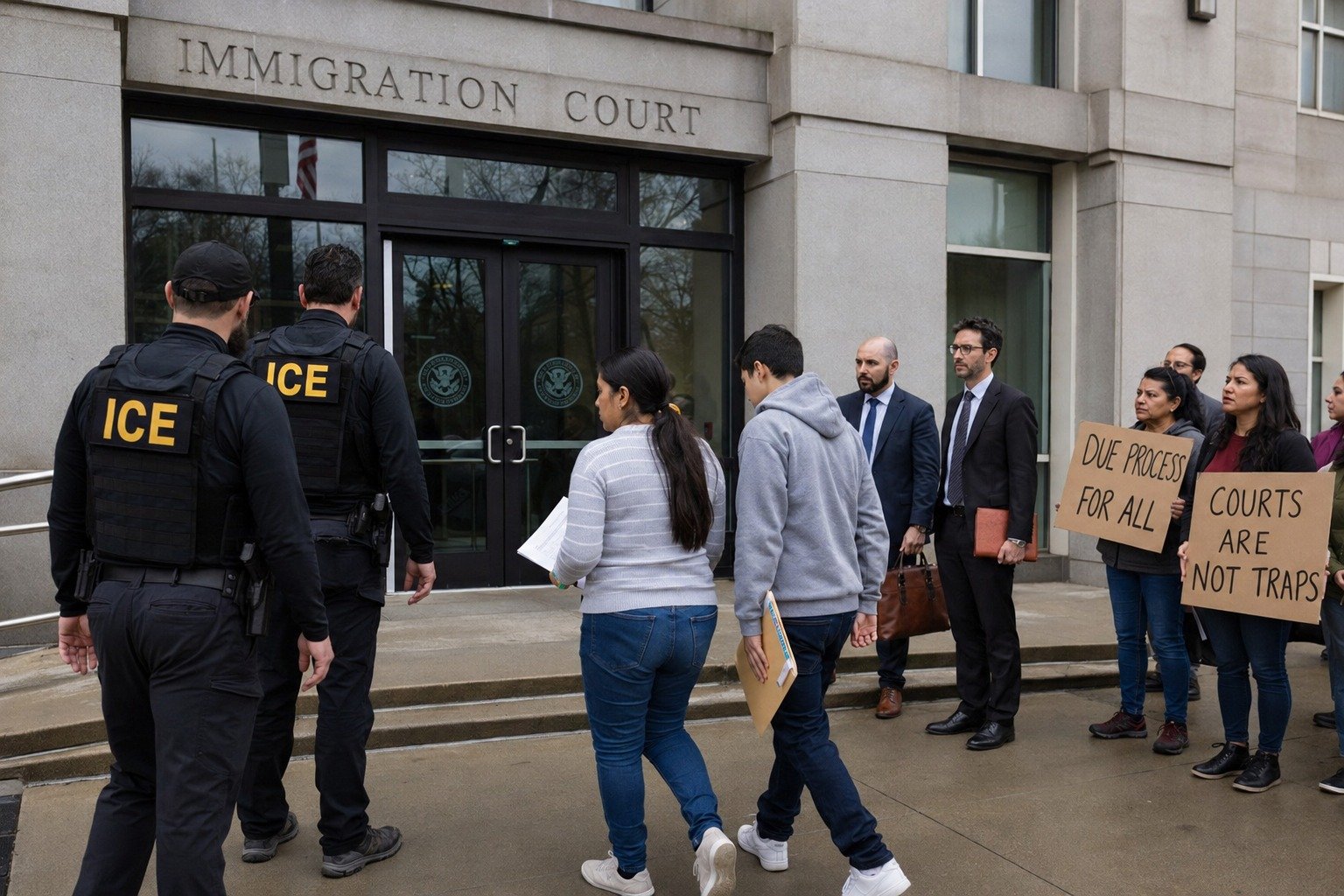
A federal judge has halted one of the Trump administration’s most aggressive immigration enforcement tactics, ruling that ICE cannot arrest people at the nation’s immigration courthouses. On June 23, 2026, U.S. District Judge P. Casey Pitts of the Northern District of California issued a nationwide order blocking the policy, finding it “arbitrary and capricious” and a violation of federal law.
In a sweeping 71-page opinion, Pitts concluded that the administration never properly justified turning the country’s immigration courts into arrest zones. The decision restores protections that had been in place under earlier guidance and delivers a significant setback to the administration’s broader push to ramp up deportations.
Why Courthouse Arrests Became a Flashpoint
Immigration courts are where people are told to show up if they want to follow the legal process. They attend hearings, present asylum claims, and respond to the government’s case against them. For years, federal guidance discouraged civil immigration arrests at or around these courthouses, on the theory that people should be able to attend their own hearings without fear of being detained on the way out.
That changed when the administration began making arrests directly at immigration courts, allowing agents to detain individuals the moment they stepped out of a hearing. Critics argued the practice punished the very people trying to do things the right way and discouraged immigrants from showing up at all, undermining the court system itself.
What the Judge Found
Judge Pitts ruled that the policy violated the Administrative Procedure Act, the federal law requiring agencies to give a reasoned explanation for major changes. He wrote that the government’s approach was “devoid of rational explanation” and rested on a “false premise” — namely, the administration’s claim that it had properly rescinded older guidance limiting arrests at immigration courthouses.
The ruling did more than stop the arrests. It also struck down ICE’s move to waive a prior 12-hour limit on how long people could be held in short-term detention facilities. Both protections — the limits on courthouse arrests and the 12-hour detention cap — are now restored nationwide. In effect, the court ordered the agencies back to the rules that were in place before the policy shift.
The Case Behind the Ruling
The lawsuit traces back to an asylum seeker who was arrested while leaving a routine hearing at the San Francisco immigration court. Additional plaintiffs were later added, all challenging the new practice of detaining people at the courthouse and the elimination of the detention time limit.
The case is not happening in isolation. Similar lawsuits challenging courthouse arrests have been filed in other parts of the country, including Baltimore, Chicago, Minnesota, and New York. The California ruling, because it applies nationwide, lands as the most consequential decision so far.
What This Means for Americans
At its core, this fight is about due process — whether people can participate in the legal system without being detained for doing so. When immigrants are afraid to attend their own hearings, cases stall, the courts grow more clogged, and the rule of law takes a hit. The decision reasserts a basic principle: agencies have to explain themselves and follow the law, even when carrying out enforcement priorities.
The administration could appeal the ruling or attempt to reissue the policy with a fuller justification. For now, the nationwide block stands, and the question is whether the government changes course or fights to revive the practice.
Stay informed on the stories that matter most. Follow Your Daily Updates on Facebook and bookmark yourdailyupdates.news for breaking news and analysis.