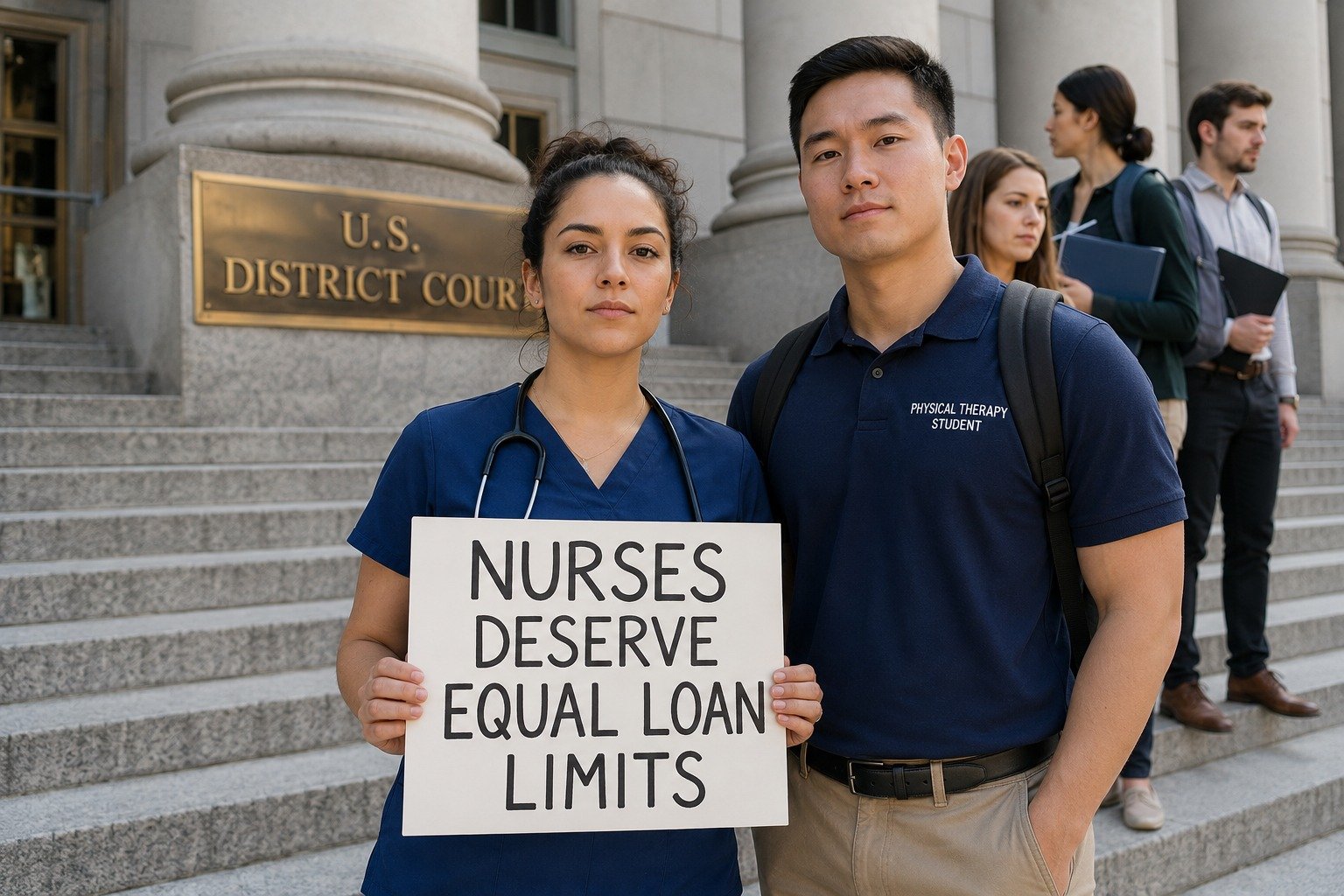
A federal judge has blocked part of a Trump administration rule that would have sharply limited the federal student loans available to people training to become nurses, physical therapists, and public health professionals, handing a significant victory to students who say the policy treated their careers as second class.
U.S. District Judge Beryl Howell issued the order in Washington, D.C., on June 25, 2026, finding that the U.S. Department of Education exceeded the authority Congress had granted it. The rule, which was set to take effect in July, would have reshaped how graduate students access federal loans by drawing a sharp line between programs labeled “professional” and those labeled simply “graduate.”
A $100,000 line in the sand
At the heart of the dispute is a cap. Under the rule, programs designated as “graduate” would have faced a federal borrowing limit of roughly $100,000, while degrees classified as “professional” would have retained access to about $200,000. The department’s definition limited the professional-degree category to a short list of fields, including law, medicine, dentistry, and theology.
Nursing, physical therapy, and public health were not on that list. That meant students pursuing advanced degrees in those fields would have been held to the lower cap, even though their programs often carry tuition costs comparable to the degrees that kept the higher limit. Critics argued the distinction was arbitrary and that it singled out fields dominated by hands-on patient care for harsher treatment.
The judge’s reasoning
Judge Howell took issue with how the Education Department had crafted its definition, finding that the agency had added “more stringent requirements” that Congress never authorized. In her view, the department did not have the power to redraw those categories in a way that locked entire professions out of the higher loan limits.
She also warned of the real-world consequences. A loss of opportunities for prospective students, she wrote, would be detrimental to the public, particularly in underserved communities that may face a shortage of healthcare and other critical professional services. The country is already grappling with shortages of nurses and other frontline care providers, and the ruling framed the loan caps as a policy that could deepen those gaps.
What it means for students right now
For students staring down summer and fall tuition bills, the practical effect is immediate. The higher federal loan limits remain in place for graduate nursing, physical therapy, and similar programs while the case continues. The order blocks the department from enforcing its narrower definition for now, meaning a future nurse will not be told that her degree qualifies for only half the federal borrowing available to a future lawyer.
That distinction matters because graduate education in healthcare fields can be expensive, and federal loans are often the most accessible financing option for students who do not have family wealth to draw on. A lower cap can force students to turn to private loans with higher interest rates, or to abandon their plans entirely.
The bigger fight
The ruling is a preliminary one, blocking the rule while the underlying legal challenge plays out. The administration retains the option to appeal, and the case could continue to wind through the courts for months. But the early signal from the bench was unmistakable: the department’s attempt to narrow who counts as a “professional” student does not appear to rest on solid legal ground.
For now, the students at the center of the case can keep planning their careers without the looming cut to their borrowing power. And advocates for the nursing and physical therapy fields are treating the decision as a reminder that policies affecting who can afford to enter healthcare carry consequences far beyond any single classroom.