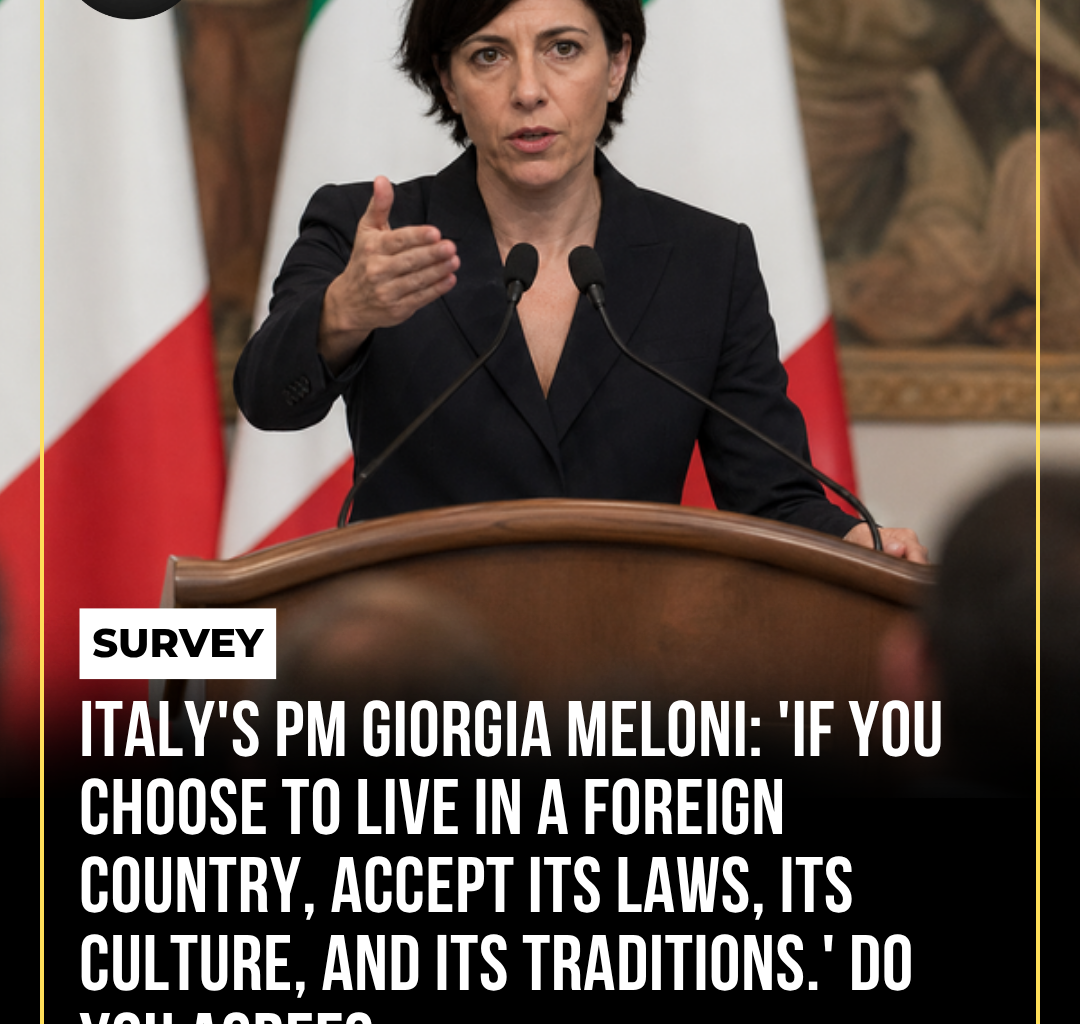
Italy’s Prime Minister Giorgia Meloni has a simple standard for anyone who crosses into another country: accept its laws, its culture, and its traditions. The statement went viral the moment it circulated online — and it split comment sections down the middle everywhere it landed.
Meloni has built her entire political identity around exactly this principle. As leader of Brothers of Italy, she has pushed through immigration rules that explicitly favor those who have shown a willingness to adopt Italian culture and block those who haven’t. Her government has been direct about its priorities, stating that immigration from communities with a lower inclination toward cultural integration is deprioritized. She has been saying this for years. She is not backing down.
For Meloni, the logic is straightforward. A nation’s ability to function depends on shared values, shared laws, and a basic degree of social cohesion. Open borders without cultural expectations, she argues, is not compassion — it is a recipe for conflict. Italy, like every European nation, has watched neighboring countries grapple with parallel societies, no-go zones, and the long-term consequences of immigration policies that prioritized numbers over integration. Meloni’s position is that Italy will not repeat those mistakes.
To her supporters, this isn’t radical. It’s common sense. Every country on earth expects residents to follow its laws. Most expect at minimum a basic respect for the society they’ve entered. No one is forced to emigrate. If you choose to move somewhere, you accept the deal. For them, Meloni is simply saying out loud what most people already believe but won’t say in an era when that kind of candor is politically costly.
Her message has resonated far beyond Italy. In an era when Western leaders routinely avoid direct statements about immigration and cultural expectation, Meloni’s willingness to state her position plainly has earned her a global audience. Supporters in the United States, France, the UK, and across Eastern Europe point to her as an example of what it looks like when a leader speaks plainly rather than performing carefully worded ambiguity.
To her critics, however, the statement raises harder questions. Who gets to define the culture? Italy has dozens of regional dialects, centuries of internal migration, and millions of Italians who emigrated to other countries over the last century — often without fully assimilating into those societies either. Italian immigrants built tight-knit enclaves in Argentina, the United States, and Australia, maintaining their language, food, and customs for generations. Critics argue that what Meloni calls “culture” is selectively defined, and that demanding immigrants adopt a fixed “tradition” ignores how societies actually evolve — including Italy’s own history.
There is also the legal dimension. The European Union has rules about freedom of movement and asylum that complicate any government’s ability to unilaterally restrict immigration based on cultural criteria. Meloni’s government has tested those boundaries repeatedly and faced legal challenges in doing so. Her critics argue that the rhetoric is easier than the policy, and that framing immigration as a cultural compatibility problem obscures the economic and humanitarian realities that drive migration in the first place.
But the debate over Meloni’s statement is bigger than Italy. It is the defining question of every Western democracy right now. How much integration is reasonable to expect? Who enforces it? What happens when expectations aren’t met? These are the questions that have reshuffled political coalitions across Europe and driven voter realignment from France to Sweden to the Netherlands. Meloni has simply put the central question in one sentence — and asked people to take a side.
The viral reach of that sentence says something on its own. It spread because millions of people, regardless of where they land on the answer, recognize the question as real. The debate is not going away. DO YOU AGREE WITH HER?