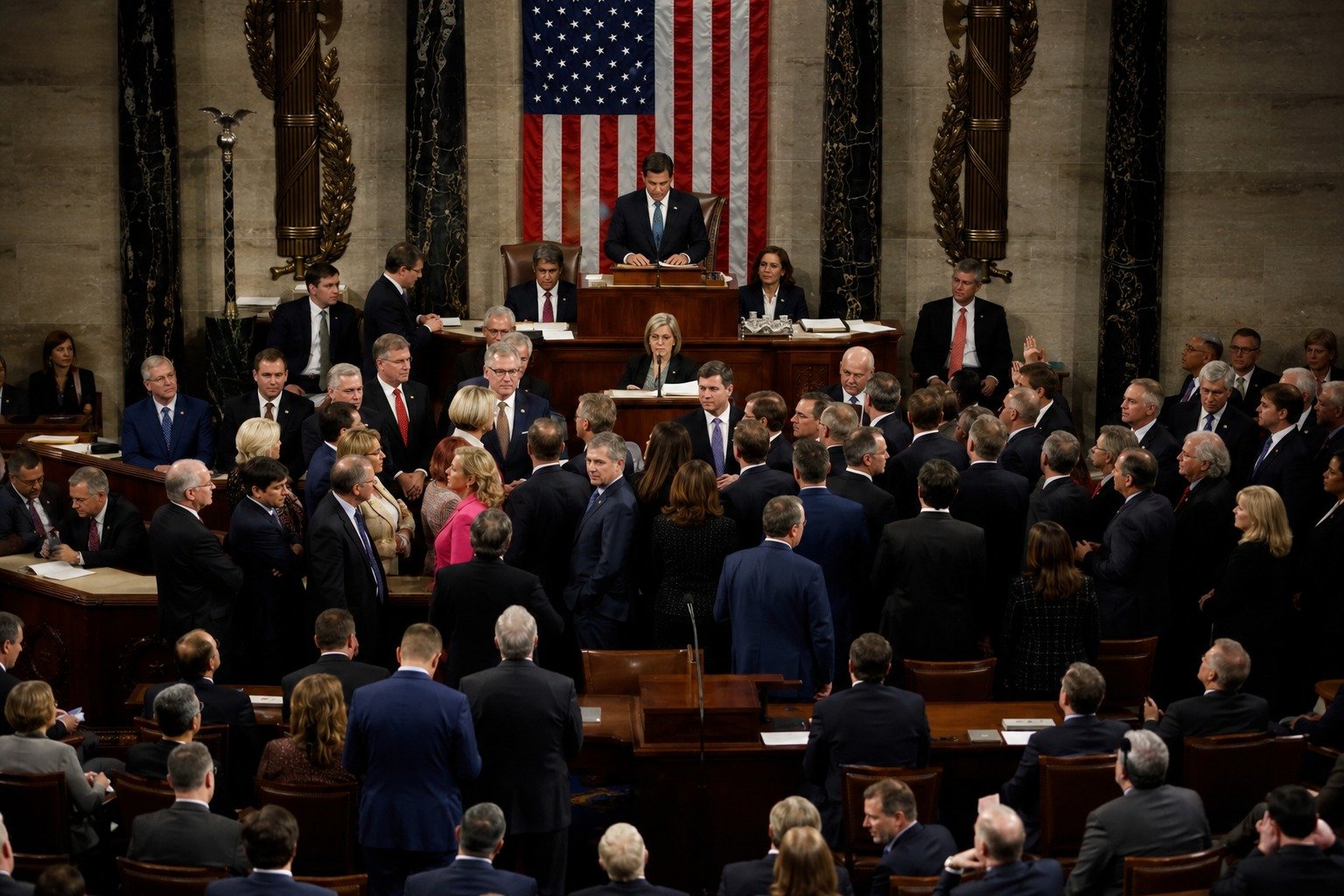
The House of Representatives has voted to halt U.S. military action against Iran, passing a war powers resolution that directs the administration to stand down unless Congress formally authorizes the use of force. The measure cleared the chamber 215 to 208, carried by every Democrat present and a small group of Republicans who broke with their party to support it.
The vote marks one of the rare moments in recent memory when the House has directly challenged a sitting president on the question of war. And it revived a constitutional debate that has simmered for generations: who actually holds the power to take the United States into armed conflict?
Why This Vote Matters
The Constitution assigns the power to declare war to Congress, not the president. But in practice, presidents of both parties have launched military operations for decades without a formal declaration, leaning on their authority as commander in chief. The War Powers Resolution of 1973 was designed to rein that in, requiring a president to seek congressional approval within 60 days of committing forces to hostilities.
The lawmakers behind this resolution argue that the 60-day window had run out, and that continuing military action against Iran without a vote from Congress crosses a constitutional line. Their position is not about whether the United States should confront Iran. It is about who gets to make that decision, and whether the legislative branch will assert the authority the Constitution gives it.
The Republicans Who Crossed the Aisle
At the center of the Republican defections was Rep. Thomas Massie of Kentucky, a longtime constitutional hardliner who has spent years arguing that no president of either party can take the country to war on their own. Massie has been consistent on this point across administrations, making him one of the most predictable votes in Congress when war powers are on the table.
He was joined by three fellow Republicans: Warren Davidson of Ohio, Brian Fitzpatrick of Pennsylvania, and Tom Barrett of Michigan. Their support, combined with unanimous backing from Democrats present, was enough to push the resolution past the finish line by a seven-vote margin.
For these Republicans, the vote carried real political risk. Breaking with a president of your own party on a national security question invites criticism from party leadership and the base. That they did so anyway underscores how deeply the war powers question divides even allies.
A Symbolic But Significant Message
For all the drama on the House floor, the resolution faces long odds of becoming binding policy. It still must clear the Senate, where the math is far less favorable, and it would almost certainly draw a presidential veto if it ever reached the desk. Overriding that veto would require two-thirds majorities in both chambers, a threshold that is realistically out of reach.
That makes the vote largely symbolic in the immediate term. But symbolism in Washington can carry weight. The message from the House was unmistakable: even inside the president’s own party, the question of war-making power is far from settled, and a bipartisan bloc is willing to go on the record demanding that Congress have a say.
What This Means for Americans
The debate over war powers is not an abstract constitutional argument. It determines whether the decision to send American troops into harm’s way is made by a single official or by the elected representatives of the people. Every American family with someone in uniform has a direct stake in how that question is answered. The outcome shapes not just foreign policy, but the basic balance of power that the founders built into the system.
The fight now moves to the Senate, and the country is left with the oldest question in the republic: who really decides when the nation goes to war?
Stay informed on the stories that matter most. Follow Your Daily Updates on Facebook and bookmark yourdailyupdates.news for breaking news and analysis.