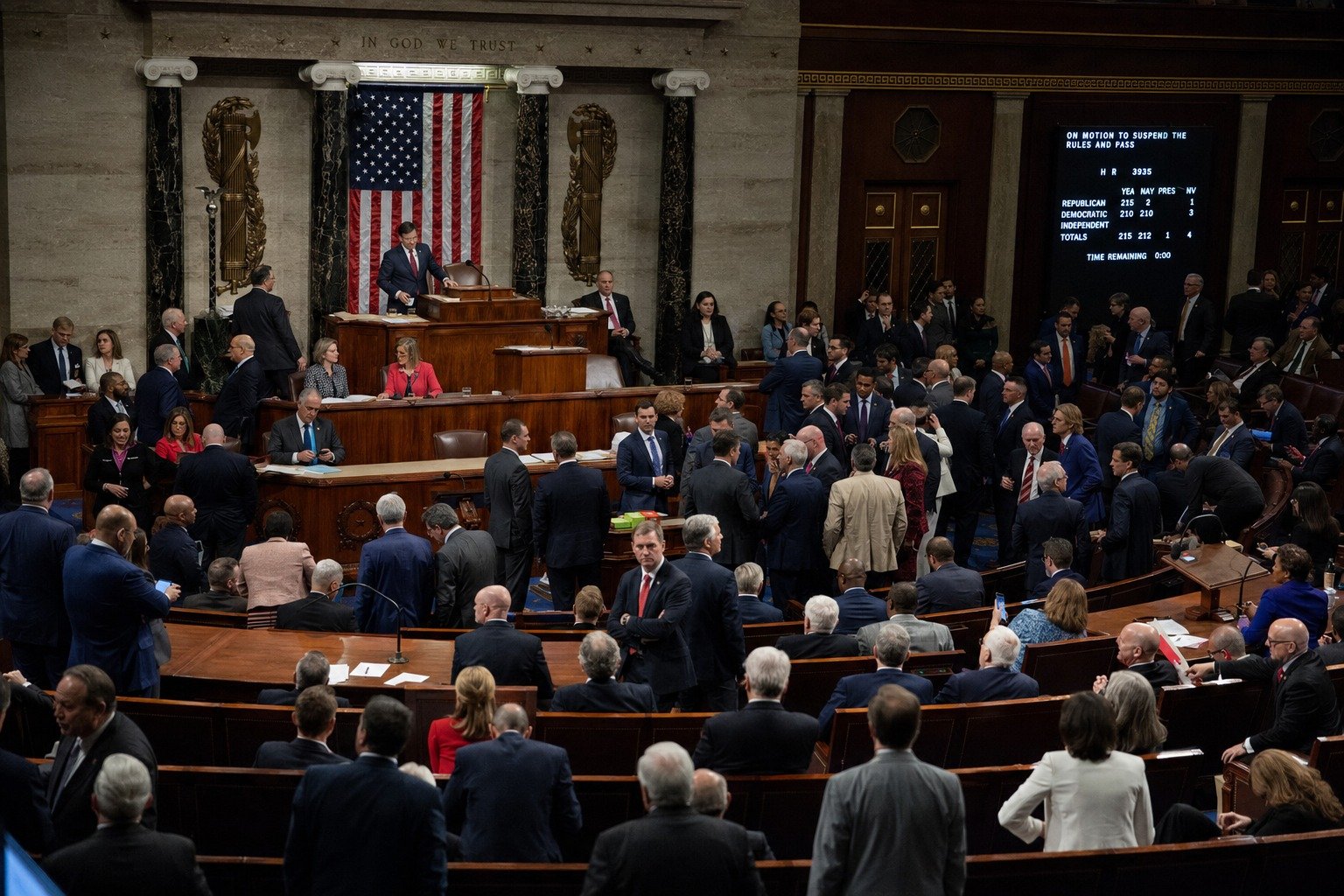
In the span of a single week, congressional Republicans broke with President Donald Trump on three separate fronts — votes on war powers, military aid, and federal spending that, taken together, amount to the most visible intraparty defiance of his second term. The Republican-led House advanced measures to limit his military options in Iran, send roughly a billion dollars in aid to Ukraine over his objections, and strip funding from two of his pet projects.
Individually, each vote could be written off as a one-off. Together, they read as something larger: a governing party that, at least for one week, stopped taking orders from the top.
The Ukraine Vote That Defied Leadership
The headline number was the Ukraine Support Act, which passed the House 226-195. The package authorizes roughly $1 billion in direct aid to Ukraine, clears the way for up to $8 billion in military loans, and imposes a new round of sanctions on Russia. Eighteen Republicans crossed both the president and their own leadership to push it through.
That defection matters because of who controls the chamber. This was not the minority forcing a vote — it was members of the majority breaking ranks on a signature foreign-policy question. For a White House that has spent months pressing for a colder posture toward Kyiv and a warmer one toward Moscow, watching eighteen of its own members vote to arm Ukraine and sanction Russia is a direct rebuke.
Reasserting Congress on War
The second front was war itself. The House passed an Iran War Powers resolution aimed at blocking continued U.S. military action, with four Republicans joining Democrats. War Powers resolutions are Congress’s constitutional tool for reclaiming authority over the use of force — a reminder that the decision to keep American forces in a fight is supposed to belong to the legislature, not the president alone.
Four Republican votes is a narrow margin, but the symbolism is heavy. Members of the president’s own party went on record saying the executive branch should not have a blank check to keep the country in a military engagement. In an era when war powers votes are often dismissed as messaging exercises, this one landed as a genuine attempt to put guardrails on the commander in chief.
Killing the Ballroom and the ‘Anti-Weaponization’ Fund
The third front was money — and it was personal. GOP factions rejected $1 billion tied to Trump’s White House ballroom project and forced a retreat on his $1.8 billion “anti-weaponization” fund, a pot of money critics warned could be turned against his political enemies.
Spending fights are where party discipline usually holds tightest, because appropriations are the currency of loyalty. That Republicans were willing to zero out a billion dollars attached to a presidential vanity project, and claw back nearly two billion more from a fund they feared could be weaponized, signals that the usual leverage is fraying. When members start saying no to the president’s own line items, the message is unmistakable.
What This Means for Americans
For ordinary Americans, the significance is about accountability. A Congress that defers entirely to the White House is a Congress that has stopped doing its job. These votes — on whether to fund a foreign war, whether to keep troops in harm’s way, and whether to bankroll a president’s personal priorities — are exactly the questions the legislative branch exists to weigh. Eighteen Republicans on Ukraine, four on Iran, and a bloc on spending decided this week that the answer would not simply be whatever the president wanted.
The open question is whether this is a one-week revolt or the beginning of a more durable independence. A single week of defiance does not remake a party. But it does show that the votes exist when members decide to use them.
Stay informed on the stories that matter most. Follow Your Daily Updates on Facebook and bookmark yourdailyupdates.news for breaking news and analysis.