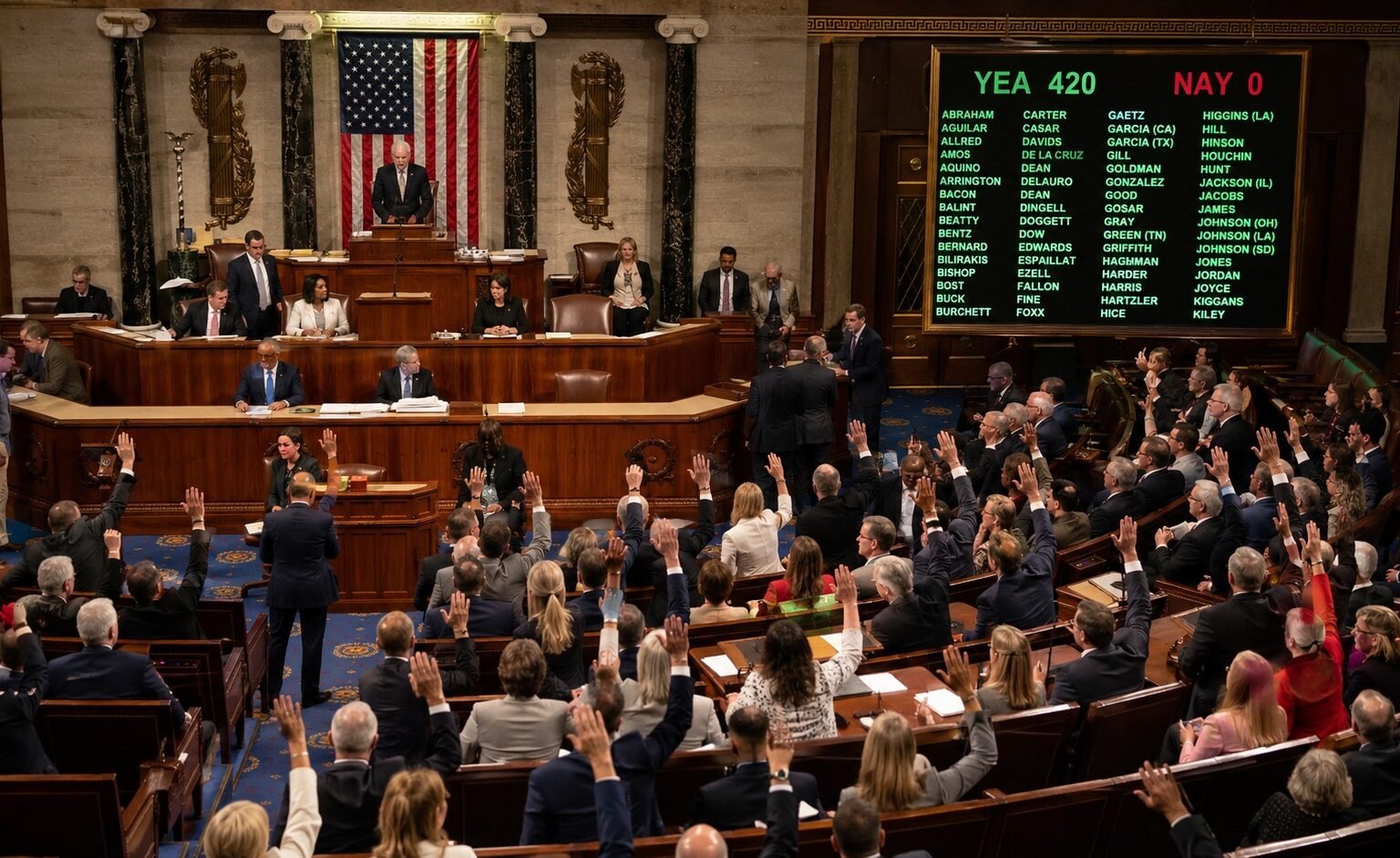
For years, when a member of Congress settled a s*xual harassment or abuse claim, the money did not always come out of the lawmaker’s own pocket. It came out of the public’s. The settlements were paid, the paperwork was filed, and the names stayed buried. On June 30, 2026, the House of Representatives voted 420-0 to end that arrangement.
What the House actually voted on
The measure is H.Res. 1399, a privileged resolution offered by Rep. Thomas Massie, a Kentucky Republican. It directs two bodies — the House Committee on Ethics and the Office of Congressional Workplace Rights, known as the OCWR — to compile a consolidated list of members of Congress involved in s*xual harassment and abuse matters that ended in taxpayer-funded payouts, and to make that list public.
The list is not supposed to be a vague summary. Under the resolution, it is to include each lawmaker’s name alongside the total amount of taxpayer money spent on that lawmaker’s settlements, awards, reimbursements, or other financial arrangements. In other words: who, and how much.
The vote was 420 to 0. Not a single member of the House voted against it. One member, Rep. Nancy Mace of South Carolina, voted “present.” Mace has said she had already subpoenaed the underlying files through the Oversight Committee in March and released them in May, which is why she did not cast a yes or no vote. It is worth being precise about this: the resolution passed without opposition, but describing it as the unanimous voice of all 435 members overstates it slightly.
The names have not been released yet
This is the part that gets lost in the excitement over a 420-0 vote. Nothing has been disclosed. No names are public. The vote was an order, not a revelation.
The Ethics Committee and the OCWR were given 60 days from adoption to compile the records and make them public. Counting from June 30, that clock runs out in late August 2026. Everything about this story — whether it becomes real accountability or another Washington promise that quietly expires — depends on what those two offices hand over when that deadline arrives.
That is the date to watch. Not the vote. The deadline.
Nobody knows the real number
Figures in the neighborhood of $300,000 have circulated in earlier coverage of congressional misconduct settlements. That number should be treated as a floor, not a total. It is not a verified accounting of what taxpayers have spent, and it was never meant to be.
The entire premise of H.Res. 1399 is that the true figure is unknown. Congress built a system in which claims against its own members could be resolved with public money under confidentiality arrangements, and then declined to publish a running tally of what that system cost. The resolution exists precisely because no one outside that process can say, with confidence, how much has been paid or on whose behalf.
That is an uncomfortable admission for an institution that spends its days demanding transparency from everyone else.
Why a unanimous vote was the easy part
It is not hard to understand why no member wanted to be recorded voting against this. Voting no would have meant standing up, on the record, in defense of secret payouts funded by constituents. There is no version of that vote that survives a campaign ad.
So the vote was free. Compliance will not be. Producing the list means naming colleagues, some of whom are still serving, and attaching dollar figures to conduct that was settled quietly on the understanding it would stay quiet. Every institutional instinct in that building runs against doing it.
There is also the matter of scope. The resolution reaches matters that resulted in taxpayer-funded payouts. Cases settled privately, or resolved some other way, may not appear at all. A list can be technically complete and still leave gaps — and the public will have no easy way to know the difference.
What accountability would actually look like
A real disclosure is one where the public learns three things: which members were involved, how much public money went out the door on their behalf, and when. Anything less — aggregate totals with no names, names with no amounts, a release that slips past the deadline with an explanation attached — is a partial answer to a question the House already voted 420-0 to answer in full.
Workers in nearly any other job who were accused of harassing a colleague would not have their employer’s customers quietly cover the settlement while their name stayed out of it. That is the deal Congress arranged for itself, using money it did not earn.
The House has now voted, without a single dissent, to take that deal apart. Late August is when we find out whether it meant it.