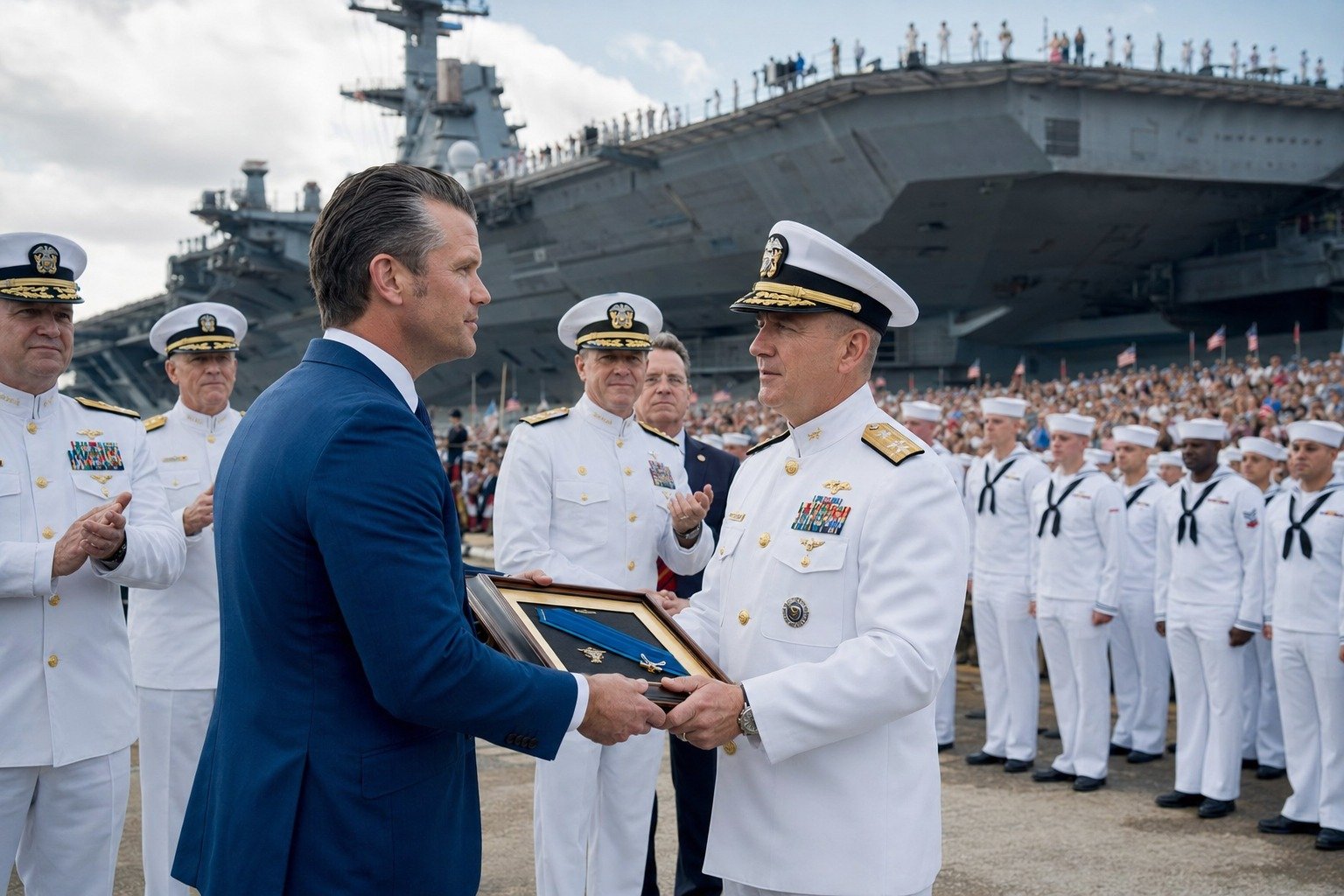
The USS Gerald R. Ford Carrier Strike Group pulled into Naval Station Norfolk, Virginia on Saturday after 326 days at sea — the longest deployment of a U.S. aircraft carrier since the Vietnam War. Secretary of Defense Pete Hegseth was standing on the pier when the ship arrived, personally welcoming home more than 4,500 sailors and awarding the unit the Presidential Unit Citation, the highest collective honor the U.S. military can bestow on a fighting force.
A Deployment That Became History
The Ford strike group left Norfolk on June 24, 2025, with orders for what was expected to be a routine European deployment. Within months, those orders had changed dramatically. In October 2025, the group was redirected to the Caribbean Sea to join a massive U.S. military operation targeting international drug trafficking routes — one of the most significant naval anti-narcotics operations in years. The mission was a success, but the deployment was far from over.
From the Caribbean, the Ford moved to the Middle East, where it became a central player in Operation Epic Fury — the joint U.S.-Israeli military campaign targeting Iranian military infrastructure in the Red Sea corridor. For months, the Ford’s aircraft flew missions over contested waters, providing air cover, intelligence support, and strike capability during one of the most intense periods of U.S. naval activity in the region in decades. Three separate missions. One ship. Ten-plus months away from home.
Hegseth at the Dock
Secretary Hegseth didn’t send a representative. He showed up himself. Standing at the pier alongside senior Navy officials, Hegseth presented the crew with the Presidential Unit Citation — a decoration that recognizes extraordinary heroism and service by an entire military unit. It is the highest honor the Department of Defense can award collectively, and it is rarely given lightly.
“You haven’t just met the standard of excellence,” Hegseth told the assembled sailors and their families. “You have redefined it for the next generation of American warfighters.” The ceremony drew cheers from thousands of family members lining the pier — many of whom hadn’t seen their loved ones in nearly a year. For some, it was the longest separation they had ever endured. For others, it was the proud culmination of a military career defined by a single, historic deployment.
What 326 Days Actually Means
To put the deployment in perspective: standard U.S. carrier deployments run 6 to 8 months. The previous modern record was held by USS Enterprise during the Vietnam era. The Ford’s crew did not just break that record — they shattered it, staying at sea through three distinct operational theaters, two hemispheres, and a combined set of missions that touched nearly every major national security priority of the past year. They fought drug cartels. They ran combat operations against Iranian-aligned forces. And they did it all without coming home in between.
What This Means for Americans
The sailors aboard the USS Gerald R. Ford aren’t abstractions — they’re sons and daughters, husbands and wives, parents who missed birthdays, anniversaries, and first steps. Behind every name on that ship is a family that held things together at home while their person held the line overseas. Saturday’s homecoming wasn’t just a military ceremony. It was a reminder that the cost of American security is paid in real time, by real people, who chose to serve anyway. That deserves to be remembered.
Stay informed on the stories that matter most. Follow Your Daily Updates on Facebook and bookmark yourdailyupdates.news for breaking news and analysis.