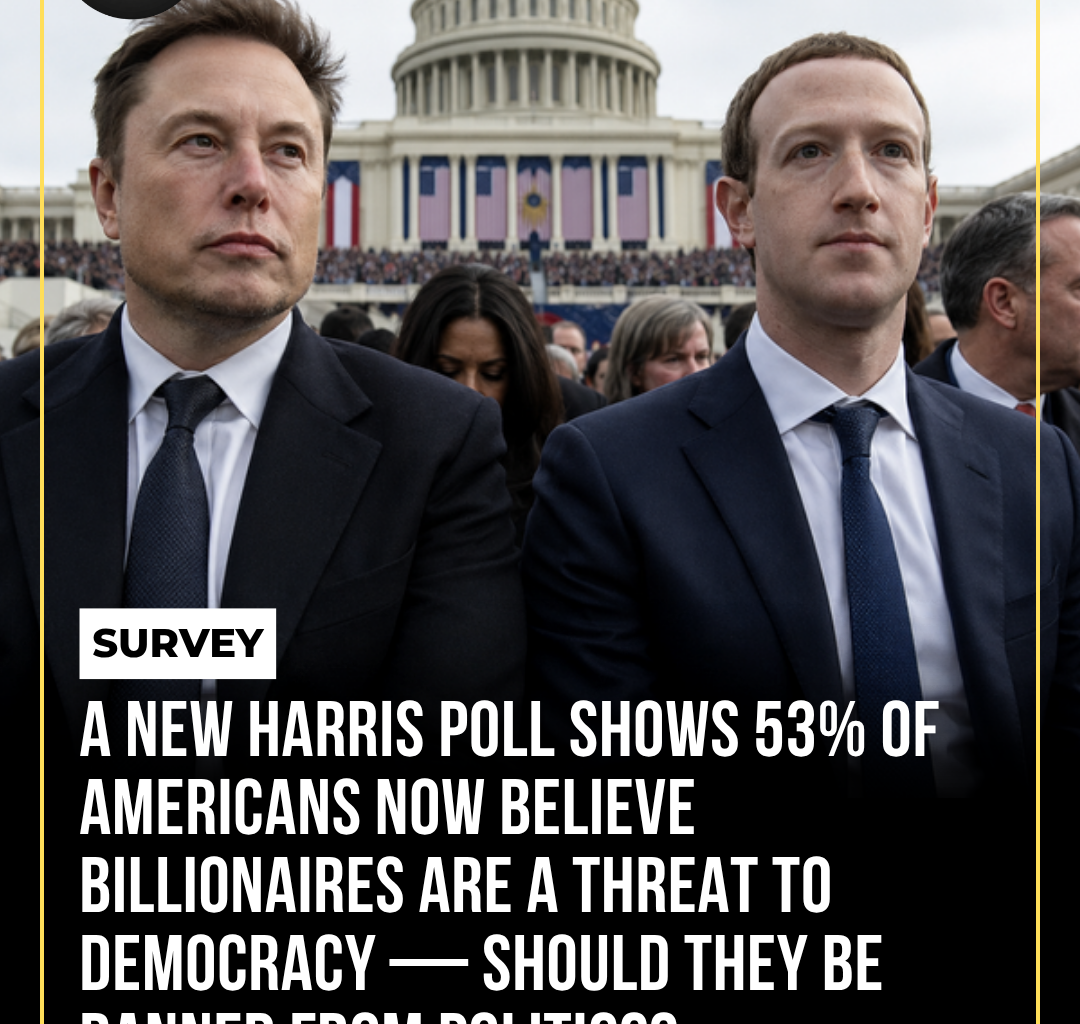
A new Harris Poll has put a number on a feeling that millions of Americans have quietly held for years: 53% of U.S. adults now view billionaires as a direct threat to American democracy. That figure is up 7 points from just one year ago, when 46% held the same view — and by all indications, it’s still rising.
The poll’s findings go deeper than the headline number. An overwhelming 71% of respondents said they want the ultra-wealthy to play a smaller role in U.S. politics. The same 71% said they support a national wealth tax on the highest earners. 64% favor mandatory philanthropic contributions for anyone with a net worth exceeding $1 billion. And 53% support placing a hard cap on personal wealth altogether — with most survey participants drawing that line at $10 billion.
Context matters when reading these results. In January 2025, Elon Musk, Mark Zuckerberg, Jeff Bezos, and Sundar Pichai all appeared together, seated front row, at Donald Trump’s presidential inauguration. The image circulated instantly across social media. For a large portion of Americans, it wasn’t simply a photo op — it was what they saw as visual confirmation that the wealthiest individuals on the planet had successfully secured a permanent seat at the table of American political power. The Harris Poll numbers suggest that image landed hard.
The United States has no legal mechanism to exclude citizens from participating in the political process based on wealth. The First Amendment protects political speech. The Supreme Court’s Citizens United ruling extended that protection to political spending. Under current law, billionaires have the same constitutional rights as any other American — and the financial capacity to exercise those rights on a scale that most citizens cannot approach.
Supporters of billionaire political involvement argue that wealthy entrepreneurs built companies that employ millions of Americans, generated economic growth, and created products that changed the world. They pay taxes — often enormous sums — and they have as much right as any American to advocate for the policies they believe in. The argument isn’t that billionaires are inherently corrupt. It’s that free political participation is a guaranteed right regardless of one’s economic status.
Critics counter that the scale of influence made possible by extreme wealth creates an uneven playing field that fundamentally distorts democratic representation. When a single individual can spend hundreds of millions of dollars influencing elections, funding think tanks, purchasing media platforms, and lobbying Congress — while the average voter can spare nothing — the democratic principle of equal political voice breaks down in practice, whatever the law says in theory.
That tension is exactly what the Harris Poll is measuring. Americans aren’t necessarily saying billionaires are evil or that wealth is wrong. They’re saying that when wealth reaches a certain level, the resulting political influence is incompatible with a functional democracy where every citizen’s voice counts equally. More than half of the country has now arrived at that conclusion.
What to actually do about it is where the debate gets harder. A wealth tax faces significant legal and logistical challenges. Caps on personal wealth would require constitutional amendments. Campaign finance reform has stalled for decades. And any attempt to restrict the political participation of wealthy citizens would immediately collide with First Amendment protections that courts have repeatedly upheld.
The poll doesn’t offer solutions — it captures sentiment. And right now, that sentiment is moving fast and in one direction. The question isn’t whether Americans are concerned about billionaire influence in politics. The Harris Poll makes clear they are. The question is: what, if anything, should be done about it — and do billionaires have the same rights as every other American citizen, or has wealth itself become a form of political power that the founders never anticipated?