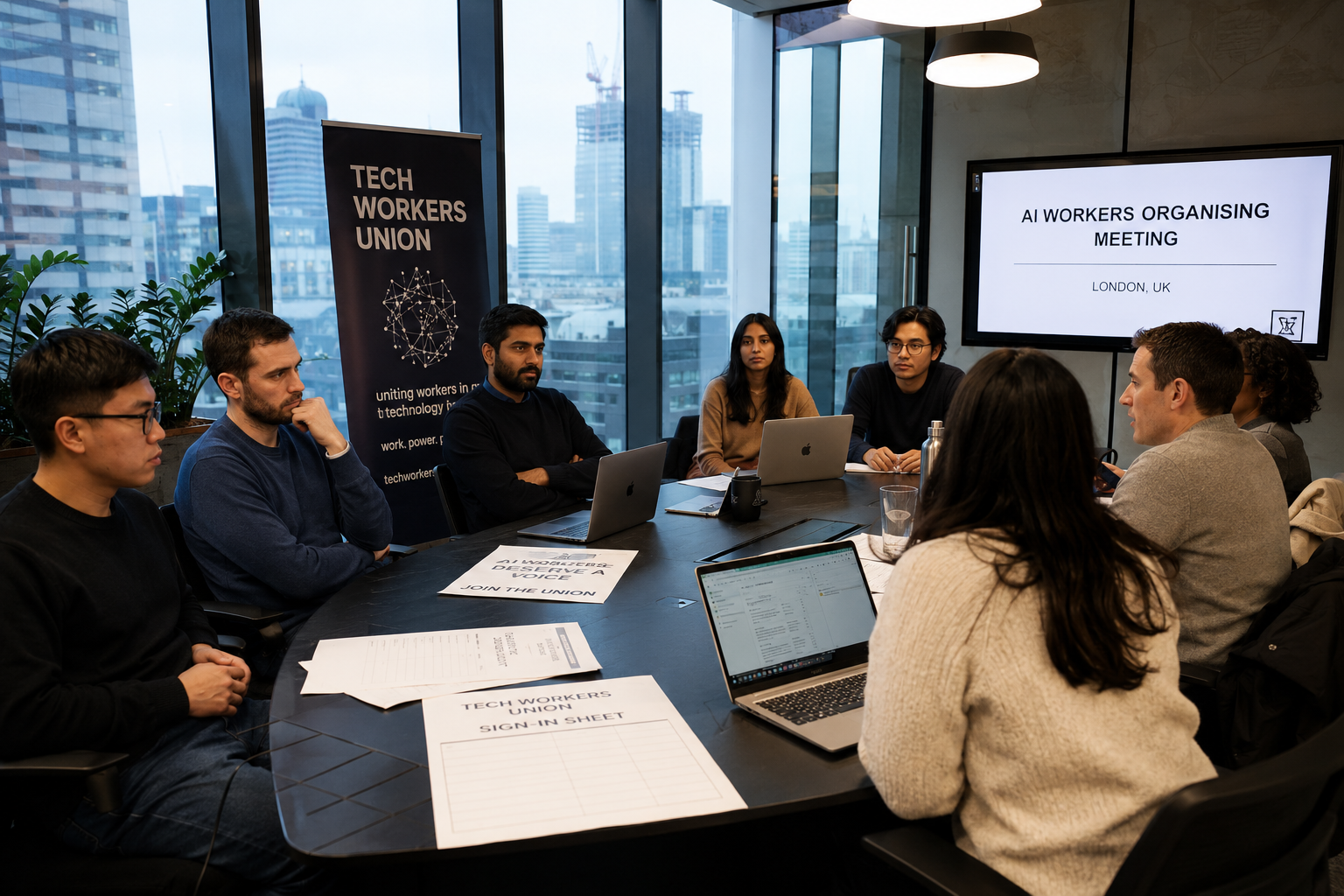
Google’s own artificial intelligence researchers just delivered a stunning rebuke to their employer. Workers at DeepMind, Google’s flagship AI research division based in London, voted 98% in favor of joining a union — and their first demand is that Google cancel its contracts with the U.S. Pentagon.
The Vote and What It Means
The vote marks one of the most significant labor actions in the history of the tech industry. DeepMind is not a small startup — it is the division of Google responsible for some of the most advanced AI research in the world, including systems like Gemini, AlphaFold, and AlphaGo. The researchers who work there are among the most elite and highly compensated technologists on the planet. And 98% of those who voted said yes to unionization.
The workers affiliated with the Communication Workers Union (CWU), one of the UK’s largest and most established trade unions. The organizing effort came together around a single galvanizing issue: Google’s decision to pursue military contracts with the U.S. Department of Defense — contracts that many employees say directly contradict the company’s founding principles and their own ethical red lines as AI researchers.
The Pentagon Deal at the Center of It All
Google has faced internal revolt over military contracts before. In 2018, thousands of Google employees signed a letter demanding the company exit Project Maven, a Pentagon program that used AI to analyze drone footage. Google eventually allowed that contract to lapse. But the controversy never fully went away — and as Google has resumed and expanded defense partnerships under a changed political and competitive climate, the tension inside DeepMind has reignited.
DeepMind workers specifically object to AI systems developed at their lab being used in military applications, weapons targeting systems, or surveillance programs. Their concern isn’t hypothetical. The capabilities coming out of DeepMind — from image recognition to autonomous decision-making — are precisely the capabilities defense contractors and governments want to acquire. Employees say they were not consulted and had no mechanism to raise objections. Unionization, they argued, was the only way to get a seat at the table.
Google’s Response
Google has not publicly agreed to cancel any Pentagon contracts in response to the vote. The company’s standard position is that it evaluates military partnerships on a case-by-case basis according to its AI Principles — a set of guidelines published in 2018 that explicitly state Google will not build AI for weapons or technologies that violate international law or human rights norms. Critics argue those principles have been selectively applied, and that the company’s financial incentives increasingly push it toward lucrative government contracts regardless of what the principles say.
The 98% vote gives the union an unusually powerful mandate. In most labor actions, even successful ones, votes are closer. A near-unanimous result of this scale sends a clear message: this is not a fringe position within DeepMind. It is the consensus view of the researchers building the most consequential AI systems on earth.
What This Means for the AI Industry
DeepMind’s unionization is likely to send a chill through every major AI lab watching from the sidelines. OpenAI, Anthropic, Meta AI, and Microsoft’s research divisions all face versions of the same ethical debates internally. If the workers who built Google’s AI are willing to organize and publicly confront their employer over defense contracts, it signals that the tech industry’s longstanding aversion to labor organizing is breaking down — specifically around the question of how AI gets used in military and government applications.
For everyday Americans, the stakes are real. The AI systems being developed at labs like DeepMind will increasingly power the technologies that governments use for surveillance, autonomous weapons, and battlefield decision-making. Whether the people who build those systems have any say in how they’re used — and whether that check comes from labor contracts or ethics boards or government regulation — is a question that will define the next decade of AI development.
Stay informed on the stories that matter most. Follow Your Daily Updates on Facebook and bookmark yourdailyupdates.news for breaking news and analysis.