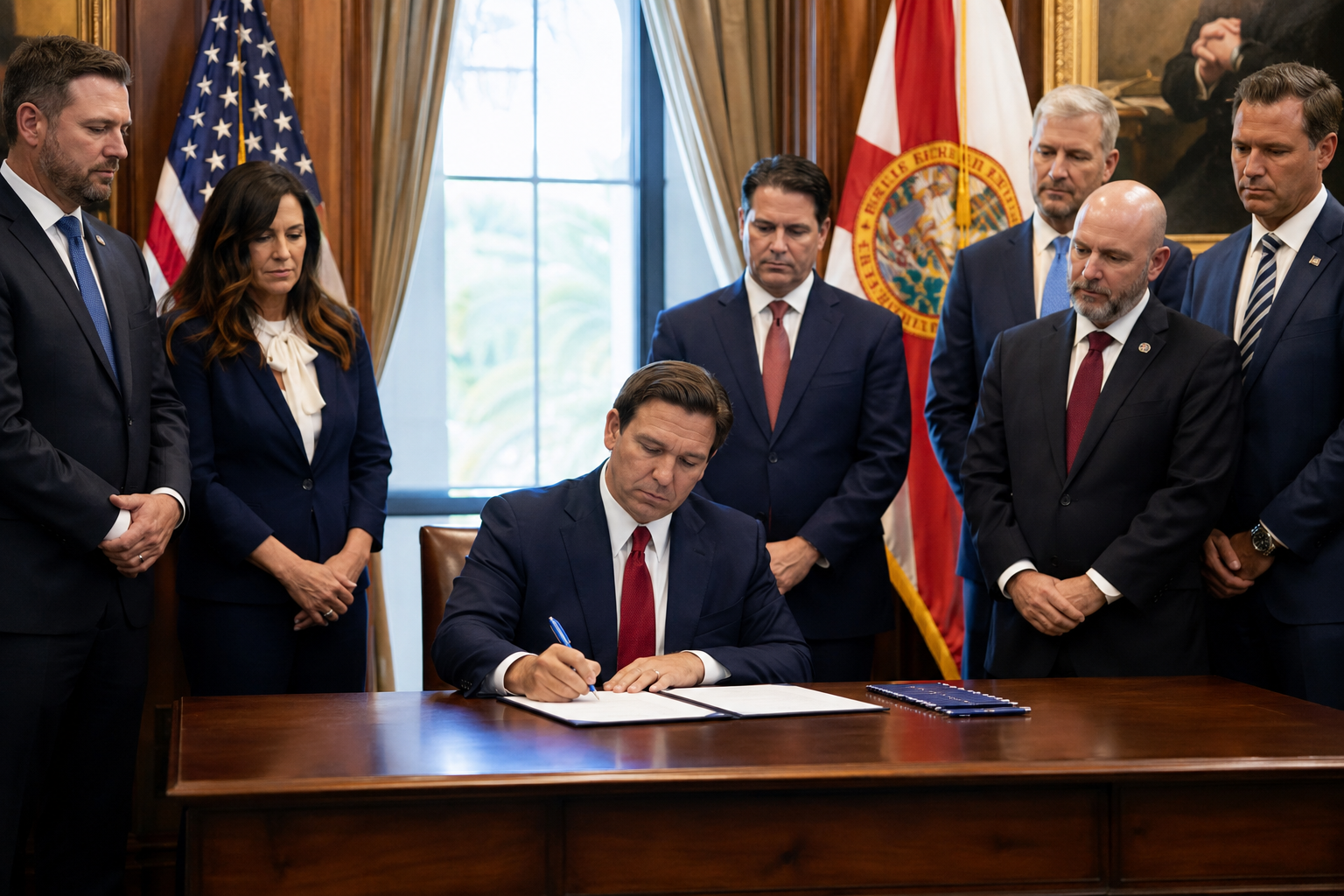
Florida has drawn a line in the sand that no other state has drawn in nearly two decades. In 2023, Governor Ron DeSantis signed a law allowing prosecutors to seek the death penalty against any adult convicted of sexually assaulting a child under the age of 12 — even if the child survived. It is the most aggressive child protection law of its kind in the country, and it’s heading toward a direct collision with the U.S. Supreme Court.
The Law and What It Says
The Florida legislation is straightforward in its intent: if an adult sexually assaults a child under 12, prosecutors can pursue the death penalty regardless of whether the child lived. Prior to this law, capital punishment in Florida — like most states — was reserved almost exclusively for homicide cases. Florida’s law deliberately expands that boundary.
The law applies only to adults. It applies only to victims under 12. And it applies whether the victim survived or not. That last point is the one that puts Florida on a direct collision course with existing Supreme Court precedent — and possibly puts the entire law’s future in the hands of nine justices in Washington.
Why This Challenges the Supreme Court
In 2008, the U.S. Supreme Court ruled 5-4 in Kennedy v. Louisiana that executing someone for child rape was unconstitutional when the victim survived. The court held that the death penalty, under the Eighth Amendment’s prohibition on cruel and unusual punishment, could only be applied in cases where the crime resulted in death. Florida’s new law is a direct challenge to that ruling.
DeSantis and supporters of the law are betting — or at least hoping — that the current Supreme Court, significantly more conservative than the 2008 court, might be open to revisiting that precedent. That calculation may or may not prove correct, but the intent is unmistakable: Florida is daring the court to take another look.
The Case for the Law
Supporters argue that children under 12 represent the most defenseless class of victims in any criminal context. They cannot consent, cannot protect themselves, and are often too young to fully articulate what happened to them. The psychological damage from sexual assault at that age can be lifelong and devastating — in many cases, supporters argue, worse than death itself.
DeSantis framed the signing as a matter of justice — not revenge. His argument is that the full weight of the law should stand behind the most vulnerable victims, and that if any crime warrants society’s ultimate penalty, it is the sexual assault of a child who cannot defend themselves. That message has resonated strongly with a large segment of the public.
The Unexpected Opposition
The most surprising critics of the law have not come from the usual political opposition — they have come from within the child advocacy and sexual abuse survivor communities. Some organizations that fight for survivors have warned that the law could produce a deadly unintended consequence: if offenders know they face execution either way, they may be more likely to kill their victims to eliminate witnesses and reduce their chances of being identified and prosecuted.
It is a painful and difficult trade-off. The goal is to protect children — but critics argue that in attempting to maximize punishment, the law could inadvertently put some children at greater risk of being killed. Advocates on both sides of the debate share the same underlying goal. They disagree sharply on which path gets there.
What This Means for the Rest of the Country
Florida is now the furthest any U.S. state has gone on this issue in 20 years. Whether the law survives a constitutional challenge will depend on whether the current Supreme Court is willing to revisit Kennedy v. Louisiana — and that decision, if it comes, will set the standard for the entire country. Every other state is essentially watching Florida and waiting to see what happens next.
For American families, the question is not abstract. It goes to the core of how society defines justice for the most vulnerable — and what consequences are proportionate for the most serious crimes committed against children. Florida has given its answer. The Supreme Court may soon be asked to give theirs.
Stay informed on the stories that matter most. Follow Your Daily Updates on Facebook and bookmark yourdailyupdates.news for breaking news and analysis.