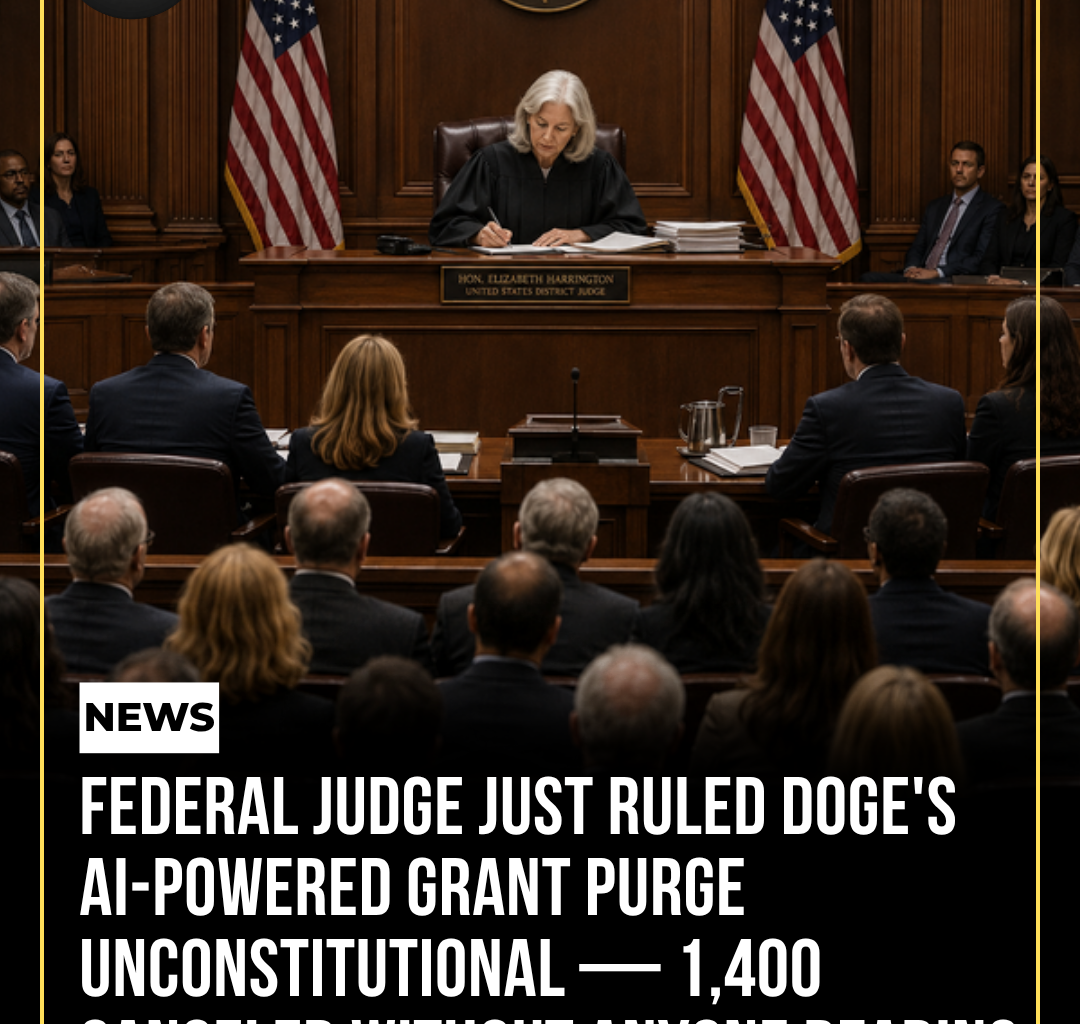
A federal judge has permanently blocked the cancellation of more than 1,400 humanities grants — ruling that the Department of Government Efficiency’s mass termination process was unconstitutional. The decision represents one of the most significant legal rebukes of DOGE’s rapid cost-cutting campaign to date.
The grants, totaling roughly $100 million, were awarded by the National Endowment for the Humanities. According to court records, DOGE staffers used an AI tool and keyword filters to flag grants for elimination — without reviewing a single individual application. The system even flagged a Jewish Holocaust anthology as a target for termination, a detail that drew sharp attention during court proceedings and underscored how blunt the screening process had become.
The court found that the cancellations violated federal law by bypassing required procedures for modifying or terminating previously approved federal awards. Under federal grant regulations, agencies cannot simply revoke approved funding without following a formal process that includes documented justification and, in many cases, an opportunity for the grant recipient to respond. DOGE’s keyword-filter approach, the judge concluded, did none of that.
The judge issued a permanent injunction ordering the grants to be restored and prohibiting further mass cancellations under the same process. The ruling is binding and immediately enforceable — meaning the National Endowment for the Humanities must reinstate the terminated awards unless and until a higher court overturns the decision on appeal.
Supporters of the original cuts argue that federal arts and humanities spending has long been a legitimate target for elimination, and that DOGE’s broader mission to slash government waste remains both necessary and constitutional. They contend that if the administration eventually loses in court, it should tighten its processes rather than abandon the goal. The administration has signaled it intends to appeal, and the outcome at the appellate level could determine whether this type of efficiency-focused review can continue in a modified form.
Critics, however, say the ruling exposes a fundamental flaw in how DOGE has operated across the government — speed over process. Using artificial intelligence to screen hundreds of millions of dollars in grants in days, rather than weeks or months, may have achieved rapid results, but courts are increasingly finding that speed does not exempt the executive branch from following established legal procedures.
The ruling sets a precedent that could constrain how DOGE operates across other agencies going forward. If courts continue to require agency-by-agency, grant-by-grant review with proper documentation and due process, the efficiency drive that defined DOGE’s early months will face significant legal headwinds. This case may be the first of many where AI-assisted federal cuts run into the limits of administrative law — and lose.