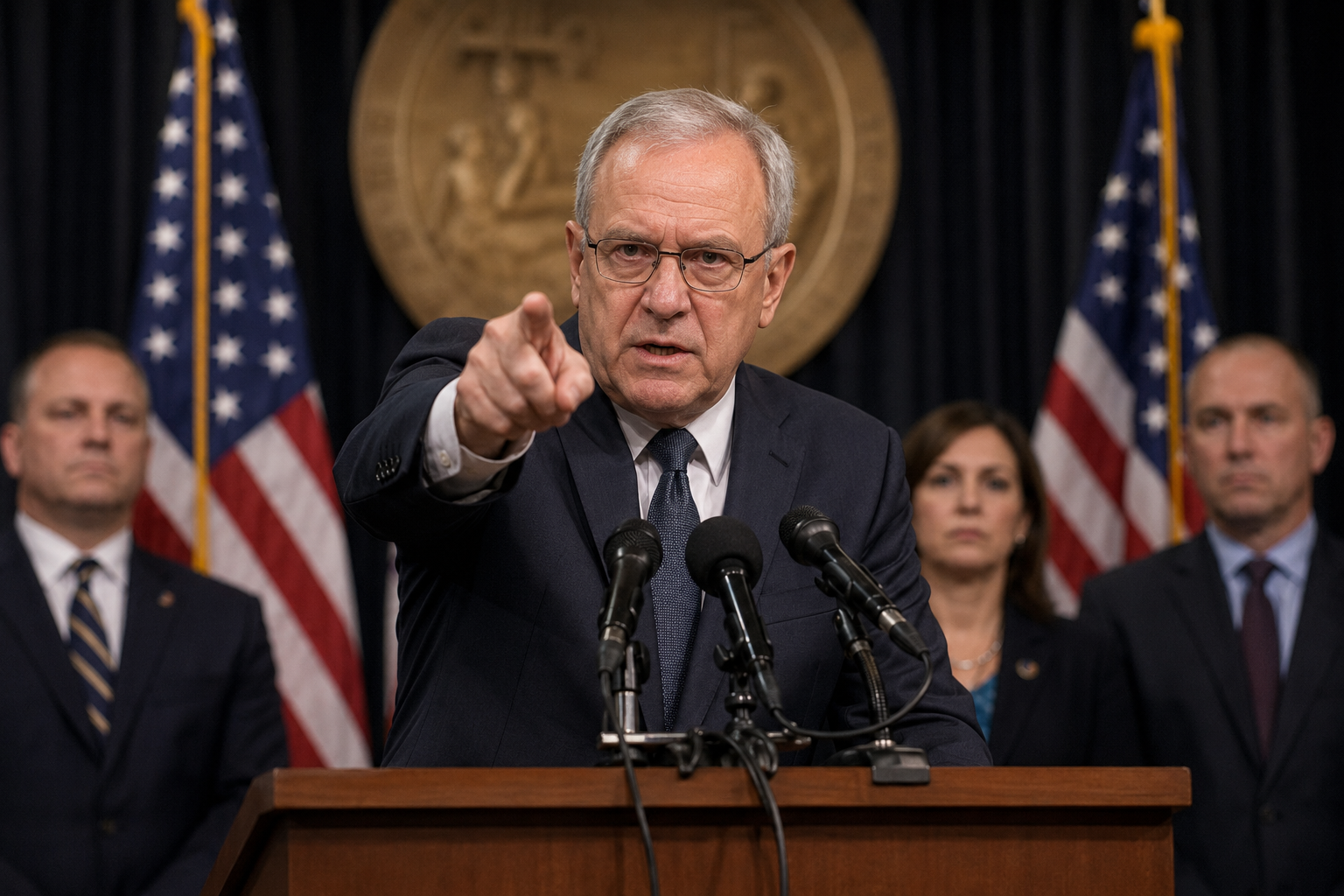
A presidential pardon can wipe out federal charges — but it cannot touch state prosecutors. Philadelphia District Attorney Larry Krasner made that crystal clear this week, putting Epstein’s associates on notice: no matter what happens in Washington, state-level prosecutors have the full authority to pursue their own cases, and nothing in the Constitution can stop them.
Krasner’s remarks came as speculation has continued to swirl around the possibility of presidential pardons shielding individuals connected to Jeffrey Epstein’s network. His message was blunt and precise: don’t count on it. At least not when it comes to state charges.
Why a Federal Pardon Doesn’t Cover Everything
Here’s what most people don’t know. Presidential pardon power only applies to “offenses against the United States” — federal crimes. It’s written directly into Article II of the Constitution. The moment a state DA decides to file charges, executive orders and pardons become completely irrelevant. That’s not a loophole. That’s the law as written, and it has been that way since the founding of the republic.
This means that even if someone connected to Epstein’s network received a full and unconditional federal pardon, a state district attorney could still walk into court the next day and file charges for the exact same conduct — as long as it violated state law. The two systems operate independently of each other, and one cannot nullify the other.
Statutes of Limitations — And Why They Matter Here
Krasner also raised a critical point that changes the math entirely: crimes involving minors often carry extended statutes of limitations under state law. In many states, the clock doesn’t start ticking until the victim reaches adulthood — or doesn’t start at all for certain categories of crimes. That means some of the cases tied to Epstein’s network may still be fully viable today, years after the events took place, depending on where the alleged offenses occurred.
This isn’t a theoretical possibility. Several states have passed laws in recent years specifically to extend or eliminate statutes of limitations for child s*xual abuse cases, in part as a direct response to abuse scandals that stretched back decades. Those reforms apply retroactively in some jurisdictions, meaning prosecutors who once had no options may now have a clear path to charges.
The Bigger Picture: Why This Matters Now
The Epstein case has haunted American politics for years. Millions of people want to know who else was involved and why federal prosecution of his associates has stalled for so long. Jeffrey Epstein died in federal custody in August 2019 before trial. Ghislaine Maxwell was convicted in 2021 and is currently serving a 20-year sentence. But the broader question — who else visited Epstein’s properties, who knew, and who benefited from decades of apparent cover — remains largely unresolved in any court of law.
Krasner’s message is direct: state prosecutors aren’t waiting on Washington to act. They have the power, and some of them may be ready to use it. In a political environment where federal accountability has stalled, the state-level route is increasingly being seen as the last realistic avenue for justice.
What Happens Next
The real question now is whether other state DAs across the country follow Krasner’s lead — and which names surface when they do. Several states where Epstein allegedly operated, including Florida and New York, have their own legal frameworks and their own prosecutorial independence. A coordinated or cascading series of state-level investigations could produce results that years of federal inaction have not.
For now, Krasner’s statement stands as the clearest public signal yet that the Epstein story is not over — and that for some in positions of power, a pardon from the president may not be enough to make it go away.