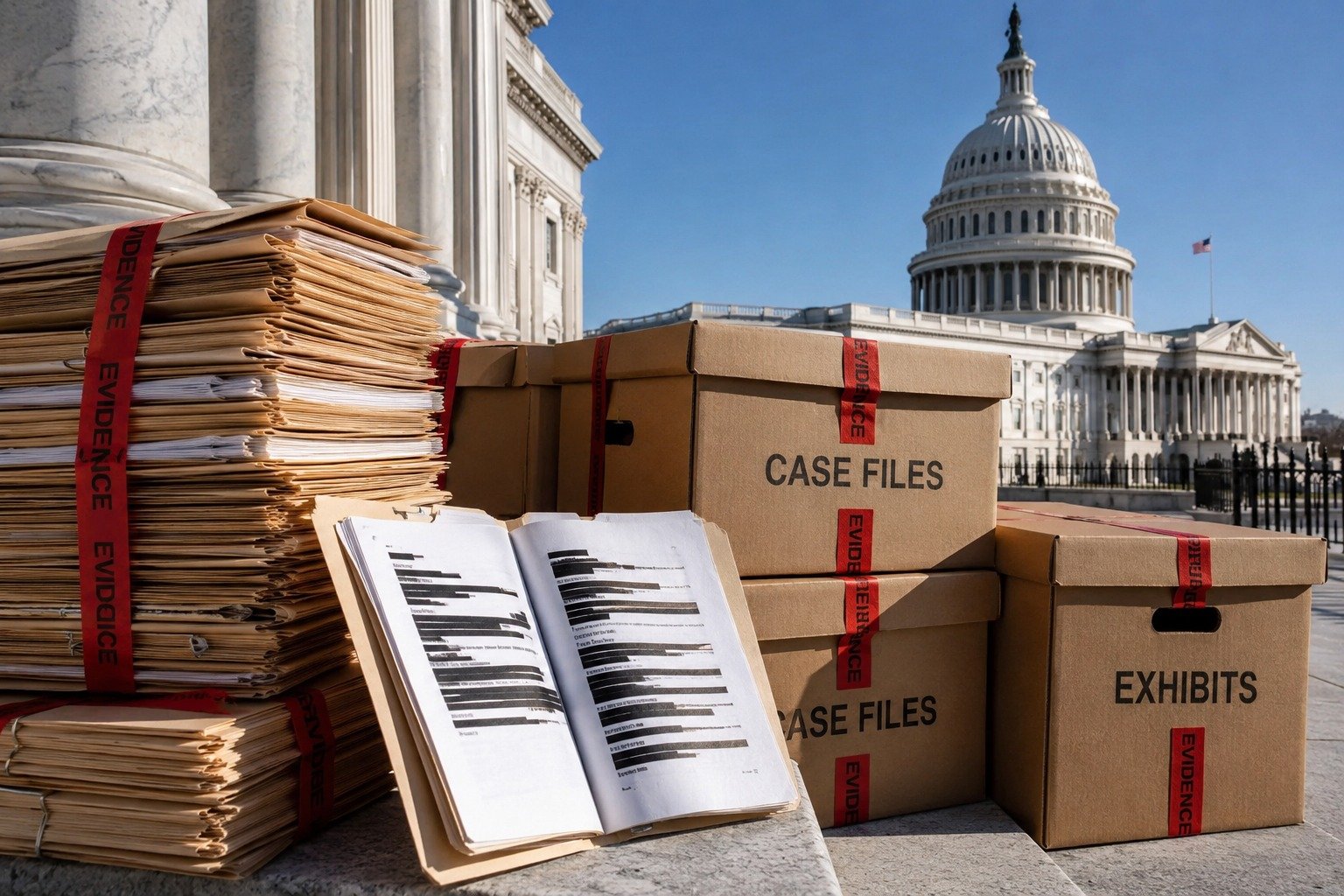
For years, Americans were told the Epstein files were too sensitive to release. Then Congress took the decision out of the executive branch’s hands entirely — and forced them into the open.
In November 2025, the House of Representatives passed the Epstein Files Transparency Act by an overwhelming vote of 427 to 1. The measure reached the floor not through the usual committee channels, but through a discharge petition — a rarely successful procedural tool that lets rank-and-file members bypass leadership. Reps. Thomas Massie, a Kentucky Republican, and Ro Khanna, a California Democrat, led the bipartisan push, and enough of their colleagues signed on to force a vote leadership had been reluctant to schedule.
The Senate cleared the bill by unanimous consent — meaning no senator objected — and the President signed it into law. The Department of Justice began releasing files in December 2025. In other words, this is not a proposal, a pending bill, or a political maybe. It is settled law, and the documents have started to come out.
The Difference Between “The Files” and “Every Page”
Here is where the story gets more complicated than a headline can capture. Forcing the release of the Epstein files and making every single page public are not the same thing.
Even under a transparency law, government releases routinely involve redactions. Names are blacked out. Some documents are withheld to protect ongoing investigations or unrelated legal proceedings. The identities of victims and survivors are — appropriately — shielded from public view. So the real fight over the Epstein files is not only whether they come out, but how much of them actually reaches the public eye once the redaction pens are done.
That distinction is at the heart of a debate now playing out among lawmakers, advocates, and ordinary citizens who have followed this saga for years.
The Case for Total Transparency
Supporters of full disclosure make a straightforward argument: a case this powerful, touching this many powerful people, should be exposed to daylight in full. After years of being stonewalled — of being told the material was too sensitive, too complicated, or too dangerous to see — the public, they say, has earned the right to read everything.
To this camp, redactions are not merely a privacy safeguard. They can also be a shield — a way for the well-connected to keep their names out of the record while less powerful figures are named. When accountability is the goal, they argue, the default should be openness, and the burden should fall on anyone who wants a name or a page kept secret to justify why.
The Case for Caution
Others urge restraint. Total, unfiltered disclosure, they warn, could sweep up innocent people whose names appear in documents only in passing — mentioned in a flight log, an address book, or an email without any allegation of wrongdoing. Publishing every page without care could turn a mention into a life-altering accusation.
And there is the deeper concern for survivors. Advocates for victims of abuse have long stressed that transparency should never come at the cost of re-traumatizing the people the system is supposed to protect. A rushed, blanket release, they argue, could do exactly that.
Why It Matters Now
What makes this moment different from the years of speculation that preceded it is that the decision to release is no longer hypothetical. Congress acted. The President signed. The DOJ has begun. The abstract question of “should these files ever see the light of day” has been answered — yes, by a nearly unanimous vote.
What remains open is the harder question: now that the machinery of disclosure is running, how far should it go? Where is the line between a redaction that protects a victim and a redaction that protects a powerful name? And who gets to decide?
Those are the questions that will define the next chapter of this story — and they are questions the public, not just insiders, will be weighing in on.
What Do You Think?
Congress forced the Epstein files into the open. Should every single page now be made public — no matter whose name is inside? Or should redactions remain to protect victims and the uninvolved? Share your view.