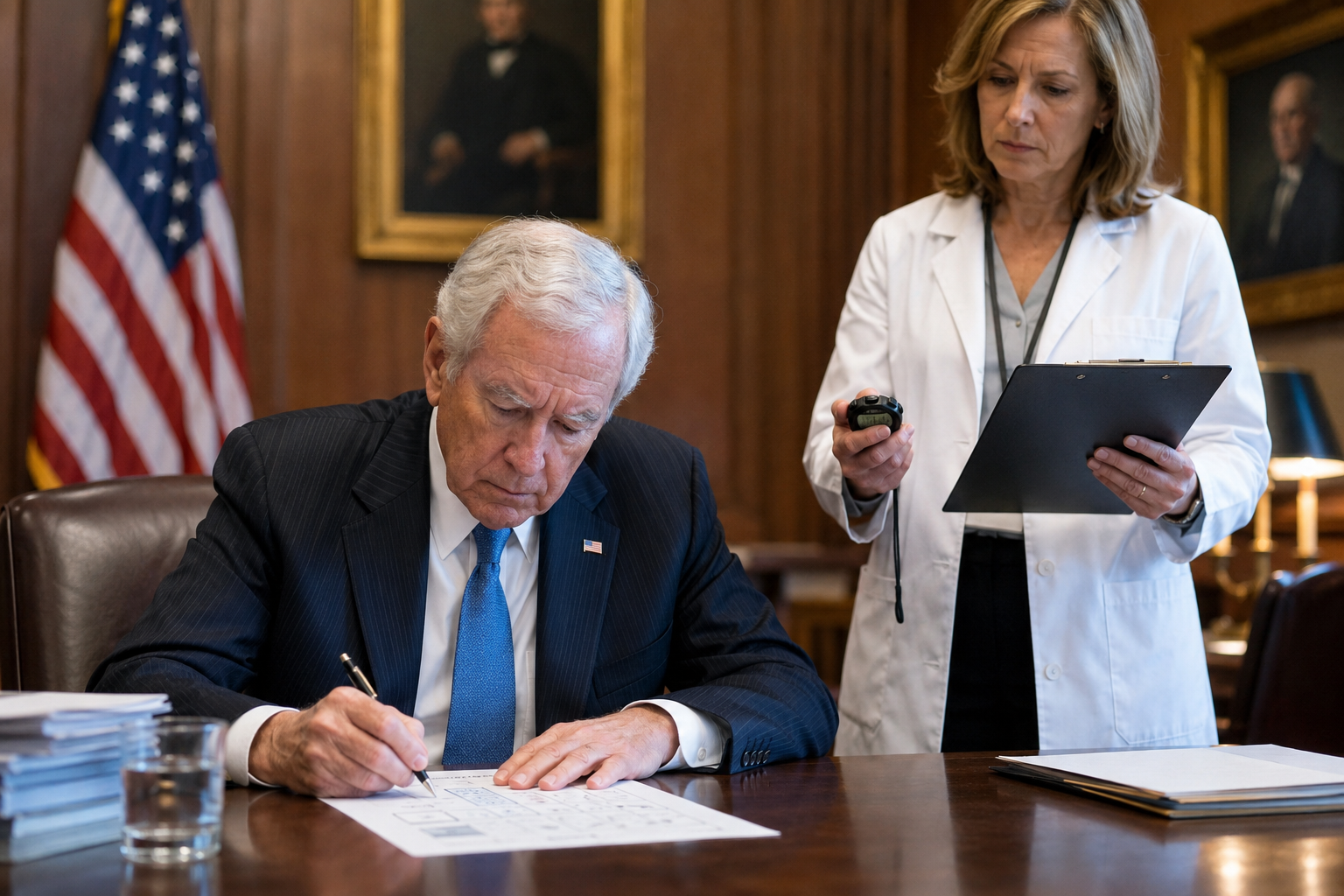
A Washington State lawmaker has put forward a proposal that could fundamentally change who gets to serve in Congress — and for how long. The measure would require all sitting and incoming members of Congress to pass mandatory cognitive fitness tests before they can vote on legislation. With nearly 120 members currently over the age of 70, the idea is generating serious debate on both sides of the aisle.
An Aging Congress and Growing Concerns
The numbers tell a striking story. Approximately 120 members of Congress are 70 years old or older — and the median age of U.S. senators now sits around 65. That’s not a new trend, but it’s one that has accelerated. As lawmakers have aged in office, so too have the concerns from voters who want to know that the people casting votes on trillion-dollar budgets and declarations of war are fully mentally capable of doing so.
Several high-profile incidents in recent years have brought the issue into sharp focus. Lawmakers have stumbled through hearings, forgotten colleagues’ names on the record, and in some cases shown visible signs of cognitive decline while still holding active committee assignments. These moments have fueled public frustration — and now, at least one legislator is trying to do something about it.
What the Proposal Would Do
The measure would establish an Office of Congressional Conduct tasked with administering standardized cognitive fitness evaluations to every member of Congress — both those already serving and any newly elected officials. Proponents argue the logic is straightforward: if a commercial airline pilot must pass regular medical and cognitive fitness reviews to remain in the cockpit, why should the people controlling America’s nuclear arsenal, its immigration policy, and its national debt face no such requirement?
Doctors must maintain their medical licenses. Truck drivers are required to demonstrate cognitive fitness before they’re cleared to operate commercial vehicles. Police officers undergo regular psychological evaluations. The argument from supporters is that lawmakers — who wield more power than almost any other profession — are uniquely exempt from the kind of accountability that applies to nearly every other high-stakes job in America.
Supporters and Critics Draw Battle Lines
Advocates for the proposal say it’s a matter of basic accountability. They point to the fact that voters often lack the information they need to judge whether their representative is truly fit to serve — and that by the time cognitive decline becomes obvious, real damage may already have been done. Supporters argue that a standardized, nonpartisan evaluation would give the public confidence that their elected officials are fully capable of doing the job.
Critics are pushing back just as hard. Opponents argue that mandatory cognitive testing amounts to age discrimination — that what actually matters is a lawmaker’s record and performance, not a score on a standardized test. There are also legitimate concerns about how such a system could be abused. In a hyper-partisan environment, cognitive testing could easily become a weapon, with political opponents demanding evaluations not out of genuine concern but as a way to target rivals and force them out of office.
The Constitutional Wall
Even if there were broad public support for cognitive fitness requirements, there’s a major obstacle standing in the way: the U.S. Constitution. Article I lays out specific, limited criteria for serving in Congress — age minimums, citizenship requirements, and residency. Courts have historically struck down attempts by states and other bodies to add requirements beyond those constitutional minimums, citing the precedent that the qualifications to serve in Congress cannot be expanded without a constitutional amendment.
That means passing cognitive fitness requirements would almost certainly require clearing an enormous legal hurdle — a constitutional amendment. That process demands two-thirds approval from both the House and Senate, followed by ratification by 38 of the 50 states. In today’s political environment, that is an extraordinarily high bar. Many legal scholars view it as effectively insurmountable in the near term, regardless of how popular the underlying idea might be with voters.
What This Means for Americans
For everyday Americans watching Congress from the outside, this debate touches something real. The people in those chambers make decisions that affect every aspect of daily life — healthcare costs, border security, military deployments, inflation, Social Security. When voters look at their representative and question whether that person is fully present and capable, it erodes trust in the institution itself. Whether or not this specific proposal ever becomes law, it has put a spotlight on a question that millions of Americans have been asking quietly for years: who exactly is running the country — and are they still fit to do it?
Stay informed on the stories that matter most. Follow Your Daily Updates on Facebook and bookmark yourdailyupdates.news for breaking news and analysis.