The Democratic Republic of Congo is now facing the deadliest Ebola outbreak in its history. The country’s national public health institute reported 4,945 confirmed cases and 2,325 deaths as of August 16, 2026, surpassing the 2018-2020 outbreak in the country’s east, which killed roughly 2,299 people. Globally, it is the second-largest Ebola outbreak ever recorded and the fastest-growing.
What makes this one different is not the size. It is the strain, and the fact that the vaccine that helped end previous Congolese outbreaks does not work against it.
A Strain With No Approved Vaccine
This outbreak is caused by Bundibugyo virus, a distinct species within the Ebola family. There is no licensed vaccine for it and no specific approved treatment. Candidate vaccines and therapeutics exist, but they remain in testing.
That is a meaningful break from recent history. The Ervebo-style vaccines that were deployed to contain earlier Congolese outbreaks were developed against Zaire ebolavirus, a different species. They are not interchangeable. This is not a case of a vaccine being withheld or rationed. For Bundibugyo virus, an approved vaccine simply does not exist yet.
The consequence is that the single most effective tool from the last decade of Ebola response, ring vaccination around confirmed cases and their contacts, is unavailable. Responders are working with isolation units, contact tracing, safe burial practices and personal protective equipment. The crude case fatality ratio has run around 44 percent, based on 1,587 deaths among 3,605 confirmed cases as of July 30.
Where the Outbreak Stands
Ituri province in the northeast is the epicenter, accounting for 4,194 cases and 1,838 deaths across 28 of its 36 health zones. Cases have also been reported in North Kivu, Haut-Uele and Tshopo. On August 13, Africa CDC said the outbreak had reached a sixth Congolese province and raised concern about spread toward South Sudan. Uganda has reported cases as well.
These figures are confirmed cases and reported deaths. Probable cases push the real totals higher, and the World Health Organization’s published tallies typically lag behind the numbers released by Congo’s own institute. Confirmed geographic spread remains within Congo and Uganda.
How It Got Here
Congo’s Ministry of Public Health, Hygiene and Social Welfare declared the outbreak on May 15, 2026, the country’s 17th. The first cases have been traced back to late April. Two days after the declaration, on May 17, the WHO designated it a Public Health Emergency of International Concern, the agency’s highest level of alarm.
So this is not a new or sudden event. It has been an internationally recognized emergency for three months, and it has grown throughout that period. Only the 2013-2016 West Africa epidemic, which killed more than 11,000 people, was larger.
The People Doing the Work
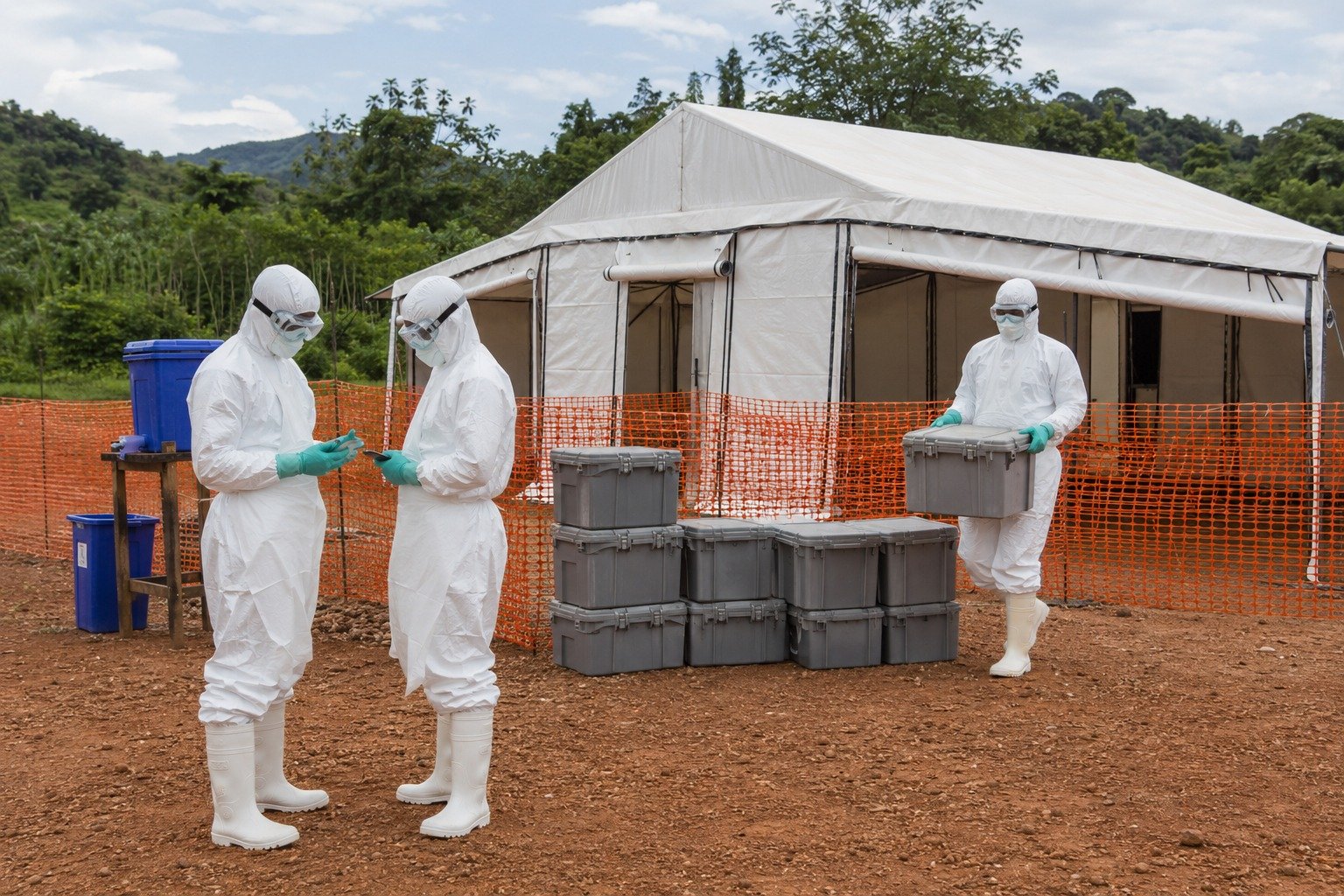
The response rests almost entirely on health workers operating treatment centers in some of the most remote and under-resourced terrain in the world. Ituri is a province with limited road access, thin health infrastructure and a long history of instability. Staffing a treatment unit there means moving protective equipment, chlorine, clean water and trained personnel into places where none of that is routine.
Those workers are also the people most exposed. Without a vaccine to protect them, protective equipment and strict protocol are the only barriers between them and a virus killing close to half of the people it infects. Every case they isolate is a chain of transmission that stops.
What This Means for Americans
The practical American stake here is not personal risk. It is funding. Outbreak response in places like Ituri is paid for by international global health budgets, and the tools that would end this one faster, a Bundibugyo vaccine and an approved treatment, exist only as candidates because research and manufacturing for rare strains depend on sustained public investment. Those budgets are being cut, not expanded.
The clearest lesson of the last Congolese outbreak was that a working vaccine changes the arithmetic of an epidemic. The clearest lesson of this one is what happens when there isn’t one.
Stay informed on the stories that matter most. Follow Your Daily Updates on Facebook and bookmark yourdailyupdates.news for breaking news and analysis.