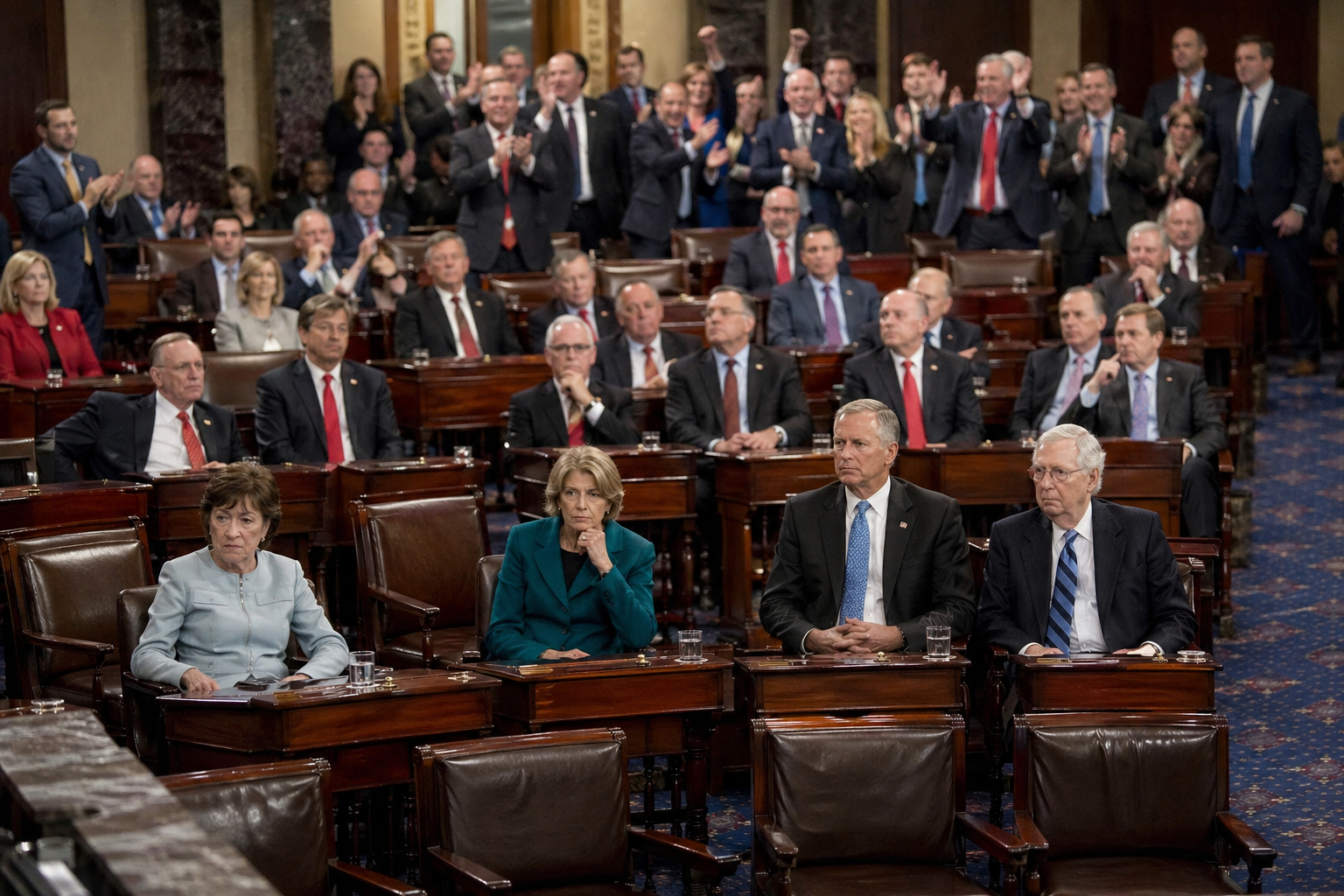
Four Republican senators broke ranks with their party on April 24, voting alongside every Senate Democrat to kill a procedural measure that would have advanced the SAVE America Act through budget reconciliation — a move that sent shockwaves through the America First movement and drew immediate condemnation from President Trump.
The Senators Who Crossed the Aisle
The senators who voted to block the measure were Susan Collins of Maine, Lisa Murkowski of Alaska, Thom Tillis of North Carolina, and Mitch McConnell of Kentucky. Their votes, combined with unanimous Democratic opposition, produced a 48–50 defeat on the procedural vote — falling short of the 50 needed to advance the legislation through the reconciliation process.
All four have long been considered the most moderate members of the Senate Republican caucus, frequently clashing with the populist wing of the party. But the decision to vote against this particular bill struck many conservatives as an especially significant betrayal, given how central election integrity has become to the America First platform.
What the SAVE America Act Would Have Done
The SAVE America Act — which stands for Safeguard American Voter Eligibility — was designed to require documentary proof of citizenship before an individual could register to vote in federal elections. Supporters argued the measure was a commonsense safeguard against potential election fraud by non-citizens. Critics, including all 48 Democrats who voted against it, called it an unnecessary barrier that would suppress legitimate voter participation among low-income and minority communities.
The legislation had been a top priority for conservatives who argue that current voter registration laws are dangerously lax. Under the current system, registering to vote requires only a signature affirming citizenship — with no documentary verification required. The SAVE Act would have changed that by requiring applicants to show a passport, birth certificate, or similar document proving their citizenship status.
Trump Responds — and Targets the Filibuster
President Trump responded swiftly to the vote, renewing his long-standing call to abolish the Senate filibuster entirely. Trump has argued for years that the filibuster — which requires 60 votes to advance most legislation — gives a small group of senators the power to indefinitely obstruct the majority’s agenda. The 48–50 loss on the SAVE Act was, in Trump’s view, a direct consequence of a procedural rule that empowers establishment Republicans to act as a check on the conservative movement.
Conservative media and America First advocates immediately branded Collins, Murkowski, Tillis, and McConnell as RINOs — Republicans In Name Only — for their votes. Many called for primary challenges and demanded that Republican voters in those states hold their senators accountable at the ballot box. The backlash online was swift and intense, with the four senators trending on social media within hours of the vote.
What This Means for Election Integrity
For millions of Americans who consider election integrity a non-negotiable issue, this vote is a gut punch. The SAVE Act was one of the most straightforward election security measures in years — asking only that voters prove they are who they say they are before casting a ballot. That four Republican senators refused to even allow it to advance for a full vote raises serious questions about where the establishment wing of the GOP truly stands on protecting the franchise.
Stay informed on the stories that matter most. Follow Your Daily Updates on Facebook and bookmark yourdailyupdates.news for breaking news and analysis.