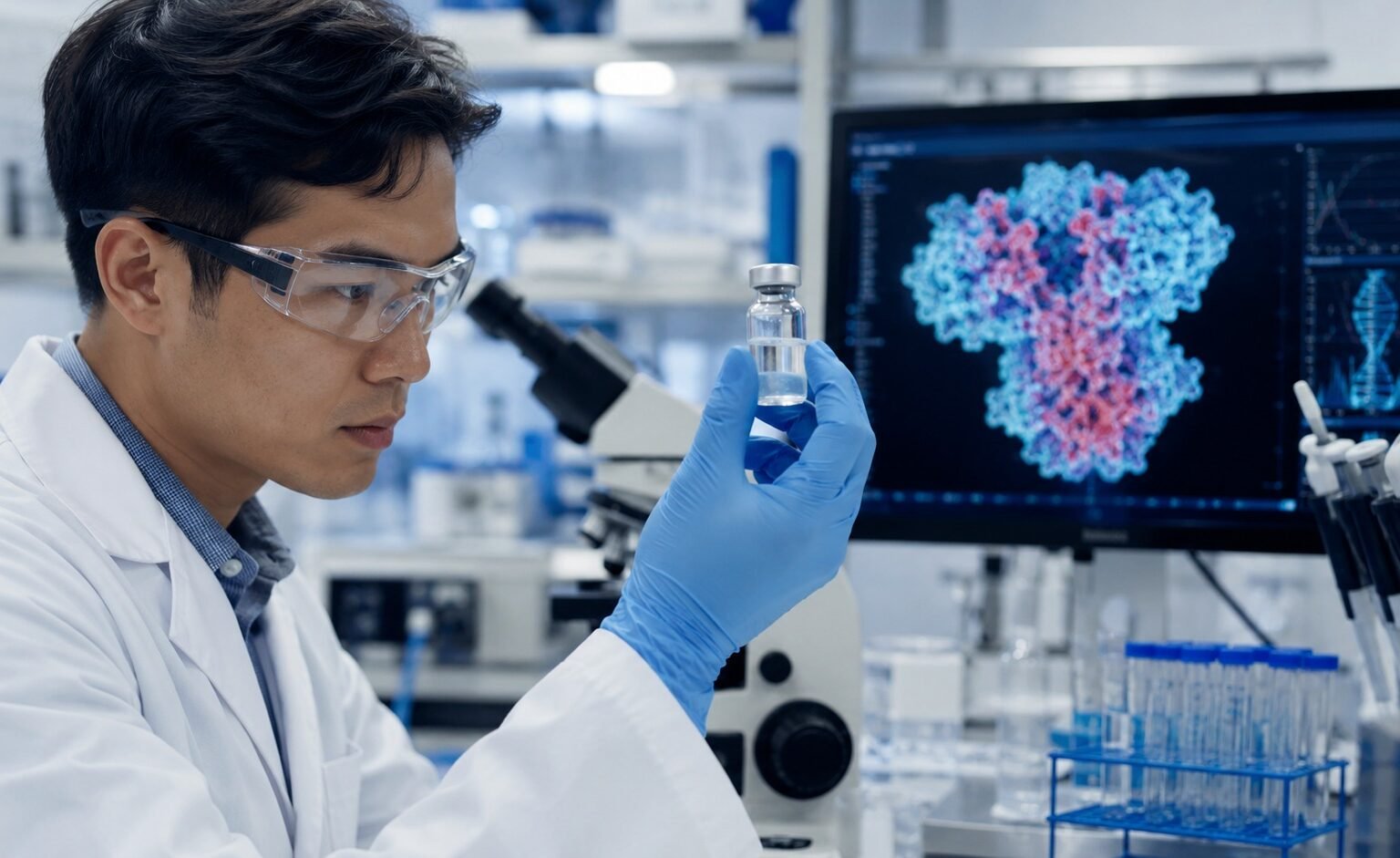
For the first time, scientists have tested a vaccine whose active ingredient was designed entirely by a computer in human beings — and it cleared the first hurdle. Researchers at the University of Cambridge and its spinout company DIOSynVax announced on June 5, 2026, that an AI-designed “universal” coronavirus vaccine passed an early-stage human trial, proving safe and triggering broad immune responses.
What Was Tested
The Phase 1 trial enrolled 39 healthy volunteers. According to results published in the Journal of Infection, the vaccine was well tolerated, with no significant side effects reported. More notably, it did not just spark immunity against COVID-19 and the original SARS virus. It also triggered immune responses against related bat coronaviruses — viruses that have never caused a large-scale human outbreak, but which scientists worry could one day make the jump.
That breadth is the entire point of the project. Most vaccines are built to match a specific known virus. This one was designed to anticipate an entire family of threats at once.
How the AI Vaccine Works
Rather than reacting to each new variant after it emerges, the Cambridge and DIOSynVax team used computer simulations to construct what they call a “super-antigen” — a synthetic target stitched together from features shared across a whole group of coronaviruses. The aim is a single shot that stays effective even as these viruses mutate over time.
DIOSynVax — short for Digitally Immune Optimised Synthetic Vaccines — was founded in 2017 as a University of Cambridge spinout. Researchers describe this trial as the first time a vaccine’s active component, designed entirely through computer modeling, has been tested in people. It is a proof of concept not just for one vaccine, but for a whole approach to building them.
An Important Reality Check
It is essential to be clear about what a Phase 1 result means — and what it does not. Phase 1 is the earliest stage of human testing. It is designed to answer two questions: is the vaccine safe, and does it provoke an immune response? On both counts, this trial succeeded.
What it does NOT do is prove the vaccine actually prevents illness in the real world. That requires years of larger Phase 2 and Phase 3 trials involving thousands of participants. This is not an approved product, and it is not ready for public use. Anyone framing it as a finished, proven vaccine is getting ahead of the science.
Why It Still Matters
Even with those caveats, this is a genuine milestone for public health science. It is early evidence that artificial intelligence can help design vaccines aimed at threats humanity cannot yet see coming — flipping the usual script of scrambling to respond after an outbreak has already begun.
The stakes behind that idea are enormous. The COVID-19 pandemic cost millions of lives and trillions of dollars precisely because the world was reacting from behind. DIOSynVax’s earlier work drew up to $42 million from a global pandemic-preparedness coalition — a bet that investing in broad, pre-emptive protection is cheaper and safer than waiting for the next crisis to arrive.
What This Means for You
For ordinary people, the promise is straightforward: a future where the next dangerous coronavirus does not catch the world flat-footed. But getting there depends on sustained public investment in preventive science — the kind of unglamorous, long-horizon research that is easy to cut when budgets tighten and no crisis is currently in the headlines. The question this breakthrough raises is whether governments will fund that work before the next pandemic, instead of after.
Stay informed on the stories that matter most. Follow Your Daily Updates on Facebook and bookmark yourdailyupdates.news for breaking news and analysis.